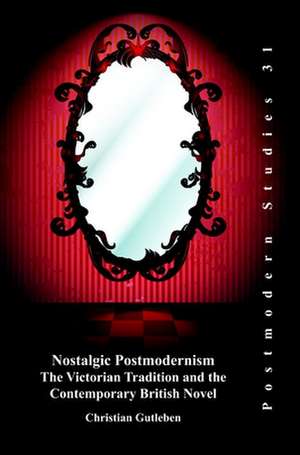
Nostalgic Postmodernism
Autor Christian Gutlebenen Limba Engleză Paperback – 2001
What this analysis ultimately proposes is a reevaluation and a redefinition of postmodernism such as it is illustrated by the British novels which paradoxically both praise and mock, honour and debunk, imitate and subvert their Victorian models. Unashamedly opportunistic and deliberately exploiting the spirit of the time, this late form of postmodernism cannibalizes and reshapes not only Victorianism but all the other previous aesthetic movements - including early postmodernism.
Preț: 853.82 lei
Preț vechi: 992.82 lei
-14%
Puncte Express: 1281
Carte tipărită la comandă
Livrare economică 04-18 decembrie
Livrare prin curier în România Termenul estimat este afișat lângă disponibilitate.
Transport gratuit pentru acest produs Plată online sau ramburs, în funcție de opțiunile comenzii.
Retur gratuit în 14 zile Comandă securizată și suport în română.
Specificații
ISBN-13: 9789042012974
ISBN-10: 9042012978
Pagini: 4
Dimensiuni: 153 x 231 x 17 mm
Greutate: 0.41 kg
Editura: Brill
ISBN-10: 9042012978
Pagini: 4
Dimensiuni: 153 x 231 x 17 mm
Greutate: 0.41 kg
Editura: Brill
V-ar putea interesa
-
 Phantom TerrorAdam ZamoyskiPreț: 127.82 lei
 -
 When the Facts ChangeTony Judt-19%Preț: 87.37 lei107.69 lei
 -
 Years of Peril and Ambition: U.S. Foreign Relations, 1776-1921George C. Herring-16%Preț: 103.98 lei124.26 lei
 -
 Charles Williams: The Third InklingGrevel Lindop-17%Preț: 207.83 lei249.65 lei
 -
 -17%Preț: 205.68 lei248.57 lei
 -
 Last Witnesses: HurricaneBrian Milton-25%Preț: 103.21 lei137.36 lei
 -
 Attrition: Fighting the First World WarWilliam Philpott-26%Preț: 73.97 lei99.78 lei
 -
 -25%Preț: 92.67 lei123.86 lei
 -
 Preț: 122.78 lei
 -
 Believe and DestroyChristian IngraoPreț: 317.62 lei
 -
 Preț: 408.46 lei
 -
 On a Sea of GlassBill WormstedtPreț: 238.27 lei
Cuprins
Introduction.
Part I: Pastiche, pastiche: the fascination of Victorianism.
Chapter 1: Victorian echoes: resurrected voices. The epigraphs, or the voices of the masters. The quotational practice: an aesthetic surplus. The derivative nature of pastiche. The parodic transformation of voices: depreciation or homage? The foregrounding of Victorian outcasts: the voices of postmodern fashion. When Victorian voices invade a whole novel...
Chapter 2: On the surface of the looking glass: an aesthetic and ideological model. ‘The fascination of Narrative’. The metonymic pole. The documentary aspect. David Lodge’s Nice Work: plus ça change... A.S. Byatt’s Possession: ‘making the past your world’.
Part II: Postmodernism as otherness: the temptation of revisitation.
Chapter 1: The parodic vein: ludic subversion. The disfigurement of the great Victorian figures. When playfulness becomes a guiding principle. Invigorating the new with the old: the regenerative art of parody in John Fowles’s The French Lieutenant’s Woman.
Chapter 2: Postmodern strategies of distanciation. An in-depth change of the surface. An aesthetics of the unsavoury. The delights of uncertainty. Fragmentation as the new consensus. The epitome of late twentieth-century postmodernist aesthetics: Graham Swift’s Ever After.
Part III: Nostalgic Postmodernism: the paradox of an iconoclastic homage.
Chapter 1: The limits of subversion: the tyranny of the politically correct. The precedents of modernism and early postmodernism. Further qualifications and clarifications. A favourable climate or a profitable vein. Sex and crinolines: a combination aimed at seduction. How to be subversive and seductive at the same time: D.M. Thomas’s Charlotte: The final journey of Jane Eyre.
Chapter 2: Postmodernism and the past: An ambiguous relation to the Victorian ancestors. An equivocal kinship. Nostalgic subversion: an oxymoric art. Evolution, not revolution: postmodernism as illustrated by retro-Victorian fiction. Conclusion. Works Cited. Index.
Part I: Pastiche, pastiche: the fascination of Victorianism.
Chapter 1: Victorian echoes: resurrected voices. The epigraphs, or the voices of the masters. The quotational practice: an aesthetic surplus. The derivative nature of pastiche. The parodic transformation of voices: depreciation or homage? The foregrounding of Victorian outcasts: the voices of postmodern fashion. When Victorian voices invade a whole novel...
Chapter 2: On the surface of the looking glass: an aesthetic and ideological model. ‘The fascination of Narrative’. The metonymic pole. The documentary aspect. David Lodge’s Nice Work: plus ça change... A.S. Byatt’s Possession: ‘making the past your world’.
Part II: Postmodernism as otherness: the temptation of revisitation.
Chapter 1: The parodic vein: ludic subversion. The disfigurement of the great Victorian figures. When playfulness becomes a guiding principle. Invigorating the new with the old: the regenerative art of parody in John Fowles’s The French Lieutenant’s Woman.
Chapter 2: Postmodern strategies of distanciation. An in-depth change of the surface. An aesthetics of the unsavoury. The delights of uncertainty. Fragmentation as the new consensus. The epitome of late twentieth-century postmodernist aesthetics: Graham Swift’s Ever After.
Part III: Nostalgic Postmodernism: the paradox of an iconoclastic homage.
Chapter 1: The limits of subversion: the tyranny of the politically correct. The precedents of modernism and early postmodernism. Further qualifications and clarifications. A favourable climate or a profitable vein. Sex and crinolines: a combination aimed at seduction. How to be subversive and seductive at the same time: D.M. Thomas’s Charlotte: The final journey of Jane Eyre.
Chapter 2: Postmodernism and the past: An ambiguous relation to the Victorian ancestors. An equivocal kinship. Nostalgic subversion: an oxymoric art. Evolution, not revolution: postmodernism as illustrated by retro-Victorian fiction. Conclusion. Works Cited. Index.
Recenzii
”…a rewarding read for anyone interested in postmodernist literature in general and, more specifically, in those novels that rewrite the Victorian tradition …” in: Miscelánea: a Journal of English and American Studies 26 (2002), pp. 103-108