North Caddo Parish
Autor Sam Collieren Limba Engleză Paperback – 19 sep 2007
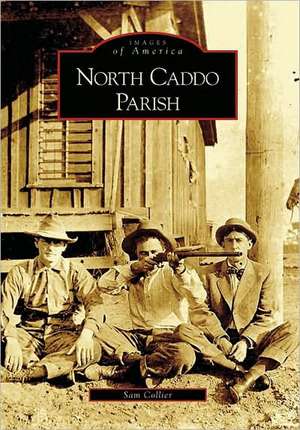
In 1835, the United States purchased close to one million acres of land from the Caddo Confederacy of Native Americans; the Louisiana portion became known as Caddo Parish. The Indian agency's protection of that land delayed the settlement of the parish for 25 years or more after it began in other parts of Louisiana, Texas, and Arkansas. The Red River logjam that existed for a few hundred years backed up bayous, which in return created navigable streams and lakes. The uplands contained massive stands of virgin timbers and bountiful fruit, berries, fish, and game. The first land patents were sold in 1841, and by 1850, the area was known as Caddo Prairie. For a majority of the next 100 years, steamboat traffic, homesteaders, plantations, subsistence farmers, logging operations, entrepreneurs, and a building boom brought on by the railroad and oil industries uniquely melded to define local, cultural history.
Preț: 128.27 lei
Puncte Express: 192
Carte indisponibilă temporar
Doresc să fiu notificat când acest titlu va fi disponibil:
Se trimite...
Specificații
ISBN-13: 9780738552828
ISBN-10: 0738552828
Pagini: 128
Dimensiuni: 166 x 234 x 9 mm
Greutate: 0.32 kg
Editura: Arcadia Publishing (SC)
ISBN-10: 0738552828
Pagini: 128
Dimensiuni: 166 x 234 x 9 mm
Greutate: 0.32 kg
Editura: Arcadia Publishing (SC)
V-ar putea interesa
-
 This Republic of SufferingDrew Gilpin FaustPreț: 101.25 lei
 -
 Billy the KidMichael WallisPreț: 145.55 lei
 -
 American-Made: When FDR Put the Nation to WorkNick TaylorPreț: 146.59 lei
 -
 Preț: 149.18 lei
 -
 The White Rock: An Exploration of the Inca HeartlandHugh Thomson-26%Preț: 71.57 lei97.21 lei
 -
 Cochineal Red: Travels Through Ancient PeruHugh Thomson-28%Preț: 64.35 lei88.97 lei
 -
 Preț: 122.42 lei
 -
 Preț: 234.33 lei
 -
 Preț: 217.92 lei
 -
 Mackinac BridgeMike FornesPreț: 174.74 lei
Descriere
In 1835, the United States purchased close to one million acres of land from the Caddo Confederacy of Native Americans; the Louisiana portion became known as Caddo Parish. The Indian agency's protection of that land delayed the settlement of the parish
for 25 years or more after it began in other parts of Louisiana, Texas, and Arkansas. The Red River logjam that existed for a few hundred years backed up bayous, which in return created navigable streams
and lakes. The uplands contained massive stands of virgin timbers and bountiful fruit, berries, fish, and game. The first land patents were sold in 1841, and by 1850, the area was known as Caddo Prairie. For a majority of the next 100 years, steamboat traffic, homesteaders, plantations, subsistence farmers, logging operations, entrepreneurs, and a building boom brought on by the railroad and oil industries uniquely melded to define local, cultural history. Today three towns and five villages are located in north Caddo Parish, while the memories of 10 historic communities remain strong.
for 25 years or more after it began in other parts of Louisiana, Texas, and Arkansas. The Red River logjam that existed for a few hundred years backed up bayous, which in return created navigable streams
and lakes. The uplands contained massive stands of virgin timbers and bountiful fruit, berries, fish, and game. The first land patents were sold in 1841, and by 1850, the area was known as Caddo Prairie. For a majority of the next 100 years, steamboat traffic, homesteaders, plantations, subsistence farmers, logging operations, entrepreneurs, and a building boom brought on by the railroad and oil industries uniquely melded to define local, cultural history. Today three towns and five villages are located in north Caddo Parish, while the memories of 10 historic communities remain strong.
Notă biografică
Author Sam Collier is a retired army officer and aerospace engineer. He currently serves as a board director of the Historical Society of North Caddo and has held the position for 10 years, serving as its president for six years prior. In 2000, he self-published the first history written specifically about the area: Terrapin Neck, Frog Level, Horseshoe, Historic Northern Caddo Parish, Louisiana, Volume I.