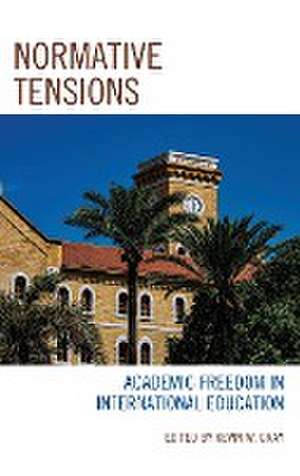
Normative Tensions: Academic Freedom in International Education: Expansion and Internationalization of Higher Education in Asia, North Africa, and the Middle East
Editat de Kevin W. Gray Contribuţii de Sevgi Dogan, Yowei Kang, Professor or Dr. Sheng-mei Ma, Sevket Benhür Oral, John Ryder, Jim Sleeper, Syd Waters, Kenneth C. C. Yangen Limba Engleză Hardback – iun 2022

Preț: 516.80 lei
Preț vechi: 768.25 lei
-33%
Puncte Express: 775
Carte tipărită la comandă
Livrare economică 23 noiembrie-07 decembrie
Livrare prin curier în România Termenul estimat este afișat lângă disponibilitate.
Transport gratuit pentru acest produs Plată online sau ramburs, în funcție de opțiunile comenzii.
Retur gratuit în 14 zile Comandă securizată și suport în română.
Specificații
ISBN-13: 9781793620330
ISBN-10: 1793620334
Pagini: 186
Ilustrații: 3 b/w illustrations;2 tables;
Dimensiuni: 160 x 230 x 17 mm
Greutate: 0.45 kg
Editura: Bloomsbury Publishing
Colecția Lexington Books
Seria Expansion and Internationalization of Higher Education in Asia, North Africa, and the Middle East
Locul publicării:New York, United States
ISBN-10: 1793620334
Pagini: 186
Ilustrații: 3 b/w illustrations;2 tables;
Dimensiuni: 160 x 230 x 17 mm
Greutate: 0.45 kg
Editura: Bloomsbury Publishing
Colecția Lexington Books
Seria Expansion and Internationalization of Higher Education in Asia, North Africa, and the Middle East
Locul publicării:New York, United States
Cuprins
Introduction by Kevin W. Gray
Chapter 1: Academic Freedom in Xi's China: A Text Mining Study of Cultural Contestations by
Kenneth C. C. Yang and Yowei Kang
Chapter 2: The Interaction of Academic Freedom and State Sovereignty by Syd Waters
Chapter 3: Higher Education in Turkey: Academic Freedom and Resistance by Sevgi Dogan
Chapter 4: Is Philosophical Thinking Possible in Higher Education in the American(-style)
Universities in the GCC? By Sevket Benhur Oral
Chapter 5: An MSU-within-MSU: Mandarin-Speaking Undergraduates Writing "Chinglish" by
Sheng-Mei Ma
Chapter 6: Innocents Abroad? Liberal Educators in Illiberal Societies by Jim Sleeper
Chapter 7: Academic Freedom and the Social Context of Universities by John Ryder
Chapter 1: Academic Freedom in Xi's China: A Text Mining Study of Cultural Contestations by
Kenneth C. C. Yang and Yowei Kang
Chapter 2: The Interaction of Academic Freedom and State Sovereignty by Syd Waters
Chapter 3: Higher Education in Turkey: Academic Freedom and Resistance by Sevgi Dogan
Chapter 4: Is Philosophical Thinking Possible in Higher Education in the American(-style)
Universities in the GCC? By Sevket Benhur Oral
Chapter 5: An MSU-within-MSU: Mandarin-Speaking Undergraduates Writing "Chinglish" by
Sheng-Mei Ma
Chapter 6: Innocents Abroad? Liberal Educators in Illiberal Societies by Jim Sleeper
Chapter 7: Academic Freedom and the Social Context of Universities by John Ryder
Recenzii
Many academics who invoke freedom assume that it exists in an abstract realm apart from all social circumstances. The essays collected in Normative Tensions give the lie to that assumption and demonstrate how non-academic pressures--political, social, financial, cultural--work to shape and constrain the freedom academics can exercise both in this country and abroad. A salutary lesson.
This ought to be one of the most important books on higher education published in 2022[.]
This collection explores the implications underpinning the internationalization of Western education in response to contemporary pressures faced by institutions of higher learning chasing dollars and rankings. From the introduction onward, the book is very readable and informative, and the brief history of academic freedom in this initial section nicely sets the stage for the balance of the essays. The book adeptly explores the complex nexus of globalization and academic freedom across seven chapters. The first few chapters address government control of academia, while another explores restrictions on student learning. The final two chapters directly consider the state of academic freedom on foreign campuses, and the concluding chapter proposes a concise definition for this construct and adeptly distinguishes between such freedoms as they play out in both teaching and research. None of the contributors shy away from challenging questions, and the contexts of China and the Middle East offer fertile ground for considering these issues. Both newly minted and veteran faculty alike will benefit from the perspectives of the contributing authors, especially those in academic units that deal directly with international topics, scholars, and students-virtually everyone across the academy in the US today. This book is recommended for graduate students, faculty, and professionals.
This ought to be one of the most important books on higher education published in 2022[.]
This collection explores the implications underpinning the internationalization of Western education in response to contemporary pressures faced by institutions of higher learning chasing dollars and rankings. From the introduction onward, the book is very readable and informative, and the brief history of academic freedom in this initial section nicely sets the stage for the balance of the essays. The book adeptly explores the complex nexus of globalization and academic freedom across seven chapters. The first few chapters address government control of academia, while another explores restrictions on student learning. The final two chapters directly consider the state of academic freedom on foreign campuses, and the concluding chapter proposes a concise definition for this construct and adeptly distinguishes between such freedoms as they play out in both teaching and research. None of the contributors shy away from challenging questions, and the contexts of China and the Middle East offer fertile ground for considering these issues. Both newly minted and veteran faculty alike will benefit from the perspectives of the contributing authors, especially those in academic units that deal directly with international topics, scholars, and students-virtually everyone across the academy in the US today. This book is recommended for graduate students, faculty, and professionals.