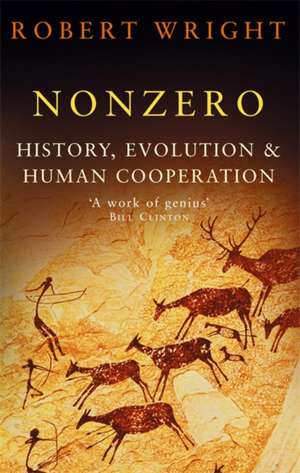
Nonzero: History, Evolution & Human Cooperation: Sapiens
Autor Robert Wrighten Limba Engleză Paperback – 6 sep 2001






Preț: 74.88 lei
Preț vechi: 101.05 lei
-26%
Puncte Express: 112
Carte disponibilă
Livrare economică 02-16 noiembrie
Livrare express 16-22 octombrie pentru 50.45 lei
Livrare prin curier în România Termenul estimat este afișat lângă disponibilitate.
Transport gratuit de la 400.00 lei Plată online sau ramburs, în funcție de opțiunile comenzii.
Retur gratuit în 14 zile Comandă securizată și suport în română.
Specificații
ISBN-13: 9780349113340
ISBN-10: 0349113343
Pagini: 448
Dimensiuni: 132 x 198 x 29 mm
Greutate: 0.31 kg
Editura: Little Brown
Colecția Abacus
Seria Sapiens
Locul publicării:London, United Kingdom
ISBN-10: 0349113343
Pagini: 448
Dimensiuni: 132 x 198 x 29 mm
Greutate: 0.31 kg
Editura: Little Brown
Colecția Abacus
Seria Sapiens
Locul publicării:London, United Kingdom
V-ar putea interesa
-
 10% HumanAlanna Collen-5%Preț: 76.00 lei80.00 lei
 -
 The Gene: An Intimate HistorySiddhartha Mukherjee-28%Preț: 78.42 lei108.37 lei
 -
 Thinking, Fast and SlowDaniel Kahneman-27%Preț: 90.73 lei123.57 leiRecomandat
 -
 UtopiaThomas More-20%Preț: 45.54 lei56.80 lei
 -
 The Language InstinctSteven Pinker-29%Preț: 77.56 lei108.48 lei
 -
 The Oxford Handbook of Prehistoric FigurinesTimothy Insoll-32%Preț: 1086.55 lei1592.30 lei
 -
 Why We Believe: Evolution and the Human Way of BeingAgustin FuentesPreț: 190.93 lei
 -
 Mother NatureSarah HrdyPreț: 142.62 lei
 -
 The Moral Animal: Why We Are The Way We AreRobert Wright-26%Preț: 79.59 lei108.08 lei
 -
 The Evolution Of God: The origins of our beliefsRobert Wright-24%Preț: 83.13 lei109.99 lei
 -
 Life on the EdgeJim Al–khalili-17%Preț: 66.54 lei80.43 lei
 -
 A Brief History of TimeStephen HawkingPreț: 104.96 lei
 -
 Fragrant PharmacyValerie Ann Worwood-16%Preț: 62.05 lei73.62 lei
 -
 The Fragrant MindValerie Ann Worwood-22%Preț: 75.14 lei96.19 lei
 -
 Awaken the Giant WithinAnthony RobbinsPreț: 85.46 lei
 -
 Why Zebras Don't Get Ulcers (Revised and Updated)Robert M. SapolskyPreț: 162.50 lei
 -
 The Cambridge Handbook of Cognitive LinguisticsBarbara Dancygier-23%Preț: 1254.74 lei1629.54 lei
 -
 The Cambridge Handbook of the ImaginationAnna Abraham-11%Preț: 485.91 lei545.96 lei
 -
 -11%Preț: 492.54 lei553.41 lei
 -
 Heart and Brain: An Awkward Yeti CollectionThe Awkward Yeti-18%Preț: 77.83 lei94.57 lei
 -
 Through the Looking GlassLewis CarrollPreț: 37.87 lei
 -
 The Meaning of Human ExistenceEdward O. WilsonPreț: 82.06 lei
 -
 A Crack in Creation: The New Power to Control EvolutionJennifer Doudna-18%Preț: 64.95 lei79.49 lei
 -
 Homo Deus: A Brief History of TomorrowYuval Noah Harari-16%Preț: 80.34 lei96.07 lei
 -
 The Story of the Lost ChildElena FerrantePreț: 80.65 lei
 -
 De la zero la unuBlake MastersPreț: 37.57 lei
Descriere
Robert Wright challenges the conventional view that biological evolution and human history are aimless. Employing game theory - the logic of "zero-sum" and "nonzero-sum" games - he isolates the impetus behind life's basic direction and takes on some of the 20th century's most prominent thinkers.
Recenzii
Wright has constructed an interesting thesis... bold and thought-provoking.
Not only a fascinating read but an important one.
One of the main layman's objections to the supposedly random process of evolution is that for all its inherent pointlessness, evolution seems to have a goal, a narrative, a conscious direction. And that direction is towards complexity. Germs become animals. Apes become humans. Blood-caked Aztec savages become liberal-minded East Coast essayists. Now Robert Wright, author of the much-praised The Moral Animal, has come along with a contentious new book to tell us that the layman has been on to something all along. Evolution does have a goal.
The author's learning is lightly worn. Sometimes too lightly. After a while his chatty, hey-let's-have-a-beer style starts to grate: "When was the last time you invented a boomerang?"; "Ah, Tahiti!". There are also some minor errors, like his claiming tha
Wright has constructed an interesting thesis... bold and thought-provoking. SUNDAY TIMES Not only a fascinating read but an important one. INDEPENDENT ON SUNDAY One of the main layman's objections to the supposedly random process of evolution is that for all its inherent pointlessness, evolution seems to have a goal, a narrative, a conscious direction. And that direction is towards complexity. Germs become animals. Apes become humans. Blood-caked Aztec savages become liberal-minded East Coast essayists. Now Robert Wright, author of the much-praised The Moral Animal, has come along with a contentious new book to tell us that the layman has been on to something all along. Evolution does have a goal. The title of Wright's book comes from games theory, which divides human interactions into "zero sum games", where for every winner there's a loser, and "non-zero sum games", where everyone gains. Wright's aim is to knit together this theory with anthropol The author's learning is lightly worn. Sometimes too lightly. After a while his chatty, hey-let's-have-a-beer style starts to grate: "When was the last time you invented a boomerang?"; "Ah, Tahiti!". There are also some minor errors, like his claiming tha Sean Thomas, AMAZON.CO.UK REVIEW
Not only a fascinating read but an important one.
One of the main layman's objections to the supposedly random process of evolution is that for all its inherent pointlessness, evolution seems to have a goal, a narrative, a conscious direction. And that direction is towards complexity. Germs become animals. Apes become humans. Blood-caked Aztec savages become liberal-minded East Coast essayists. Now Robert Wright, author of the much-praised The Moral Animal, has come along with a contentious new book to tell us that the layman has been on to something all along. Evolution does have a goal.
The author's learning is lightly worn. Sometimes too lightly. After a while his chatty, hey-let's-have-a-beer style starts to grate: "When was the last time you invented a boomerang?"; "Ah, Tahiti!". There are also some minor errors, like his claiming tha
Wright has constructed an interesting thesis... bold and thought-provoking. SUNDAY TIMES Not only a fascinating read but an important one. INDEPENDENT ON SUNDAY One of the main layman's objections to the supposedly random process of evolution is that for all its inherent pointlessness, evolution seems to have a goal, a narrative, a conscious direction. And that direction is towards complexity. Germs become animals. Apes become humans. Blood-caked Aztec savages become liberal-minded East Coast essayists. Now Robert Wright, author of the much-praised The Moral Animal, has come along with a contentious new book to tell us that the layman has been on to something all along. Evolution does have a goal. The title of Wright's book comes from games theory, which divides human interactions into "zero sum games", where for every winner there's a loser, and "non-zero sum games", where everyone gains. Wright's aim is to knit together this theory with anthropol The author's learning is lightly worn. Sometimes too lightly. After a while his chatty, hey-let's-have-a-beer style starts to grate: "When was the last time you invented a boomerang?"; "Ah, Tahiti!". There are also some minor errors, like his claiming tha Sean Thomas, AMAZON.CO.UK REVIEW
Notă biografică
Robert Wright has written extensively for THE ATLANTIC MONTHLY, THE NEW YORKER and TIME magazine, and currently works as a senior editor at THE NEW REPUBLIC.