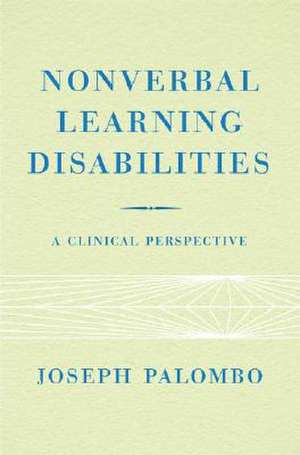
Nonverbal Learning Disabilities – A Clinical Perspective
Autor Joseph Palomboen Limba Engleză Paperback – 24 apr 2006
Găsim în Nonverbal Learning Disabilities – A Clinical Perspective un volum solid, în format paperback de 342 de pagini, tipărit de prestigioasa editură W. W. Norton & Company. Calitatea hârtiei și legătura rezistentă sunt gândite pentru o consultare frecventă, specifică unui manual de referință care va fi răsfoit repetat în cabinetul de specialitate sau în biblioteca personală a unui terapeut.
Suntem de părere că lucrarea lui Joseph Palombo depășește simpla descriere a simptomelor, oferind o viziune tridimensională asupra tulburării de învățare nonverbală (NLD). Autorul structurează materialul cu o rigoare academică remarcabilă, începând de la fundamentele neuro-comportamentale și ajungând la complexitatea interacțiunilor sociale. Un element distinctiv este introducerea conceptului de „mindsharing” — capacitatea de a simți și cunoaște experiența celuilalt — a cărui absență explică nu doar dificultățile sociale ale tinerilor cu NLD, ci și lipsa de coeziune a propriului lor sine. Cine a studiat Medical and Educational Perspectives on Nonverbal Learning Disability in Children and Young Adults de Barbara Rissman va aprecia aici profunzimea perspectivei intrapersonale, care completează abordarea educațională cu o analiză psihologică și neuropsihologică detaliată.
Această lucrare reprezintă o evoluție firească în opera autorului. Dacă în The Neuropsychodynamic Treatment of Self-Deficits Joseph Palombo explora modul în care deficitele neuropsihologice afectează structura sinelui, în volumul de față el aplică aceste teorii specifice pe tabloul clinic al NLD. Tonul este unul clinic, dar plin de empatie, reușind să ofere un limbaj comun pentru psihiatri, psihologi și asistenți sociali. Structura în patru părți ghidează cititorul de la etiologie și studii de caz către o sinteză terapeutică menită să ghideze intervenția practică.
Preț: 230.17 lei
Carte disponibilă
Livrare economică 15-29 mai
Specificații
ISBN-10: 0393704785
Pagini: 342
Dimensiuni: 164 x 235 x 23 mm
Greutate: 0.49 kg
Editura: W. W. Norton & Company
V-ar putea interesa
-
 A Mandate for Playful Learning in Preschool: Presenting the EvidenceKathy Hirsh-Pasek-16%Preț: 244.94 lei292.57 lei
 -
 -20%Preț: 450.12 lei563.38 lei
 -
 Preț: 310.68 lei
 -
 Patterns of Artistic Development in Children: Comparative Studies of TalentConstance Milbrath PhDPreț: 332.92 lei
 -
 Developmental PsychologyPenney UptonPreț: 375.70 lei
De ce să citești această carte
Pentru specialiștii care lucrează cu tineri ce prezintă deficite de percepție socială, această carte oferă un cadru clinic riguros. Cititorul câștigă o înțelegere profundă a celor patru subtipuri de NLD și, mai ales, instrumente terapeutice bazate pe conceptul de „mindsharing”. Este o resursă esențială pentru a transforma observațiile clinice într-un plan de tratament coerent, adresat atât dificultăților academice, cât și celor emoționale.
Descriere scurtă
Based on current neurobehavioral research, this book brings together perspectives drawn from the three major domains of knowledge about NLD--neurobehavioral, social, and intrapersonal. From the neurobehavioral perspective, Palombo provides a research-based phenomenological description of the NLD child's symptoms. From the social perspective, he presents the child's social context and how that contributes (in positive and negative ways) to the child's skills and deficits. From the intrapersonal perspective, he introduces the concept of mindsharing as basic to understand the development of the sense of self in children with NLD.
In Part I, readers are introduced to NLD as it presents in the clinic with a review of the etiology and symptomatology of the syndrome reflected in a case study. The author then goes on to describe the neurobehavioral profile of NLD (including its psychological and social dimensions). In Part II the social perspective and intrapersonal aspect of NLD are considered. Palombo describes the impact of the syndrome on social functioning, social communication, and emotional functioning. At the close of this part, readers find a clear articulation of the four NLD subtypes.
The intrapersonal area is addressed in Part III where Palombo presents the concept of mindsharing--i.e., the ability of one person to both know and feel what another person is experiencing. Because they lack a capacity for mindsharing, children and adolescents affected by the syndrome often fail not only a social and emotional connection with others but also experience a lack of cohesion in their own sense of self. Finally, in Part IV, Palombo presents a therapeutic approach to working with youth with NLD. Drawing together the various clinical insights from earlier in the book, these last chapters synthesize the material and highlight the most important aspects so as to best guide the treatment of children and adolescents.
Addressed to clinicians, psychiatrists, psychologists, clinical social workers, and other psychotherapists, this book is a fund of knowledge and clinical wisdom for working with youth with NLD. It offers an overarching paradigm relevant to all professionals and parents alike as they care for effected children and adolescents.