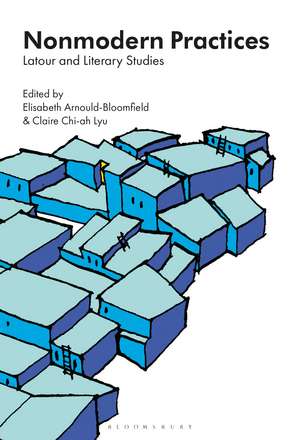
Nonmodern Practices: Latour and Literary Studies
Editat de Professor or Dr. Elisabeth Arnould-Bloomfield, Professor or Dr. Claire Chi-ah Lyuen Limba Engleză Paperback – 21 apr 2022
Preț: 213.16 lei
Preț vechi: 307.86 lei
-31%
Puncte Express: 320
Carte tipărită la comandă
Livrare economică 26 noiembrie-10 decembrie
Livrare prin curier în România Termenul estimat este afișat lângă disponibilitate.
Transport gratuit de la 400.00 lei Plată online sau ramburs, în funcție de opțiunile comenzii.
Retur gratuit în 14 zile Comandă securizată și suport în română.
Specificații
ISBN-13: 9781501369278
ISBN-10: 150136927X
Pagini: 272
Dimensiuni: 152 x 229 x 18 mm
Greutate: 0.37 kg
Editura: Bloomsbury Publishing
Colecția Bloomsbury Academic
Locul publicării:New York, United States
ISBN-10: 150136927X
Pagini: 272
Dimensiuni: 152 x 229 x 18 mm
Greutate: 0.37 kg
Editura: Bloomsbury Publishing
Colecția Bloomsbury Academic
Locul publicării:New York, United States
V-ar putea interesa
-
 -26%Preț: 974.75 lei1314.81 lei
 -
 New Perspectives on the European BildungsromanDr Giovanna Summerfield-25%Preț: 276.77 lei368.86 lei
 -
 Preț: 276.10 lei
 -
 Iris Murdoch: Philosophical NovelistDr Miles Leeson-26%Preț: 275.60 lei374.30 lei
 -
 -25%Preț: 280.90 lei374.56 lei
 -
 Preț: 195.73 lei
 -
 Religion, Literature and the Imagination: Sacred WorldsDr Mark KnightPreț: 281.10 lei
 -
 Postmodern Science Fiction and Temporal ImaginationDr Elana Gomel-25%Preț: 276.19 lei368.54 lei
 -
 Preț: 281.10 lei
 -
 Styles of Extinction: Cormac McCarthy's The RoadJulian MurphetPreț: 254.35 lei
 -
 Les débuts d'une étoileXavier De MontépinPreț: 176.46 lei
 -
 Maman Léo: Le Secret Des Habits-NoirsPaul FévalPreț: 200.84 lei
 -
 La famille Wieland, ou Les prodiges. Tome 3Pigault-MaubaillarcqPreț: 177.17 lei
 -
 La Famille Wieland, Ou Les Prodiges. Tome 1Pigault-MaubaillarcqPreț: 131.62 lei
 -
 Preț: 79.76 lei
 -
 Confessions d'Un BohêmeXavier De MontépinPreț: 109.02 lei
 -
 Théophile Gautier, OdeThéodore de BanvillePreț: 78.79 lei
 -
 La terre d'Anahuac (Mexique)Thomas Mayne ReidPreț: 101.63 lei
 -
 Les Esclaves, poëme dramatique en 5 actes et en versEdgar QuinetPreț: 137.80 lei
 -
 HavinEugène De MirecourtPreț: 87.59 lei
 -
 Preț: 94.71 lei
 -
 Preț: 79.99 lei
 -
 Contes Fantastiques de Hoffmann (Éd.1861)Ernst-Théodor-Amadeus HoffmannPreț: 231.07 lei
 -
 Choix d'Éloges Français Les Plus EstimésBernard de Bovier de FontenellePreț: 145.92 lei
 -
 Horace, tragédie en 5 actes, avec des notes et des commentairesPierre CorneillePreț: 101.31 lei
 -
 La Belle NivernaiseAlphonse DaudetPreț: 146.48 lei
 -
 Histoires Grotesques Et SérieusesEdgar Allan PoePreț: 191.87 lei
 -
 Ode Pour Monseigneur Le Cardinal Mazarin.Jean ChapelainPreț: 79.18 lei
 -
 Ballet royal d'Alcidiane, divisé en trois partiesIsaac De BenseradePreț: 79.84 lei
Cuprins
Foreword
William Paulson (University of Michigan, USA)
Introduction
Elisabeth Arnould-Bloomfield (University of Colorado, Boulder, USA)
Part I Early Modern Tradition from a Latourian Relational Perspective
1. "Nonmodern Humanism": A Relational Reading of Latour and Montaigne
Jan Miernowski (University of Wisconsin-Madison, USA)
2. Practices of Early Modern Orientalism: A Latourian Perspective
Oumelbanine Zhiri (University of California, San Diego, USA)
Part II Reassessing the Literary and Political Modernity with Latour
3. Nonmodern Flaubert
William Paulson (University of Michigan, USA)
4 Latour, Stengers, and Nonmodern Poetry
Claire Chi-ah Lyu (University of Virginia, USA)
5. Kafka's Whipper and Joyce's Pandybat: Reading Scenes of Discipline with Latour
Gabriel Hankins (Clemson University, USA)
6. Michelet's Nonmodernity
Maxime Goergen (University of Sheffield, UK)
Part III Latour's Contributions to the Field of Contemporary Animal Studies
7. Landing in Animal Territories
Vinciane Despret (University of Liège, Belgium)
8. Composing with the "Animal Side"
Elisabeth Arnould-Bloomfield (University of Colorado, Boulder, USA)
Part IV Issues of Practical Concern Related to Latour's Thinking
9 Latour's Interpretation of Donald Trump
Graham Harman (SCI-Arc, USA, and European Graduate School)
10. The Literary Worlds: Indigenous and Western Network Ethnography
Stephen Muecke (Flinders University, Australia)
Afterword
Rita Felski (University of Virginia, USA, and University of Southern Denmark)
Notes on Contributors
Index
William Paulson (University of Michigan, USA)
Introduction
Elisabeth Arnould-Bloomfield (University of Colorado, Boulder, USA)
Part I Early Modern Tradition from a Latourian Relational Perspective
1. "Nonmodern Humanism": A Relational Reading of Latour and Montaigne
Jan Miernowski (University of Wisconsin-Madison, USA)
2. Practices of Early Modern Orientalism: A Latourian Perspective
Oumelbanine Zhiri (University of California, San Diego, USA)
Part II Reassessing the Literary and Political Modernity with Latour
3. Nonmodern Flaubert
William Paulson (University of Michigan, USA)
4 Latour, Stengers, and Nonmodern Poetry
Claire Chi-ah Lyu (University of Virginia, USA)
5. Kafka's Whipper and Joyce's Pandybat: Reading Scenes of Discipline with Latour
Gabriel Hankins (Clemson University, USA)
6. Michelet's Nonmodernity
Maxime Goergen (University of Sheffield, UK)
Part III Latour's Contributions to the Field of Contemporary Animal Studies
7. Landing in Animal Territories
Vinciane Despret (University of Liège, Belgium)
8. Composing with the "Animal Side"
Elisabeth Arnould-Bloomfield (University of Colorado, Boulder, USA)
Part IV Issues of Practical Concern Related to Latour's Thinking
9 Latour's Interpretation of Donald Trump
Graham Harman (SCI-Arc, USA, and European Graduate School)
10. The Literary Worlds: Indigenous and Western Network Ethnography
Stephen Muecke (Flinders University, Australia)
Afterword
Rita Felski (University of Virginia, USA, and University of Southern Denmark)
Notes on Contributors
Index
Recenzii
Nonmodern Practices assembles an outstanding body of distinguished international scholars to consolidate the multifaceted work of Bruno Latour as a provocation to comparative literary studies. William Paulson's foreword and Rita Felski's afterword join co-editor Elisabeth Arnould-Bloomfield's lucid introduction to provide a short course in Latour's master trope of the nonmodern. His actor-network theory comes forward as opening a field of empirical and interpretive possibilities ready to inform a renovated literary academy following Latour's lead beyond the (im)postures of ideological critique. A suite of spare and spirited essays-with standout contributions by Vinciane Despret and Graham Harman-model the practice of nonmodernity by stepping over the purified national, periodic, and disciplinary boundaries of standard literary discussion.
To a man holding a hammer, everything looks like a nail. To a modern scholar, everything looks like an occasion to prove one's mastery by devising neat distinctions between science and illusion, progress and tradition, emancipation and servitude. We may never have been (fully) modern, but neither can we simply trash modernity as a bad idea. Our most important task may be to complement modernization-and to contain its dramatic excesses, leading to the sixth great extinction and climate change-by reclaiming "nonmodern practices", which trade self-righteous hammers for careful attention. Literary studies are best positioned to do so, as this volume brilliantly demonstrates. What has been held against them (not being "scientific" enough) may be their strongest asset: in fact, literary studies have always been nonmodern. They mobilize the power of illusions in their solicitude towards fiction, they are intrinsically rooted in cultural traditions, and they often uncover the hidden servitudes of emancipatory claims. From Montaigne to Donald Trump through Kafka, via orientalism and animal territories, this volume joyfully illustrates the platform of transdisciplinarity provided by Latour-inspired literary studies.
To a man holding a hammer, everything looks like a nail. To a modern scholar, everything looks like an occasion to prove one's mastery by devising neat distinctions between science and illusion, progress and tradition, emancipation and servitude. We may never have been (fully) modern, but neither can we simply trash modernity as a bad idea. Our most important task may be to complement modernization-and to contain its dramatic excesses, leading to the sixth great extinction and climate change-by reclaiming "nonmodern practices", which trade self-righteous hammers for careful attention. Literary studies are best positioned to do so, as this volume brilliantly demonstrates. What has been held against them (not being "scientific" enough) may be their strongest asset: in fact, literary studies have always been nonmodern. They mobilize the power of illusions in their solicitude towards fiction, they are intrinsically rooted in cultural traditions, and they often uncover the hidden servitudes of emancipatory claims. From Montaigne to Donald Trump through Kafka, via orientalism and animal territories, this volume joyfully illustrates the platform of transdisciplinarity provided by Latour-inspired literary studies.