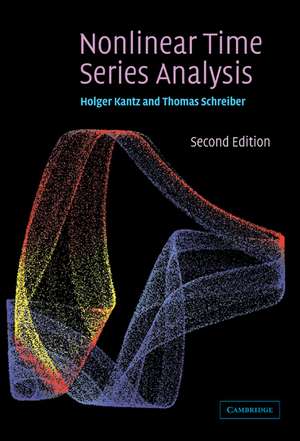
Nonlinear Time Series Analysis
Autor Holger Kantz, Thomas Schreiberen Limba Engleză Paperback – 23 aug 2006
Prezentat sub formă de manual academic de referință, Nonlinear Time Series Analysis de Holger Kantz și Thomas Schreiber ajunge la a doua ediție, consolidându-și poziția de resursă fundamentală pentru cercetătorii din științele aplicate. Reținem că această lucrare face trecerea critică de la teoria abstractă a sistemelor haotice la aplicabilitatea lor în lumea reală, oferind instrumente matematice pentru a descifra comportamentele neregulate care nu sunt neapărat stocastice. Structura volumului este riguros pedagogică, incluzând 43 de exerciții care facilitează înțelegerea conceptelor de dinamică non-liniară. Observăm o continuitate clară în opera lui Holger Kantz; dacă în Nonlinear Analysis of Physiological Data autorul se concentra pe specificul științelor vieții, volumul de față extinde spectrul analizei către geofizică și economie, oferind un cadru teoretic unificat. Cititorii familiarizați cu Analysis of Observed Chaotic Data de H D I Abarbanel vor aprecia la Kantz și Schreiber accentul pus pe identificarea capcanelor metodologice și a utilizării greșite a tehnicilor de analiză, un aspect semnalat pozitiv și de recenziile de specialitate. Spre deosebire de abordarea pur statistică din Non-linear Time Series de Howell Tong, acest manual se ancorează în paradigma haosului determinist, oferind o perspectivă mai profundă asupra structurilor matematice ascunse în datele experimentale. Ediția actuală beneficiază de o actualizare a tehnicilor de analiză a datelor, reflectând progresele dramatice din laboratoarele de dinamică non-liniară. Cele 118 ilustrații sprijină vizualizarea atractanților și a evoluțiilor complexe, transformând o materie densă într-un parcurs coerent pentru nivelul postuniversitar și profesional.
Preț: 648.32 lei
Preț vechi: 728.45 lei
-11%
Carte tipărită la comandă
Livrare economică 05-19 decembrie
Specificații
ISBN-10: 0521529026
Pagini: 388
Ilustrații: 118 b/w illus. 4 tables 43 exercises
Dimensiuni: 170 x 244 x 21 mm
Greutate: 0.67 kg
Ediția:Revizuită
Editura: Cambridge University Press
Locul publicării:Cambridge, United Kingdom
V-ar putea interesa
-
 Chaos: A Very Short IntroductionLeonard Smith-18%Preț: 58.37 lei71.53 lei
 -
 Complexity: A Very Short IntroductionJohn H. Holland-20%Preț: 56.65 lei70.82 lei
 -
 Nonlinear SystemsShankar Sastry-15%Preț: 682.48 lei802.92 lei
 -
 Capablanca's Best Chess EndingsIrving Chernev-27%Preț: 88.70 lei122.20 lei
 -
 Preț: 325.10 lei
 -
 Pattern Formation and Dynamics in Nonequilibrium SystemsMichael Cross-14%Preț: 828.27 lei963.10 lei
 -
 -18%Preț: 935.46 lei1140.81 lei
 -
 Preț: 354.78 lei
 -
 Preț: 454.49 lei
 -
 Toward Analytical Chaos in NonAlbert C J Luo-9%Preț: 838.76 lei921.71 lei
 -
 Mathematical Methods in Biology and NeurobiologyJürgen Jost-15%Preț: 488.29 lei574.46 lei
 -
 Isospectral TransformationsLeonid BunimovichPreț: 402.24 lei
 -
 Henri Poincaré, 1912-2012Bertrand Duplantier-18%Preț: 812.88 lei991.31 lei
 -
 Dynamics of Quasi-Stable Dissipative SystemsIgor ChueshovPreț: 397.95 lei
 -
 Preț: 346.73 lei
De ce să citești această carte
Această ediție a doua este esențială pentru cercetătorii care lucrează cu date experimentale complexe. Cititorul câștigă o metodologie riguroasă pentru a distinge între zgomotul aleatoriu și haosul determinist, beneficiind de expertiza unor autori care au definit domeniul. Este un instrument de lucru indispensabil în econometrie, fiziologie sau geofizică, unde metodele liniare tradiționale eșuează în captarea complexității sistemelor.
Descriere scurtă
Cuprins
Recenzii
'This book will be of value to any graduate student or researcher who needs to be able to analyse time series data, especially in the fields of physics, chemistry, biology, geophysics, medicine, economics and the social sciences.' Mathematical Reviews
'… a very readable introduction to the concepts and clear descriptions of the techniques, as well as cautions, where appropriate, about potential pitfalls and misuses of the methods. … the book is a good reference to the current state of the art from the nonlinear dynamics community and is important reading for anyone faced with interpreting irregular time series.' Contemporary Physics