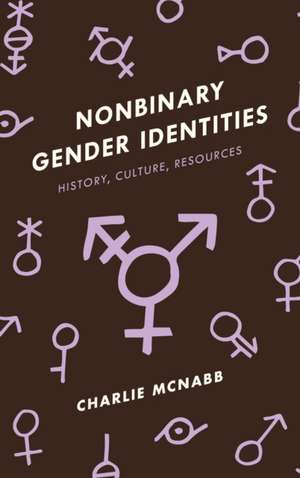
Nonbinary Gender Identities: History, Culture, Resources
Autor Charlie McNabben Limba Engleză Hardback – 8 dec 2017
Preț: 507.84 lei
Preț vechi: 723.31 lei
-30%
Puncte Express: 762
Carte tipărită la comandă
Livrare economică 04-18 decembrie
Livrare prin curier în România Termenul estimat este afișat lângă disponibilitate.
Transport gratuit pentru acest produs Plată online sau ramburs, în funcție de opțiunile comenzii.
Retur gratuit în 14 zile Comandă securizată și suport în română.
Specificații
ISBN-13: 9781442275515
ISBN-10: 1442275510
Pagini: 330
Ilustrații: 28 b/w photos; 1 chart
Dimensiuni: 161 x 236 x 27 mm
Greutate: 0.64 kg
Editura: Bloomsbury Publishing
Colecția Rowman & Littlefield
Locul publicării:New York, United States
ISBN-10: 1442275510
Pagini: 330
Ilustrații: 28 b/w photos; 1 chart
Dimensiuni: 161 x 236 x 27 mm
Greutate: 0.64 kg
Editura: Bloomsbury Publishing
Colecția Rowman & Littlefield
Locul publicării:New York, United States
Descriere
Nonbinary gender identities are those that fall outside the traditional binary of "man" and "woman." These include genderfluid, androgynous, genderqueer, and a multitude of other identity terms, some of which overlap. Although there have always been people who identify outside the gender binary, only recently have they gained popular media attention. Despite some visibility, however, nonbinary gender identities are poorly understood by the general public.
It is critically important for gender minorities to find themselves in the media that they consume. Just as important is the need for those outside the minority community to understand and appreciate them. Nonbinary gender identities are represented in books and other media, but these resources prove difficult to locate, as classification vocabulary doesn't evolve as quickly as community language.
Reference sources identified include archives and special collections, theses and dissertations, key journals, and related organizations and associations.
This timely resource-the first reference on nonbinary gender identities-offers an accessible entry into researching this topic. Written by a nonbinary scholar and librarian, this guide includes valuable appendixes that will aid every researcher and writer: a glossary of the rich vocabulary emerging from nonbinary communities; a guide to pronoun usage; a primer on sex, sexuality, and gender; and Library of Congress Classification information.
It is critically important for gender minorities to find themselves in the media that they consume. Just as important is the need for those outside the minority community to understand and appreciate them. Nonbinary gender identities are represented in books and other media, but these resources prove difficult to locate, as classification vocabulary doesn't evolve as quickly as community language.
Reference sources identified include archives and special collections, theses and dissertations, key journals, and related organizations and associations.
This timely resource-the first reference on nonbinary gender identities-offers an accessible entry into researching this topic. Written by a nonbinary scholar and librarian, this guide includes valuable appendixes that will aid every researcher and writer: a glossary of the rich vocabulary emerging from nonbinary communities; a guide to pronoun usage; a primer on sex, sexuality, and gender; and Library of Congress Classification information.
Cuprins
Part I: (Hir)stories
1 Introduction to Nonbinary Gender
2 Nonbinary Visibility in the United States
3 Culturally-Specific Genders
4 Nonbinary Genders in Popular Culture
5 Notable Nonbinary People
Part II: Resources
6 Archives and Special Collections
7 Nonfiction
8 Journal Literature
9 Theses and Dissertations
10 Fiction
11 Organizations and Associations
12 Online Resources
13 Multimedia
Appendix 1: Glossary
Appendix 2: Pronoun Usage
Appendix 3: Sex, Sexuality, and Gender Primer
Appendix 4: Library of Congress Subject Headings
1 Introduction to Nonbinary Gender
2 Nonbinary Visibility in the United States
3 Culturally-Specific Genders
4 Nonbinary Genders in Popular Culture
5 Notable Nonbinary People
Part II: Resources
6 Archives and Special Collections
7 Nonfiction
8 Journal Literature
9 Theses and Dissertations
10 Fiction
11 Organizations and Associations
12 Online Resources
13 Multimedia
Appendix 1: Glossary
Appendix 2: Pronoun Usage
Appendix 3: Sex, Sexuality, and Gender Primer
Appendix 4: Library of Congress Subject Headings
Recenzii
McNabb, a folklorist, archivist, librarian, and queer activist, offers a strong introduction to definitions, histories, and cultures of nonbinary individuals. In addition, McNabb provides scholars,
archivists, librarians, and teachers with a treasure-trove of resources to learn about, and research,
the history and contemporary experiences of nonbinary people. . . . Overall, McNabb provides a fine introduction to the history and culture of nonbinary gender identities. . . . [Part 2] will offer readers something not available elsewhere: an abundance of resources for learning about, engaging with, and researching the history and contemporary experiences of nonbinary individuals and groups.
Since nonbinary genders are not well understood by the general public, the first book by folklorist, librarian, and activist McNabb is not only timely but informative and helpful.... The essays, ranging from the cultural and political history of nonbinary-gender identities in the U.S. to their history worldwide and including profiles of notable nonbinary people, are well written: clear, readable, and educational in the best sense, serving to explicate and to center the story of nonbinary genders in context.... A solid, educational, useful, and engrossing resource on nonbinary genders, this work deserves a home in most college, university, and large public libraries.
This book is a compilation of resources for nonbinary gender identities: individuals who are not exclusively male or female. It is an umbrella term, as the author states in the preface: other terms include genderfluid, bigender, and genderqueer. These individuals have existed in society for centuries, but have often been marginalized and even persecuted. This book is meant to be a pathfinder book for nonbinary people as well as a guide for those who wish to educate themselves on this topic, and is a point-in-time publication given the resources cited. It is divided into two parts: Part 1, (Hir)stories, has five chapters on issues such as definition and introduction, visibility in the United States, culturally specific genders, nonbinary genders in popular culture, and notable nonbinary people. Part 2, Resources, has eight chapters which focus on places to find information such as archives and special collections, nonfiction books, journals, theses and dissertations, fiction books, organizations and associations, online resources, and multimedia. Four appendixes provide a glossary, pronoun usage, a sexuality and gender primer, and Library of Congress subject headings, along with a bibliography and index. Given that there are very few print resources in this area, I highly recommend this book for high school and academic libraries.
Nonbinary Gender Identities emerges at a critical moment when nonbinary youth are exploding the prejudice that bodies and genders can only be one of two. Charlie McNabb explains what it means to be nonbinary or genderqueer with sensitivity, precision, and kindness. This is a book for any reader who wants to better understand what it means to be nonbinary, or even what it means to be human.
As a social sciences librarian, I am always on the lookout for works that provide strong coverage of LGBTQIA topics. Charlie McNabb fills a significant publication gap with a thoroughly researched volume on nonbinary gender identities. It will serve researchers and librarians alike with its definitions, historical and cultural information, and detailed bibliographies for further research. This is an essential resource for anyone developing library collections for gender studies or studying gender.
archivists, librarians, and teachers with a treasure-trove of resources to learn about, and research,
the history and contemporary experiences of nonbinary people. . . . Overall, McNabb provides a fine introduction to the history and culture of nonbinary gender identities. . . . [Part 2] will offer readers something not available elsewhere: an abundance of resources for learning about, engaging with, and researching the history and contemporary experiences of nonbinary individuals and groups.
Since nonbinary genders are not well understood by the general public, the first book by folklorist, librarian, and activist McNabb is not only timely but informative and helpful.... The essays, ranging from the cultural and political history of nonbinary-gender identities in the U.S. to their history worldwide and including profiles of notable nonbinary people, are well written: clear, readable, and educational in the best sense, serving to explicate and to center the story of nonbinary genders in context.... A solid, educational, useful, and engrossing resource on nonbinary genders, this work deserves a home in most college, university, and large public libraries.
This book is a compilation of resources for nonbinary gender identities: individuals who are not exclusively male or female. It is an umbrella term, as the author states in the preface: other terms include genderfluid, bigender, and genderqueer. These individuals have existed in society for centuries, but have often been marginalized and even persecuted. This book is meant to be a pathfinder book for nonbinary people as well as a guide for those who wish to educate themselves on this topic, and is a point-in-time publication given the resources cited. It is divided into two parts: Part 1, (Hir)stories, has five chapters on issues such as definition and introduction, visibility in the United States, culturally specific genders, nonbinary genders in popular culture, and notable nonbinary people. Part 2, Resources, has eight chapters which focus on places to find information such as archives and special collections, nonfiction books, journals, theses and dissertations, fiction books, organizations and associations, online resources, and multimedia. Four appendixes provide a glossary, pronoun usage, a sexuality and gender primer, and Library of Congress subject headings, along with a bibliography and index. Given that there are very few print resources in this area, I highly recommend this book for high school and academic libraries.
Nonbinary Gender Identities emerges at a critical moment when nonbinary youth are exploding the prejudice that bodies and genders can only be one of two. Charlie McNabb explains what it means to be nonbinary or genderqueer with sensitivity, precision, and kindness. This is a book for any reader who wants to better understand what it means to be nonbinary, or even what it means to be human.
As a social sciences librarian, I am always on the lookout for works that provide strong coverage of LGBTQIA topics. Charlie McNabb fills a significant publication gap with a thoroughly researched volume on nonbinary gender identities. It will serve researchers and librarians alike with its definitions, historical and cultural information, and detailed bibliographies for further research. This is an essential resource for anyone developing library collections for gender studies or studying gender.
Notă biografică
Charlie McNabb was a queer adolescent. When they entered puberty, Charlie was told that they was "a woman now" and it was made clear that there was an expectation of eventual heterosexual union and childbearing. That was uncomfortable! Charlie has been fascinated by queer puberty experiences ever since. Charlie started doing research on queer and transgender menarche experiences in 2010. They've surveyed over 150 people and done in-depth one-on-one interviews with a few dozen more. In addition, they have been collecting puberty accounts and ephemera from both popular and DIY culture (advertisements, fiction, zines, and so forth). This research has produced several conference papers and zines as well as a growing archival collection. Charlie's background in anthropology (BA 2005), folklore (MA 2011), and library science (MLIS 2013) has given them experience with large-scale surveys and interviews, library and archival research, and sensitive analysis. Rowman & Littlefield published Charlie's previous book, Nonbinary Gender Identities: History, Culture, Resources in 2017.