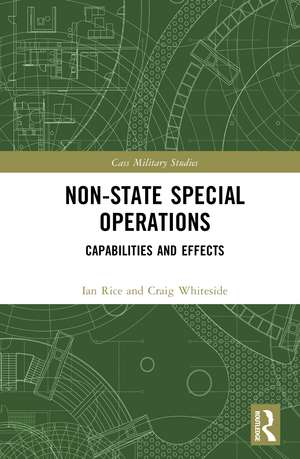
Non-state Special Operations: Capabilities and Effects: Cass Military Studies
Autor Ian Rice, Craig Whitesideen Limba Engleză Hardback – 25 iul 2025
Building on previous research on Islamic State special operations, the book develops a theoretical framework surrounding a typology of VNSA (militants, proxies, criminal/cults, and mercenaries) to explore variations of non-state special operations, with multiple cases for each category of actor. Understanding when and why VNSAs use special operations provides insights into the inner workings of such groups and how they campaign and also has implications for the proliferation of special operation forces around the globe and its influence on non-state behavior. This volume contributes to research on the recent trend of non-state actors surprising, and in some cases humiliating, their state opponents.
This book will be of much interest to students of military and strategic studies, defense studies, and security studies.
Din seria Cass Military Studies
- 26%
 Preț: 346.55 lei
 - 21%
 Preț: 243.60 lei
 - 29%
 Preț: 930.77 lei
 - 26%
 Preț: 348.85 lei
 - 20%
 Preț: 283.24 lei
 - 29%
 Preț: 873.67 lei
 - 29%
 Preț: 928.93 lei
 - 26%
 Preț: 322.13 lei
 - 26%
 Preț: 345.96 lei
 - 26%
 Preț: 320.43 lei
 - 29%
 Preț: 871.53 lei
 - 29%
 Preț: 872.78 lei
 - 52%
 Preț: 558.40 lei
 - 26%
 Preț: 334.10 lei
 - 30%
 Preț: 898.17 lei
 - 29%
 Preț: 929.29 lei
 - 26%
 Preț: 345.40 lei
 - 17%
 Preț: 321.07 lei
 - 17%
 Preț: 331.02 lei
 - 29%
 Preț: 870.75 lei
 - 17%
 Preț: 358.10 lei
 - 29%
 Preț: 869.98 lei
 - 29%
 Preț: 870.70 lei
 - 29%
 Preț: 872.39 lei
 - 29%
 Preț: 877.18 lei
 - 29%
 Preț: 869.42 lei
 - 29%
 Preț: 874.24 lei
 - 29%
 Preț: 871.09 lei
 - 29%
 Preț: 871.45 lei
 - 29%
 Preț: 931.70 lei
 - 30%
 Preț: 868.87 lei
 - 29%
 Preț: 869.42 lei
 - 29%
 Preț: 875.88 lei
 - 29%
 Preț: 872.57 lei
 - 34%
 Preț: 344.82 lei
 - 30%
 Preț: 865.92 lei
 - 29%
 Preț: 843.29 lei
 - 29%
 Preț: 1073.55 lei
 - 29%
 Preț: 872.94 lei
Preț: 842.55 lei
Preț vechi: 1274.97 lei
-34%
Puncte Express: 1264
Preț estimativ în valută:
149.11€ • 174.27$ • 129.46£
149.11€ • 174.27$ • 129.46£
Carte disponibilă
Livrare economică 30 ianuarie-13 februarie
Preluare comenzi: 021 569.72.76
Specificații
ISBN-13: 9781032594514
ISBN-10: 1032594519
Pagini: 192
Ilustrații: 74
Dimensiuni: 156 x 234 x 15 mm
Greutate: 0.52 kg
Ediția:1
Editura: Taylor & Francis
Colecția Routledge
Seria Cass Military Studies
Locul publicării:Oxford, United Kingdom
ISBN-10: 1032594519
Pagini: 192
Ilustrații: 74
Dimensiuni: 156 x 234 x 15 mm
Greutate: 0.52 kg
Ediția:1
Editura: Taylor & Francis
Colecția Routledge
Seria Cass Military Studies
Locul publicării:Oxford, United Kingdom
Public țintă
Postgraduate, Professional Reference, and Undergraduate AdvancedCuprins
1: Introduction to Non-State Special Operations 2: A Theoretical Framework of Non-State Special Operations 3: Militant Groups 4: Proxy Groups 5: Criminal Groups and Violent Cults 6: Mercenaries 7: Conclusion
Notă biografică
Ian Rice is an adjunct Senior Lecturer in the Department of Defense Analysis, Naval Postgraduate School, adjunct faculty member with the College of Distance Education, USMC University, and a guest lecturer with the Royal Danish Defence College. He is a retired US Army officer who served with special operations forces.
Craig Whiteside is Professor of National Security Affairs at the US Naval War College resident program at the Naval Postgraduate School, Monterey, California. He is the co-author of The ISIS Reader: Milestone Texts of the Islamic State Movement (2020). He has a PhD in Political Science from Washington State University and is a former US Army infantry officer.
Craig Whiteside is Professor of National Security Affairs at the US Naval War College resident program at the Naval Postgraduate School, Monterey, California. He is the co-author of The ISIS Reader: Milestone Texts of the Islamic State Movement (2020). He has a PhD in Political Science from Washington State University and is a former US Army infantry officer.
Recenzii
"This book is an original and much needed study. Special operations have become a domain of terrorists and insurgents as ever more accessible technology--drones, social media, AI--has expanded their capabilities. From the Islamic State to the Houthis today, non-state special operations have become a significant military concern. Whiteside and Rice have broken new ground in explaining why non-state actors undertake special operations, helping scholars and policymakers think about how better to counter them."
Carter Malkasian, Chair of the Defense Analysis Program at the Naval Postgraduate School, Monterey, USA
"Whiteside and Rice deliver a fascinating and ground-breaking work. They analyze past examples through the lens of their invaluable method for examining special operations, particularly those mounted by violent, non-state actors, and illustrate their ideas with great case studies and analysis. A fine and original addition to the field of military studies."
Donald Stoker, National Defense University, Washington, DC, USA
"This is a significant contribution to the security studies literature on terrorism and the larger issue of violent groups ... Whiteside and Rice develop an original typology and theoretical approach, then apply their framework to a wealth of examples ... their case studies are diverse, encompassing criminal organizations, proxy warfare, and cults, and ranging as far as Mexico, Sicily, and Japan. Hamas’ October 7, 2023 attack on Israel is only the most prominent reminder that the evidence points to important conclusions. Whiteside and Rice’s work is a warning that leaves no doubt: Violent non-state special operations, enabled by the globalized democratization of information and weapons technologies, are on the rise and spreading."
Todd Greentree, former US foreign service officer and member of the Changing Character of War Centre, Oxford University, UK
"Rice and Whiteside crisply and confidently challenge the prevailing paradigm of special operations in this concise, engaging work on violent non-state actor special operations. Practitioners and scholars ignore this challenge at their peril."
James D. Kiras, Dean & Professor, Military Strategy & Security Studies, School of Advanced Air and Space Studies, USA
“VNSAs can (and often do) 'utilize unorthodox methods to surprise adversaries with guile and tactical acumen to achieve outsized results as part of larger campaigns.' Incorporating an appreciation for this in our security policies and intelligence community efforts could help us avoid strategic surprises (like the attacks of 9/11) in the future. Second, we must address how globalization has enabled increasingly global knowledge networks among VNSAs. The transfer of special operations tactics and strategies through these knowledge networks will undoubtedly expand due to the proliferation of information technologies, and particularly encrypted communication platforms. Third, the typology of various VNSA categories can help us better identify and appreciate why a particular VNSA is conducting different kinds of operations, and more importantly, craft relevant strategies to counter that group and its objectives. And finally, as the U.S. and others shift their attention toward 'great power competition' and away from VNSAs, we run the very real risk of turning a blind eye toward the future threat posed by VNSA capabilities for special operations.”
James Forest, University of Massachusetts Lowell and the Editor-in-Chief of Terrorism & Political Violence
Carter Malkasian, Chair of the Defense Analysis Program at the Naval Postgraduate School, Monterey, USA
"Whiteside and Rice deliver a fascinating and ground-breaking work. They analyze past examples through the lens of their invaluable method for examining special operations, particularly those mounted by violent, non-state actors, and illustrate their ideas with great case studies and analysis. A fine and original addition to the field of military studies."
Donald Stoker, National Defense University, Washington, DC, USA
"This is a significant contribution to the security studies literature on terrorism and the larger issue of violent groups ... Whiteside and Rice develop an original typology and theoretical approach, then apply their framework to a wealth of examples ... their case studies are diverse, encompassing criminal organizations, proxy warfare, and cults, and ranging as far as Mexico, Sicily, and Japan. Hamas’ October 7, 2023 attack on Israel is only the most prominent reminder that the evidence points to important conclusions. Whiteside and Rice’s work is a warning that leaves no doubt: Violent non-state special operations, enabled by the globalized democratization of information and weapons technologies, are on the rise and spreading."
Todd Greentree, former US foreign service officer and member of the Changing Character of War Centre, Oxford University, UK
"Rice and Whiteside crisply and confidently challenge the prevailing paradigm of special operations in this concise, engaging work on violent non-state actor special operations. Practitioners and scholars ignore this challenge at their peril."
James D. Kiras, Dean & Professor, Military Strategy & Security Studies, School of Advanced Air and Space Studies, USA
“VNSAs can (and often do) 'utilize unorthodox methods to surprise adversaries with guile and tactical acumen to achieve outsized results as part of larger campaigns.' Incorporating an appreciation for this in our security policies and intelligence community efforts could help us avoid strategic surprises (like the attacks of 9/11) in the future. Second, we must address how globalization has enabled increasingly global knowledge networks among VNSAs. The transfer of special operations tactics and strategies through these knowledge networks will undoubtedly expand due to the proliferation of information technologies, and particularly encrypted communication platforms. Third, the typology of various VNSA categories can help us better identify and appreciate why a particular VNSA is conducting different kinds of operations, and more importantly, craft relevant strategies to counter that group and its objectives. And finally, as the U.S. and others shift their attention toward 'great power competition' and away from VNSAs, we run the very real risk of turning a blind eye toward the future threat posed by VNSA capabilities for special operations.”
James Forest, University of Massachusetts Lowell and the Editor-in-Chief of Terrorism & Political Violence
Descriere
This book examines how non-state actors (VNSA) emulate and develop military special operation capabilities.