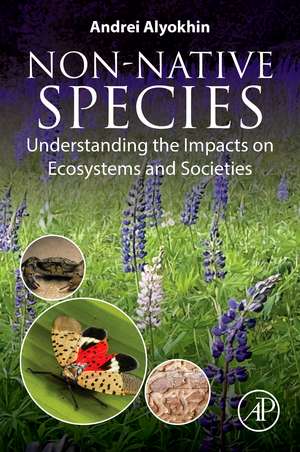
Non-Native Species: Understanding the Impacts on Ecosystems and Societies
Autor Andrei Alyokhinen Limba Engleză Paperback – 30 mar 2026
Written by an entomologist who studies invasive insects and plants and has spent over 20 years teaching a course on biological invasions, Non-Native Species: Understanding the Impacts on Ecosystems and Societies offers anecdotes, insights, and case studies from the author’s own work and research. This book is an ideal reference for early career researchers with an interest in invasion ecology, or an ideal course companion for students at the undergraduate and graduate levels enrolled in courses on invasive species, non-native species, or biological invasions, particularly those who plan to major, minor, or concentrate in entomology.
- Covers biologiocal invasions for undergraduate and graduate students as well as early career researchers
- Offers ecological, economic, political, and ethical perspectives on non-native species
- Includes unique and engaging case studies from the author’s work in entomology, plant science, and IPM
Preț: 742.04 lei
Preț vechi: 1090.00 lei
-32%
Puncte Express: 1113
Carte tipărită la comandă
Livrare economică 01-15 decembrie
Livrare prin curier în România Termenul estimat este afișat lângă disponibilitate.
Transport gratuit pentru acest produs Plată online sau ramburs, în funcție de opțiunile comenzii.
Retur gratuit în 14 zile Comandă securizată și suport în română.
Specificații
ISBN-13: 9780443288463
ISBN-10: 0443288461
Pagini: 494
Dimensiuni: 216 x 276 mm
Greutate: 0.45 kg
Editura: ELSEVIER SCIENCE
ISBN-10: 0443288461
Pagini: 494
Dimensiuni: 216 x 276 mm
Greutate: 0.45 kg
Editura: ELSEVIER SCIENCE
Cuprins
Part I: Understanding invasions
1. Definitions
2. The process in space and time
3. Ecological aspects
4. Evolutionary considerations
Part II: Putting things in perspective
5. Natural invasions
6. Unnatural invasions
7. Human invasions
8. Supervised invasions
Part III: Dealing with invasions
9. Predicting
10. Management tactics
11. Management strategies
12. Accepting
Part IV: Human dimensions
13. Economics
14. Ethics
15. Public perceptions
16. Scientific perspectives
17. Moving forward
18. Glossary
1. Definitions
2. The process in space and time
3. Ecological aspects
4. Evolutionary considerations
Part II: Putting things in perspective
5. Natural invasions
6. Unnatural invasions
7. Human invasions
8. Supervised invasions
Part III: Dealing with invasions
9. Predicting
10. Management tactics
11. Management strategies
12. Accepting
Part IV: Human dimensions
13. Economics
14. Ethics
15. Public perceptions
16. Scientific perspectives
17. Moving forward
18. Glossary
Notă biografică
Dr. Andrei Alyokhin received B.S. degree in Education in Biology and Chemistry from Moscow Pedagogical State University in Moscow, Russia. He then completed a Ph.D. in Entomology at the University of Massachusetts in Amherst, advised by Dr. David Ferro. After doing post-doctoral work at the University of Hawaii under the supervision of Dr. Russell Messing, he joined faculty at the University of Maine in January of 2001 as an Assistant Professor of Applied Entomology. He was promoted to Associate Professor in 2007, and then to Professor in 2013. He also served one term as a Director of the School of Biology and Ecology.
Dr. Alyokhin is interested in applied insect ecology, behavior, evolution of insecticide resistance, and integrated pest management. He is working mostly in potato agroecosystems, although recently he also started looking at insect mediated recycling of organic wastes. Dr. Alyokhin has authored or co-authored 181 publications, including 83 peer-reviewed articles in scientific journals. He also taught or co-taught Insect Ecology, Pesticides and the Environment, Biological Invasions, Introductory Applied Entomology, Evolution, Advanced Insect Pest Ecology and Management, Capstone Experience in Biological Sciences, and Professionalism in Biology. In addition, Dr. Alyokhin maintains an extensive outreach program to a variety of stakeholders, including potato growers, other crop production professionals, natural resource managers, K-12 students, and members of the general public. He is a recipient of several professional awards from Entomological Society of America, National Association of County Agricultural Agents, Aroostook County Extension Association, College of Natural Sciences, Food, and Agriculture at the University of Maine, and the U.S. National Park Service.
Dr. Alyokhin is interested in applied insect ecology, behavior, evolution of insecticide resistance, and integrated pest management. He is working mostly in potato agroecosystems, although recently he also started looking at insect mediated recycling of organic wastes. Dr. Alyokhin has authored or co-authored 181 publications, including 83 peer-reviewed articles in scientific journals. He also taught or co-taught Insect Ecology, Pesticides and the Environment, Biological Invasions, Introductory Applied Entomology, Evolution, Advanced Insect Pest Ecology and Management, Capstone Experience in Biological Sciences, and Professionalism in Biology. In addition, Dr. Alyokhin maintains an extensive outreach program to a variety of stakeholders, including potato growers, other crop production professionals, natural resource managers, K-12 students, and members of the general public. He is a recipient of several professional awards from Entomological Society of America, National Association of County Agricultural Agents, Aroostook County Extension Association, College of Natural Sciences, Food, and Agriculture at the University of Maine, and the U.S. National Park Service.