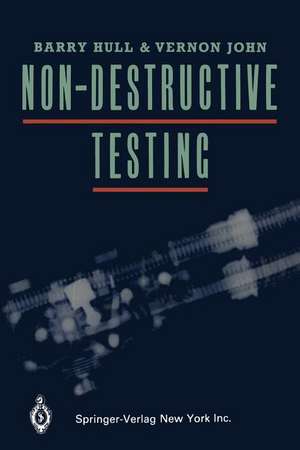
Non-Destructive Testing
Autor B. Hullen Limba Engleză Paperback – 19 mar 2012
Preț: 609.53 lei
Preț vechi: 717.10 lei
-15%
Puncte Express: 914
Carte tipărită la comandă
Livrare economică 23 noiembrie-07 decembrie
Livrare prin curier în România Termenul estimat este afișat lângă disponibilitate.
Transport gratuit pentru acest produs Plată online sau ramburs, în funcție de opțiunile comenzii.
Retur gratuit în 14 zile Comandă securizată și suport în română.
Specificații
ISBN-13: 9781468462999
ISBN-10: 1468462997
Pagini: 164
Ilustrații: 144 p.
Dimensiuni: 155 x 235 x 15 mm
Greutate: 0.24 kg
Ediția:Softcover reprint of the original 1st ed. 1988
Editura: Springer
Colecția Springer
Locul publicării:New York, NY, United States
ISBN-10: 1468462997
Pagini: 164
Ilustrații: 144 p.
Dimensiuni: 155 x 235 x 15 mm
Greutate: 0.24 kg
Ediția:Softcover reprint of the original 1st ed. 1988
Editura: Springer
Colecția Springer
Locul publicării:New York, NY, United States
V-ar putea interesa
-
 Fracture Mechanics: Fundamentals and ApplicationsMichael Janssen-15%Preț: 642.70 lei756.12 lei
 -
 Mechanics of Materials for DummiesJames H. AllenPreț: 137.54 lei
 -
 History of Strength of MaterialsStephen P TimoshenkoPreț: 170.74 lei
 -
 General Continuum MechanicsT. J. Chung-23%Preț: 901.02 lei1170.15 lei
 -
 Pipe Stress EngineeringAsme Press-23%Preț: 831.60 lei1080.01 lei
 -
 -32%Preț: 750.53 lei1104.03 lei
 -
 -9%Preț: 936.15 lei1028.74 lei
 -
 Applied Mechanics of SolidsAllan F. Bower-18%Preț: 851.69 lei1038.65 lei
 -
 Introduction to Analytical DynamicsNicholas WoodhousePreț: 348.85 lei
Public țintă
ResearchCuprins
1 Introduction.- 1.1 Need for inspection; 1.2 Types of inspection system; 1.3 Quality of inspection; 1.4 Reliability of defect detection; 1.5 Benefits of nondestructive test examination.- 2 Liquid Penetrant Inspection.- 2.1 Introduction; 2.2 Principles of penetrant inspection; 2.3 Characteristics of a penetrant; 2.4 Water-washable system; 2.5 Post-emulsification system; 2.6 Solvent-removable system; 2.7 Surface preparation and cleaning; 2.8 Penetrant application; 2.9 Development; 2.10 Advantages and limitations; 2.11 Range of applications..- 3 Magnetic Particle Inspection.- 3.1 Introduction; 3.2 Magnetisation; 3.3 Magnetisation methods; 3.4 Continuous and residual methods; 3.5 Sensitivities; 3.6 Demagnetisation; 3.7 Magnetic particles; 3.8 Applications; 3.9 Advantages and limitations of magnetic particle inspection.- 4 Electrical Test Methods (Eddy Current Testing).- 4.1 Introduction; 4.2 Principles of eddy current inspection; 4.3 Conductivity of a material; 4.4 Magnetic properties; 4.5 Coil impedance; 4.6 Lift-off factor and edge effects; 4.7 Skin effect; 4.8 Inspection frequency; 4.9 Coil arrangements; 4.10 Inspection probes; 4.11 Types of circuit; 4.12 Reference pieces; 4.13 Phase analysis; 4.14 Display methods; 4.15 Typical applications of eddy current techniques.- 5 Ultrasonic Testing.- 5.1 Introduction; 5.2 Nature of sound; 5.3 Wave velocity; 5.4 Wavelength; 5.5 Generation of ultrasound; 5.6 Characteristics of an ultrasonic beam; 5.7 Sound waves at interfaces; 5.8 Sound attenuation; 5.9 Display systems; 5.10 Probe construction; 5.11 Type of display; 5.12 Inspection techniques; 5.13 Identification of defects; 5.14 Immersion testing; 5.15 Sensitivity and calibration; 5.16 Reference standards; 5.17 Surface condition; 5.18 Some applications of ultrasonic testing.- 6 Radiography.- 6.1 Introduction; 6.2 Uses of radiography; 6.3 Some limitations of radiography; 6.4 Principles of radiography; 6.5 Radiation sources; 6.6 Production of X-rays; 6.7 X-ray spectra; 6.8 ?-radiation sources; 6.9 Attenuation of radiation; 6.10 Radiographic equivalence; 6.11 Shadow formation, enlargement and distortion; 6.12 Radiographic film and paper; 6.13 Xeroradiography; 6.14 Fluoroscopy; 6.15 Exposure factors; 6.16 Radiographic screens; 6.17 Identification markers and Image Quality Indicators; 6.18 Inspection of simple shapes; 6.19 Inspection of complex shapes; 6.20 Viewing and interpretation of radiographs; 6.21 The radiation hazard; 6.22 Protection against radiation; 6.23 Measurement of radiation received by personnel.- 7 Other Non-destructive Inspection Techniques.- 7.1 Optical inspection probes; 7.2 Neutron radiography; 7.3 Laser-induced ultrasonics; 7.4 Time-of-flight diffractions; 7.5 Acoustic emission inspection; 7.6 Crack depth gauges; 7.7 Thermography; 7.8 Surface texture analysis; 7.9 Multi-phase flow analysis; 7.10 Conclusions.