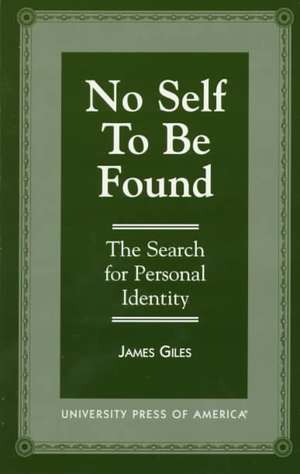
No Self to be Found: The Search for Personal Identity
Autor James Gilesen Limba Engleză Paperback – 24 apr 1997
Preț: 368.65 lei
Preț vechi: 576.21 lei
-36%
Puncte Express: 553
Carte tipărită la comandă
Livrare economică 16-30 noiembrie
Livrare prin curier în România Termenul estimat este afișat lângă disponibilitate.
Transport gratuit de la 400.00 lei Plată online sau ramburs, în funcție de opțiunile comenzii.
Retur gratuit în 14 zile Comandă securizată și suport în română.
Specificații
ISBN-13: 9780761806684
ISBN-10: 0761806687
Pagini: 176
Dimensiuni: 137 x 214 x 10 mm
Greutate: 0.21 kg
Ediția:New.
Editura: Bloomsbury Publishing
Colecția University Press of America
Locul publicării:New York, United States
ISBN-10: 0761806687
Pagini: 176
Dimensiuni: 137 x 214 x 10 mm
Greutate: 0.21 kg
Ediția:New.
Editura: Bloomsbury Publishing
Colecția University Press of America
Locul publicării:New York, United States
V-ar putea interesa
-
 Tropes: Properties, Objects, and Mental CausationDouglas Ehring-11%Preț: 322.41 lei363.50 lei
 -
 -16%Preț: 357.60 lei424.40 lei
 -
 -31%Preț: 538.88 lei780.17 lei
 -
 A Brief History of the Philosophy of TimeAdrian Bardon-6%Preț: 211.07 lei225.54 lei
 -
 The Nature of TimeUlrich Meyer-31%Preț: 535.66 lei778.21 lei
 -
 Locke's MetaphysicsMatthew Stuart-31%Preț: 828.25 lei1197.33 lei
 -
 The Oxford Handbook of the SelfShaun Gallagher-19%Preț: 316.37 lei391.22 lei
 -
 Oxford Studies in Metaphysics, Volume 8Karen Bennett-12%Preț: 364.31 lei416.07 lei
 -
 Intuition, Imagination, and Philosophical MethodologyTamar Szabó Gendler-11%Preț: 347.70 lei390.44 lei
 -
 -31%Preț: 557.29 lei807.61 lei
 -
 -21%Preț: 444.32 lei561.28 lei
 -
 Without Hierarchies: The Scale Freedom of the UniverseMariam Thalos-31%Preț: 629.80 lei914.72 lei
 -
 The Eternal LawJohn H. SpencerPreț: 146.75 lei
 -
 MetaphysicsRobert C. KoonsPreț: 182.31 lei
 -
 Time: A Philosophical IntroductionJames Harrington-16%Preț: 201.80 lei240.71 lei
 -
 A Philosophy of EmptinessGay Watson-30%Preț: 118.96 lei170.91 lei
Cuprins
1. The Problem of Personal Identity
2. The Indefinable Self
3. The Psychological Theory
4. Bodily Theory and the Theory of the Body
5. No Self to Be Found
Notes
Bibliography
Index
2. The Indefinable Self
3. The Psychological Theory
4. Bodily Theory and the Theory of the Body
5. No Self to Be Found
Notes
Bibliography
Index
Recenzii
James Giles' work is a clear, well-informed investigation of the psychological subject in the analytic style. It aims to correct some misleading assumptions that have distorted discussion of personal identity by philosophers and psychologists for centuries.
Giles has a gift of being able to express in an accessible manner very complex and at times technical arguments. He provides one of the best summaries of the literature of self and identity that I have seen recently. He wages his counter-arguments andlodges his criticisms of the positions with skill and insight. This is a book well worth taking seriously, if only as a test of any argument that proposes to defend a notion of the self and a meaningful personal identity. This book would be useful in graduate seminars in philosophical psychology, and it would be accessible to advanced undergraduates.
Giles has a gift of being able to express in an accessible manner very complex and at times technical arguments. He provides one of the best summaries of the literature of self and identity that I have seen recently. He wages his counter-arguments andlodges his criticisms of the positions with skill and insight. This is a book well worth taking seriously, if only as a test of any argument that proposes to defend a notion of the self and a meaningful personal identity. This book would be useful in graduate seminars in philosophical psychology, and it would be accessible to advanced undergraduates.
Notă biografică
JAMES GILES is a lecturer in the University of Cambridge Institute for Continuing Education. His writings on philosophical psychology, metaphysics, and human relationships are widely discussed. He is best known for his version of the no-self theory of personal identity, the vulnerability and care theory of love, and the theory of sexual desire as an existential need. Giles' works are typically interdisciplinary and intercultural, drawing on such areas as philosophy, psychology, anthropology, and biology, while exploring their expression in different cultures.