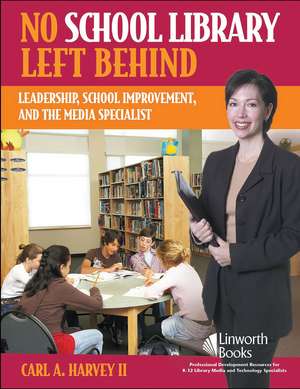
No School Library Left Behind: Leadership, School Improvement, and the Media Specialist
Autor Carl A. Harvey IIen Limba Engleză Paperback – 25 apr 2008
. Learn to create a library media program that is crucial to increasing information literacy, while meeting academic standards
.Prove the essential value library media specialists add to student achievement and to their schools
Here is a must-have tool for every school library media specialist who wants to prove the direct correlation between effective library media programs and student achievement. Library media specialists can learn to become leaders in the school by creating dynamic programs that students need, administrator's support, and teachers rely upon. Learn how to align the library media program with the school improvement process so that teachers, parents, and students will fight to maintain the valuable library program and the essential media specialist.
Preț: 252.91 lei
Preț vechi: 320.72 lei
-21%
Puncte Express: 379
Carte tipărită la comandă
Livrare economică 07-21 noiembrie
Livrare prin curier în România Termenul estimat este afișat lângă disponibilitate.
Transport gratuit de la 400.00 lei Plată online sau ramburs, în funcție de opțiunile comenzii.
Retur gratuit în 14 zile Comandă securizată și suport în română.
Specificații
ISBN-13: 9781586832339
ISBN-10: 1586832336
Pagini: 128
Dimensiuni: 152 x 229 x 8 mm
Greutate: 0.18 kg
Ediția:New.
Editura: Bloomsbury Publishing
Colecția Linworth
Locul publicării:New York, United States
ISBN-10: 1586832336
Pagini: 128
Dimensiuni: 152 x 229 x 8 mm
Greutate: 0.18 kg
Ediția:New.
Editura: Bloomsbury Publishing
Colecția Linworth
Locul publicării:New York, United States
V-ar putea interesa
-
 The Intellectual Foundation of Information OrganizationElaine Svenonius-20%Preț: 206.64 lei258.30 lei
 -
 Preț: 378.98 lei
 -
 Less Is More: A Practical Guide to Weeding School Library CollectionsDonna J. BaumbachPreț: 321.78 lei
 -
 Extensible Processing for Archives and Special CollectionsDaniel a. Santamaria-23%Preț: 424.21 lei550.93 lei
 -
 Cut Flower GardenErin Benzakein-26%Preț: 150.72 lei204.31 lei
 -
 -19%Preț: 595.52 lei735.20 lei
Recenzii
This title is well-organized, and the author's knowledge and experience is evident! The book will provide a useful primer for library media specialists seeking to better define their leadership role within the school environment.
This succinct guide shows library media specialists how to create exemplary programs that are aligned with school objectives, including improvement plans, processes, and outcomes, and how to measure the value of these efforts, especially in terms of academic standards and the development of information literacy skills. These criteria are often used to determine programs that should be supported and enhanced. The volume includes practical strategies; many informational sidebars, some of which are bibliographies; and appendixes that supply various assessment tools. It is an outstanding addition because of the wealth of tables, graphics, case studies, and professional and Web resources, all of which are well integrated into the text.
This slim volume packs a tremendous amount of useful, practical information into well-organized chapters and manageable subsections. The content constitutes a crash course in school improvement, covering definitions, history, legislation, research, best practices, assessment, profiles of accreditation associations, and most importantly, a strong rationale for why media specialists should lead the way in school improvement efforts. Fictionalized scenarios of how media specialists can move into leadership roles begin every chapter, and while they seem to reflect ideal situations, the accompanying strategies and straightforward advice provide realistic, effective suggestions that can be applied in any situation. Of particular note are the sections on reviewing library policies and practices to ensure they support school improvement goals, including an entire chapter devoted to how media programs can support math goals. The final chapter addresses school improvement beyond the building, including how library media specialists can enhance school improvement efforts through parent involvement, the school library Web page, and applying for grants and initiatives. Specialized bibliographies and lists of supporting Web sites are included throughout, as are easily accessible bulleted lists, accompanied by brief but well-reasoned explanations. Of major interest to novice and seasoned practitioners, this guide is timely and relevant. Highly Recommended.
This succinct guide shows library media specialists how to create exemplary programs that are aligned with school objectives, including improvement plans, processes, and outcomes, and how to measure the value of these efforts, especially in terms of academic standards and the development of information literacy skills. These criteria are often used to determine programs that should be supported and enhanced. The volume includes practical strategies; many informational sidebars, some of which are bibliographies; and appendixes that supply various assessment tools. It is an outstanding addition because of the wealth of tables, graphics, case studies, and professional and Web resources, all of which are well integrated into the text.
This slim volume packs a tremendous amount of useful, practical information into well-organized chapters and manageable subsections. The content constitutes a crash course in school improvement, covering definitions, history, legislation, research, best practices, assessment, profiles of accreditation associations, and most importantly, a strong rationale for why media specialists should lead the way in school improvement efforts. Fictionalized scenarios of how media specialists can move into leadership roles begin every chapter, and while they seem to reflect ideal situations, the accompanying strategies and straightforward advice provide realistic, effective suggestions that can be applied in any situation. Of particular note are the sections on reviewing library policies and practices to ensure they support school improvement goals, including an entire chapter devoted to how media programs can support math goals. The final chapter addresses school improvement beyond the building, including how library media specialists can enhance school improvement efforts through parent involvement, the school library Web page, and applying for grants and initiatives. Specialized bibliographies and lists of supporting Web sites are included throughout, as are easily accessible bulleted lists, accompanied by brief but well-reasoned explanations. Of major interest to novice and seasoned practitioners, this guide is timely and relevant. Highly Recommended.