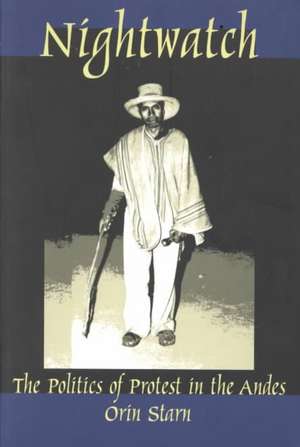
Nightwatch
Autor Orin Starnen Limba Engleză Paperback – 24 mai 1999
Relevanța lucrării Nightwatch pentru studiile de antropologie politică și istorie latino-americană este fundamentală, fiind un text de referință pentru înțelegerea mecanismelor de justiție comunitară. Observăm în această lucrare prima analiză etnografică detaliată în limba engleză despre 'rondas campesinas', o mișcare de autoapărare apărută în munții din nordul Peru la mijlocul anilor '70. Autorul Orin Starn reconstruiește parcursul acestor grupuri de la simple patrule împotriva hoților de animale la un sistem complex de justiție socială și mândrie rurală. Descoperim aici o structură narativă ce îmbină rigoarea academică cu o perspectivă umană, pornind de la 'poveștile de origine' ale mișcării și explorând capitole esențiale precum rolul femeilor în cadrul 'rondas' sau impactul apariției ONG-urilor în peisajul rural. Această abordare amintește de lucrarea Struggle in the Andes de Howard Handelman, care documentează mobilizarea politică țărănească, însă Nightwatch oferă o perspectivă mult mai intimă și prelungită în timp, bazată pe un deceniu de observație directă. De asemenea, spre deosebire de Peasant Cooperation and Capitalist Expansion in Central Peru, care se concentrează pe aspectele economice și de dezvoltare regională, textul lui Starn se apleacă asupra naturii puterii, rezistenței și identității subalternilor. Considerăm că această ediție publicată de Duke University Press este esențială pentru a înțelege contextul politic peruan, completând temele explorate de autor în The Shining Path. Dacă lucrarea anterioară se concentra pe mișcarea de gherilă, Nightwatch oferă contraponderea necesară: reacția grassroots a populației rurale în fața insecurității și eșecului statului.
Preț: 256.49 lei
Carte tipărită la comandă
Livrare economică 27 noiembrie-11 decembrie
Specificații
ISBN-10: 0822323214
Pagini: 344
Ilustrații: 42 b&w photographs, 2 maps
Dimensiuni: 153 x 230 x 28 mm
Greutate: 0.56 kg
Ediția:New.
Editura: Duke University Press
V-ar putea interesa
-
 Conservatism in a Divided AmericaGeorge HawleyPreț: 342.55 lei
 -
 The Shining PathOrin StarnPreț: 176.11 lei
 -
 Negligence Without FaultAlbert A. Ehrenzweig-23%Preț: 553.98 lei719.45 lei
 -
 Between Resistance and Revolution: Cultural Politics and Social ProtestProfessor Richard G. FoxPreț: 291.89 lei
 -
 The Peru Reader – History, Culture, PoliticsOrin StarnPreț: 210.80 lei
 -
 The Age of the World TargetRey ChowPreț: 209.87 lei
 -
 The Passion of Tiger WoodsOrin StarnPreț: 209.82 lei
 -
 Writing Culture and the Life of AnthropologyOrin StarnPreț: 250.05 lei
 -
 A Bond Between SoulsColeman M FordPreț: 157.15 lei
 -
 Indigenous Experience TodayMarisol de la CadenaPreț: 404.93 lei
 -
 Construire l' architectureAndrea DeplazesPreț: 716.17 lei
 -
 Women in Architecture Berlinn-ails e. V.Preț: 253.92 lei
 -
 Little TravellerSimone GoodingPreț: 112.50 lei
 -
 Color Atlas of OtologyAnirban Ghosh-5%Preț: 412.90 lei434.63 lei
De ce să citești această carte
Această carte este o resursă indispensabilă pentru studenții și cercetătorii din domeniul științelor umaniste care doresc să înțeleagă cum se organizează o societate în absența protecției statului. Cititorul câștigă o perspectivă rară asupra justiției comunitare din Peru, susținută de fotografii de arhivă și hărți, primind totodată o lecție metodologică valoroasă despre ce înseamnă munca de teren antropologică și reprezentarea corectă a mișcărilor sociale.
Despre autor
Orin Starn este profesor de Antropologie Culturală la Universitatea Duke, fiind o voce autoritară în studiile latino-americane. Experiența sa vastă în Peru este reflectată în lucrări precum The Shining Path, unde explorează originile conflictului armat intern. Interesele sale de cercetare sunt remarcabil de diverse, scriind de la eseuri despre evoluția disciplinei în Writing Culture and the Life of Anthropology, până la analize culturale contemporane precum The Passion of Tiger Woods. În Nightwatch, Starn își folosește expertiza pentru a oferi o voce comunităților andine, rămânând fidel unei abordări care combină istoria cu observația participantă.
Descriere scurtă
Drawing on fieldwork conducted over the course of a decade, Orin Starn chronicles the historical conditions that led to the formation of the rondas, the social and geographical expansion of the movement, and its gradual decline in the 1990s.
Starn moves easily from global to local contexts, and from the fifteenth to the twentieth century, presenting this movement in a forthright manner that makes it accessible to both specialists and non-specialists.
Although an engagingly written story of village mobilisation, Nightwatch is also a meditation on the nature of fieldwork, the representation of subaltern people, the relationship between resistance and power, and what it means to be politically active at the end of the century. It will appeal widely to scholars and students of anthropology, Latin American studies, cultural studies, history, subaltern studies, and those interested in the politics of social movements
Cuprins
Acknowledgements; Introduction
Origin stories
Nightwatch
Nightcourt
Women and the Rondas
The Rondas in the age of the NGO
Leaders and followers
Epilogue; Notes; Bibliography; Index
Recenzii
"Orin Starn's Nightwatch is the most thoroughly researched and perceptive study to date on peasant crime patrols and grassroots justice assemblies in northern Peru during the 1970s and 1980s. The book conveys cultural complexity in an engaging manner. Ethnographically rich and analytically astute, Nightwatch provides a remarkably vivid sense of peasant culture, politics, and justice in times of great difficulty" Steven J. Stern, author of Shining and Other Paths
"Fascinating for any reader, and indispensable for anyone seeking to understand modern Peru" Alma Guillermoprieto, author of The heart that bleeds: Latin America now"Nightwatch is an elegantly crafted and important book that deserves a readership that extends far beyond the confines of Latin American anthropology and Peruvian studies. It successfully meshes a gripping narrative with an engaging discussion of key themes, ranging from the nature of fieldwork to peasant resistance and globalisation. More important, it brings to light one of the most important Latin American peasant movements of the twentieth century, until now overshadowed by the dramatic impact of the Shining Path on Peru." Paulo Drinot, Left History "Against the blemished backdrop of anthropology, Nightwatch stands as evidence of [Starns] own thoughtful striving for disciplinary renewal." Andrew Orta, Anthropological Quarterly "Orin Starn tells the story well, with compelling ethnography drawing on over a decade of fieldwork in the region, but the work is also theoretically sophisticated and historically informed. In the best tradition of political anthropology, the dialogue between detailed local knowledge and the national and international political contexts in which these developments took place is never forgotten. . . . This well-written, accessible account has plenty to engage both the Peruvianist and the more general reader." Penelope Harvey, Journal of the Royal Anthropological Institute "This is an excellent book, exceptionally well-written, provocative and challenging and a must read for the layman or specialist interested in the dynamics of the Andean world." Roger P. Davis, South Eastern Latin Americanist "[A] sensitive, wide-ranging account of one of the largest recent popular grassroots movements in Latin America. . . ." Stuart Rockefeller, American Ethnologist "[A]n important commentary on the self-empowerment of a peasantry recently freed from serfdom on haciendas and their creation of what is characterized as the most important massive movement in recent Peruvian history." S. L. Rozman, Choice "An in-depth account. . . . This masterful work is captivating and honest, filled with engaging anecdotes yet analytically informed by classic and recent theoretical works. . . . Nightwatch is an extensive and impressive study of the rondas of the north." Jennifer S. Holmes, Latin American Research Review "[E]ngagingly written. . . . Nightwatch provides a most interesting mix of people, institutions, and culture that makes it a very worthwhile read. Numerous photos breathe even more life into the written word." Ward Stavig, The Historian "[W]ritten in an accessible and engaging style . . . interestingly enlivened with photographs, drawings, and quotations from songs popular among the villagers. . . . [H]ighly recommended both to Andean specialists and to others interested in relations between villagers and the modern state. The combination of clarity of exposition and respect for complexity makes it an excellent text for readers at all levels from bright undergraduate to professional practitioner." Ray Abrahams, Cambridge Anthropology "Nightwatch is highly engaging and well written, with a tight narrative structure . . . And evocative fluid prose." Peter Wogan, Identities
"Based on ethnography of rarely-accomplished nuance and historical depth, Nightwatch is a vivid, elegant, and enlightening account of the rise and development of what has come to be widely recognised as the most important rural movement to emerge in Latin America since the late 1960s. Orin Starn has profound knowledge and understanding of both the Peruvian situation today and its recent and distant history. He writes in direct and artfully crafted prose, informed by the most up-to-date theoretical debates. This book will be of great interest not just to those who care about Peru and Latin America but also to scholars across anthropology, cultural studies, political science and history" Arturo Escobar, University of Massachusetts at Amherst and author of Encoutnering development: the making and unmaking of the Third World "Orin Starn's Nightwatch is the most thoroughly researched and perceptive study to date on peasant crime patrols and grassroots justice assemblies in northern Peru during the 1970s and 1980s. The book conveys cultural complexity in an engaging manner. Ethnographically rich and analytically astute, Nightwatch provides a remarkably vivid sense of peasant culture, politics, and justice in times of great difficulty" Steven J. Stern, author of Shining and Other Paths "Fascinating for any reader, and indispensable for anyone seeking to understand modern Peru" Alma Guillermoprieto, author of The heart that bleeds: Latin America now "Nightwatch is an elegantly crafted and important book that deserves a readership that extends far beyond the confines of Latin American anthropology and Peruvian studies. It successfully meshes a gripping narrative with an engaging discussion of key themes, ranging from the nature of fieldwork to peasant resistance and globalisation. More important, it brings to light one of the most important Latin American peasant movements of the twentieth century, until now overshadowed by the dramatic impact of the Shining Path on Peru." Paulo Drinot, Left History "Against the blemished backdrop of anthropology, Nightwatch stands as evidence of [Starn's] own thoughtful striving for disciplinary renewal." Andrew Orta, Anthropological Quarterly "Orin Starn tells the story well, with compelling ethnography drawing on over a decade of fieldwork in the region, but the work is also theoretically sophisticated and historically informed. In the best tradition of political anthropology, the dialogue between detailed local knowledge and the national and international political contexts in which these developments took place is never forgotten... This well-written, accessible account has plenty to engage both the Peruvianist and the more general reader." Penelope Harvey, Journal of the Royal Anthropological Institute "This is an excellent book, exceptionally well-written, provocative and challenging and a must read for the layman or specialist interested in the dynamics of the Andean world." Roger P. Davis, South Eastern Latin Americanist "[A] sensitive, wide-ranging account of one of the largest recent popular grassroots movements in Latin America..." Stuart Rockefeller, American Ethnologist "[A]n important commentary on the self-empowerment of a peasantry recently freed from serfdom on haciendas and their creation of what is characterized as the most important massive movement in recent Peruvian history." S. L. Rozman, Choice "An in-depth account... This masterful work is captivating and honest, filled with engaging anecdotes yet analytically informed by classic and recent theoretical works... Nightwatch is an extensive and impressive study of the rondas of the north." Jennifer S. Holmes, Latin American Research Review "[E]ngagingly written... Nightwatch provides a most interesting mix of people, institutions, and culture that makes it a very worthwhile read. Numerous photos breathe even more life into the written word." Ward Stavig, The Historian "[W]ritten in an accessible and engaging style ... interestingly enlivened with photographs, drawings, and quotations from songs popular among the villagers... [H]ighly recommended both to Andean specialists and to others interested in relations between villagers and the modern state. The combination of clarity of exposition and respect for complexity makes it an excellent text for readers at all levels from bright undergraduate to professional practitioner." Ray Abrahams, Cambridge Anthropology "Nightwatch is highly engaging and well written, with a tight narrative structure ... And evocative fluid prose." Peter Wogan, Identities