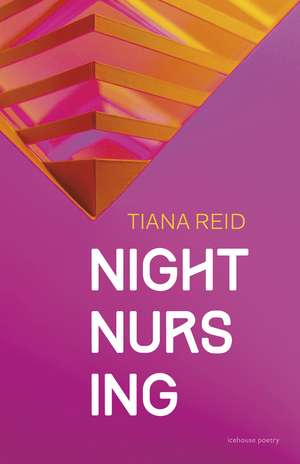
Nightnursing
Autor Tiana Reiden Limba Engleză Paperback – 22 sep 2026
In a world where the innate need for “better” is both trauma and treatment, what does sobriety and recovery really mean?
Nightnursing explores memory, care, and the mercurial nature of recovery from a Queer and Black perspective. At once intimate and adventurous, Nightnursing embraces uncertainty and the beauty of unfinished work, questioning the systems that define wellness and inclusion.
Reid’s experimental and playful poems drift through the haze of time, pressing fists to the boundaries of language and the self, and simultanteously running towards and away from reality.
Preț: 128.53 lei
Precomandă
Puncte Express: 193
Carte nepublicată încă
Livrare prin curier în România Precomanda se expediază când titlul devine disponibil.
Transport gratuit de la 400.00 lei Plată online sau ramburs, în funcție de opțiunile comenzii.
Retur gratuit în 14 zile Comandă securizată și suport în română.
Doresc să fiu notificat când acest titlu va fi disponibil:
Se trimite...
Specificații
ISBN-13: 9781773104690
ISBN-10: 1773104691
Pagini: 80
Dimensiuni: 140 x 216 x 6 mm
Greutate: 0.14 kg
Editura: Goose Lane Editions
Colecția Icehouse Poetry
Locul publicării:Canada
ISBN-10: 1773104691
Pagini: 80
Dimensiuni: 140 x 216 x 6 mm
Greutate: 0.14 kg
Editura: Goose Lane Editions
Colecția Icehouse Poetry
Locul publicării:Canada
Recenzii
Nightnursing inventories the racialization of care, cure, and memory with erudite flair and paratactic presence. In these poems, the past is not only remembered, it is the present. “Had to blow up the idea that everything would be fine,” Reid writes, then expands the frame to make space for an infinite us. In the face of recovery discourses’ “spectacular violence,” what a “kind of lightning” it is to be electrified and unraveled by this work.
Nightnursing — a state of wailing with Gregory from the truth of the baseline of all riddims, of all life: only she, the mother of the self, can quench this thirst. The mother — Reid — beckons the call, like music, of repetition: she uses it to redirect the pace of her poems, she uses it to refocus, she uses it to thicken the point, the plot, the plan. This collection gives honesty to the being that is in charge of the self and the controls of the self that memory and substance can take hold of. Reid either asks the questions of existence or speaks to existence, both without hesitation. This is a generous and beautiful book of poetry that challenges the rhythm of the voice and the space of a page. May this collection sit amongst us beyond our time.
The poems in Tiana Reid’s self-confronting debut speak through a bitten tongue — through origin, loss, coping, care, cure, and anti-cure — about the fugitive possibilities of life in grief ’s looping, inescapable presence. Betraying the limits of self-medication and recovery, Nightnursing tends to the buried summaries “emerging/from morning sun” to persist in and with the impossible world. “What/love/from/the/level/of an/other”: Nightnursing is transformational medicine for capacious life lived in the open.
“I fail to organize contradiction. I want to mourn myself.” As if circling a drain, the hypervigilant intellect of Tiana Reid’s Nightnursing refuses to swallow itself, to move on. With richly sensorial poems that reject solution and trouble the institutionalization of care, we are delivered into a fragmented memory where grief, having transmuted itself to mimic desire, reveals the fantasy of recovery as a point of conclusion. Nightnursing feeds its reader on repetition — the repetition of need, of addiction, of phrase, of failure, of history and the violence it inflicts, of the child hovering in the doorway of it all, stuck. I did not leave this book in ease. I wept reading Reid’s text, heartbroken and thankful to have found a voice and a poet committed to the kind of honesty I have been exhaustively hiding from within myself.
Tiana Reid’s Nightnursing is as visceral as it is luminous. This collection moves with grit and frankness and striking language, laying bare a journey through “healing” and sobriety. More than charting recovery, Reid troubles the very idea of it, resisting the demand that survival resolve into wellness, coherence, or cure. This work is experimental in language and form; playful and gutting in turns. The poet slants language in surprising and delightful ways, even as the poems stun you.
Nightnursing — a state of wailing with Gregory from the truth of the baseline of all riddims, of all life: only she, the mother of the self, can quench this thirst. The mother — Reid — beckons the call, like music, of repetition: she uses it to redirect the pace of her poems, she uses it to refocus, she uses it to thicken the point, the plot, the plan. This collection gives honesty to the being that is in charge of the self and the controls of the self that memory and substance can take hold of. Reid either asks the questions of existence or speaks to existence, both without hesitation. This is a generous and beautiful book of poetry that challenges the rhythm of the voice and the space of a page. May this collection sit amongst us beyond our time.
The poems in Tiana Reid’s self-confronting debut speak through a bitten tongue — through origin, loss, coping, care, cure, and anti-cure — about the fugitive possibilities of life in grief ’s looping, inescapable presence. Betraying the limits of self-medication and recovery, Nightnursing tends to the buried summaries “emerging/from morning sun” to persist in and with the impossible world. “What/love/from/the/level/of an/other”: Nightnursing is transformational medicine for capacious life lived in the open.
“I fail to organize contradiction. I want to mourn myself.” As if circling a drain, the hypervigilant intellect of Tiana Reid’s Nightnursing refuses to swallow itself, to move on. With richly sensorial poems that reject solution and trouble the institutionalization of care, we are delivered into a fragmented memory where grief, having transmuted itself to mimic desire, reveals the fantasy of recovery as a point of conclusion. Nightnursing feeds its reader on repetition — the repetition of need, of addiction, of phrase, of failure, of history and the violence it inflicts, of the child hovering in the doorway of it all, stuck. I did not leave this book in ease. I wept reading Reid’s text, heartbroken and thankful to have found a voice and a poet committed to the kind of honesty I have been exhaustively hiding from within myself.
Tiana Reid’s Nightnursing is as visceral as it is luminous. This collection moves with grit and frankness and striking language, laying bare a journey through “healing” and sobriety. More than charting recovery, Reid troubles the very idea of it, resisting the demand that survival resolve into wellness, coherence, or cure. This work is experimental in language and form; playful and gutting in turns. The poet slants language in surprising and delightful ways, even as the poems stun you.