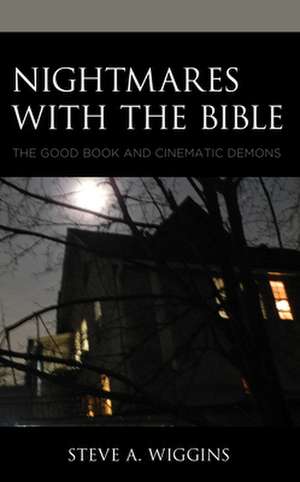
Nightmares with the Bible: The Good Book and Cinematic Demons: Horror and Scripture
Autor Steve A. Wigginsen Limba Engleză Hardback – 16 noi 2020
Preț: 555.82 lei
Preț vechi: 837.41 lei
-34%
Puncte Express: 834
Carte tipărită la comandă
Livrare economică 16-30 noiembrie
Livrare prin curier în România Termenul estimat este afișat lângă disponibilitate.
Transport gratuit pentru acest produs Plată online sau ramburs, în funcție de opțiunile comenzii.
Retur gratuit în 14 zile Comandă securizată și suport în română.
Specificații
ISBN-13: 9781978703186
ISBN-10: 197870318X
Pagini: 254
Dimensiuni: 161 x 229 x 24 mm
Greutate: 0.52 kg
Editura: Bloomsbury Publishing
Colecția Fortress Academic
Seria Horror and Scripture
Locul publicării:New York, United States
ISBN-10: 197870318X
Pagini: 254
Dimensiuni: 161 x 229 x 24 mm
Greutate: 0.52 kg
Editura: Bloomsbury Publishing
Colecția Fortress Academic
Seria Horror and Scripture
Locul publicării:New York, United States
V-ar putea interesa
-
 Marriage and Family in a Changing Society, 4th EdJames M. Henslin-12%Preț: 169.80 lei191.90 lei
 -
 -22%Preț: 338.98 lei437.03 lei
 -
 -24%Preț: 369.36 lei484.91 lei
 -
 Social Networking and Impression Management: Self-Presentation in the Digital AgeCarolyn M. Cunningham-32%Preț: 361.34 lei532.21 lei
 -
 Mistake in Identity: A Cultural Studies Murder MysteryArthur Asa Berger-26%Preț: 217.33 lei292.70 lei
 -
 -29%Preț: 218.37 lei305.64 lei
 -
 -28%Preț: 432.31 lei597.85 lei
 -
 Preț: 119.74 lei
 -
 Staying Tuned: Contemporary Soap Opera CriticismSuzanne FrentzPreț: 114.85 lei
 -
 Rejuvenating the HumanitiesRay B. BrownePreț: 113.21 lei
 -
 The Medical Research Novel in English and German, 1900-1950Phillip A. ScottPreț: 80.59 lei
 -
 Visions of War: World War II in Popular Literature and CultureM. Paul HolsingerPreț: 94.31 lei
 -
 Preț: 87.27 lei
 -
 The Many Tongues of LiteracyRay B. BrownePreț: 100.87 lei
 -
 The Gateway Arch: Fact & SymbolW. Arthur MehrhoffPreț: 85.46 lei
 -
 Preț: 242.04 lei
 -
 Preț: 91.61 lei
 -
 Beyond the Stars 4: Locales in American Popular FilmPaul LoukidesPreț: 119.84 lei
 -
 Alarms & Epitaphs: The Art of Eric AmblerPeter WolfePreț: 95.54 lei
 -
 The Terrible Fitzball: The Melodramatist of the MacabreLarry Stephen CliftonPreț: 94.91 lei
 -
 Preț: 94.31 lei
 -
 Preț: 78.91 lei
 -
 Child Brides and IntrudersCarol WershovenPreț: 121.79 lei
 -
 Preț: 92.84 lei
 -
 Aging Heroes: Growing Old in Popular CultureNorma Jones-34%Preț: 512.00 lei770.66 lei
 -
 -15%Preț: 112.52 lei132.32 lei
 -
 Henry VIII in Twenty-First Century Popular CultureJonas Takors-33%Preț: 640.95 lei959.25 lei
 -
 Weathering the PsalmsSteve A. WigginsPreț: 143.75 lei
Cuprins
Chapter 1 Introducing Demons
Chapter 2 Possession
Chapter 3 Demonic Beginnings
Chapter 4 Developing Demons
Chapter 5 New Testament Demons, the Devil, and Hell
Chapter 6 Setting the Stage: The Long Middle Ages
Chapter 7 Demons: No Laughing Matter
Chapter 8 The Conjuring Universe
Chapter 9 Amityville Horrors
Chapter 10 Paranormal Activities
Chapter 11 The Exorcist Franchise
Chapter 12 Aftermath
Chapter 2 Possession
Chapter 3 Demonic Beginnings
Chapter 4 Developing Demons
Chapter 5 New Testament Demons, the Devil, and Hell
Chapter 6 Setting the Stage: The Long Middle Ages
Chapter 7 Demons: No Laughing Matter
Chapter 8 The Conjuring Universe
Chapter 9 Amityville Horrors
Chapter 10 Paranormal Activities
Chapter 11 The Exorcist Franchise
Chapter 12 Aftermath
Recenzii
Steve A. Wiggins brings together the careful attention of a trained biblical scholar with the delight of an unabashed fan to take his readers on journey through some of the darkest spaces in their religious worlds. A pleasure to read, and another fine example illustrating how horror cinema not only helps us explore those religious worlds, but reminds us how closely our faith and our fears are related.
In Nightmares with the Bible: The Good Book and Cinematic Demons, Wiggins invites us to peer into the Bible's dark corners and follow its demons from the pages of the Good Book to the movie theater. From the first murmurings of demons in the ancient Near East to classics such as The Exorcist and Rosemary's Baby to Paranormal Activity and other contemporary demon films, Wiggins unpacks the significance of demons, the gender politics of possession, and the manifold ways the Bible haunts us even today. This book is smart, analytical, wide-ranging, and hard to shake- not unlike demons themselves. A diabolical delight for horror lovers, scholars, and casual movie viewers alike.
Scholars who study popular culture typically know nothing of biblical studies. Most scholars who delve into Ugaritic texts and pseudepigrapha won't even admit to having seen a horror movie. Wiggins is a rare scholar who walks in both worlds. Finally there is a book that allows the reader to understand how the demonic has evolved across millennia in a way that is smart, accessible, and complete.
Perhaps we live in evil times, but Wiggins is always determined to make the best of it. Talk of demons is prevalent on the U.S. national stage, so Wiggins explores the timely topic by using the evidence of their activity in popular movies. He walks his readers down the dark and winding path of demonic forces in a variety of world traditions before settling in to focus on the Bible. He pays attention to the way that women are often at the center of this site of disorder. This well-researched, but pointedly non-academic book helps readers identify demons and sort out possession and what they may have heard from history and Hollywood. Wiggins helps readers track the demonic in the Hebrew Bible, Second Temple Judaism, New Testament, and the Middle Ages, before showing how they jumped straight into our modern world. Comedies, Oscar-contenders, and big box office draws all prove good places to find demons doing what they do, and they offer Wiggins plenty of opportunities to show that the nightmares have real insights on our confusing world. This book is a valuable companion to students of U.S. fears.
Revisiting the religious demonology of his Holy Horror: The Bible and Fear in Movies (2018), Wiggins descends on a dark trajectory in Nightmares with the Bible, a fulfillment of William Rockett's downward transcendence. Opting for the portrayal of demons from the texts of popular culture rather than departments of theology and looking into the abyss, Wiggins writes with insight, readable historical scholarship, humor, and a flair for igniting the imagination of the reader. Using reception history, Wiggins demonstrates how a biblically illiterate population absorbs its understanding of the demonic primarily through movies (e.g., The Exorcist, The Conjuring). He traces demonic origins back to Mesopotamia and the Jewish apocrypha through the medieval era. He then explores the shadowy fragments of evil creatures, possession, witches, female victims, and other things that go bump in the soul, as they are manifested through and in cinematic culture. To quote Leonard Cohen's "Anthem," there is a "crack in everything / that's how the light gets in." Wiggins illumines the darkness with piercing light and panache in this lucid, delightful, and fascinating book, but one not to be read after midnight. Recommended. Lower-division undergraduates through faculty; general readers.
This book is a great addition to the field of interdisciplinary studies on religion and pop culture, and specifically to movie theories, horror as a genre, and biblical studies. Anyone interested in the impact of culture in the formation of religious ideas in general and biblical interpretation specifically should pay attention to the reflections of Wiggins.
In Nightmares with the Bible: The Good Book and Cinematic Demons, Wiggins invites us to peer into the Bible's dark corners and follow its demons from the pages of the Good Book to the movie theater. From the first murmurings of demons in the ancient Near East to classics such as The Exorcist and Rosemary's Baby to Paranormal Activity and other contemporary demon films, Wiggins unpacks the significance of demons, the gender politics of possession, and the manifold ways the Bible haunts us even today. This book is smart, analytical, wide-ranging, and hard to shake- not unlike demons themselves. A diabolical delight for horror lovers, scholars, and casual movie viewers alike.
Scholars who study popular culture typically know nothing of biblical studies. Most scholars who delve into Ugaritic texts and pseudepigrapha won't even admit to having seen a horror movie. Wiggins is a rare scholar who walks in both worlds. Finally there is a book that allows the reader to understand how the demonic has evolved across millennia in a way that is smart, accessible, and complete.
Perhaps we live in evil times, but Wiggins is always determined to make the best of it. Talk of demons is prevalent on the U.S. national stage, so Wiggins explores the timely topic by using the evidence of their activity in popular movies. He walks his readers down the dark and winding path of demonic forces in a variety of world traditions before settling in to focus on the Bible. He pays attention to the way that women are often at the center of this site of disorder. This well-researched, but pointedly non-academic book helps readers identify demons and sort out possession and what they may have heard from history and Hollywood. Wiggins helps readers track the demonic in the Hebrew Bible, Second Temple Judaism, New Testament, and the Middle Ages, before showing how they jumped straight into our modern world. Comedies, Oscar-contenders, and big box office draws all prove good places to find demons doing what they do, and they offer Wiggins plenty of opportunities to show that the nightmares have real insights on our confusing world. This book is a valuable companion to students of U.S. fears.
Revisiting the religious demonology of his Holy Horror: The Bible and Fear in Movies (2018), Wiggins descends on a dark trajectory in Nightmares with the Bible, a fulfillment of William Rockett's downward transcendence. Opting for the portrayal of demons from the texts of popular culture rather than departments of theology and looking into the abyss, Wiggins writes with insight, readable historical scholarship, humor, and a flair for igniting the imagination of the reader. Using reception history, Wiggins demonstrates how a biblically illiterate population absorbs its understanding of the demonic primarily through movies (e.g., The Exorcist, The Conjuring). He traces demonic origins back to Mesopotamia and the Jewish apocrypha through the medieval era. He then explores the shadowy fragments of evil creatures, possession, witches, female victims, and other things that go bump in the soul, as they are manifested through and in cinematic culture. To quote Leonard Cohen's "Anthem," there is a "crack in everything / that's how the light gets in." Wiggins illumines the darkness with piercing light and panache in this lucid, delightful, and fascinating book, but one not to be read after midnight. Recommended. Lower-division undergraduates through faculty; general readers.
This book is a great addition to the field of interdisciplinary studies on religion and pop culture, and specifically to movie theories, horror as a genre, and biblical studies. Anyone interested in the impact of culture in the formation of religious ideas in general and biblical interpretation specifically should pay attention to the reflections of Wiggins.