
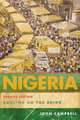
Nigeria: Dancing on the Brink: A Council on Foreign Relations Book
Autor John Campbellen Limba Engleză Hardback – 7 iun 2013
Ceea ce aduce nou această a doua ediție a volumului Nigeria este o analiză aprofundată a degradării climatului de securitate sub administrația Goodluck Jonathan și a impactului devastator pe care insurgența radicală Boko Haram îl are asupra stabilității regionale. Ne-a atras atenția modul în care John Campbell reușește să actualizeze tabloul politic al celui mai important partener strategic al SUA din Africa de Vest, oferind cititorului instrumentele necesare pentru a înțelege de ce această „dinamică uriașă” se află într-un punct de inflexiune periculos.
Structura cărții urmărește o progresie logică, de la o introducere în istoria post-colonială în capitolul „Un Peu d’Histoire”, până la analize punctuale ale paradoxului economic nigerian: de ce o țară atât de bogată în resurse are o populație atât de săracă? Capitolele dedicate Deltei Nigerului și sistemului politic fracturat explică mecanismele prin care corupția și competiția elitelor subminează instituțiile democratice. Cititorii familiarizați cu A History of Nigeria de Toyin Falola vor aprecia aici focalizarea pe dinamica diplomatică contemporană și pe soluțiile practice propuse pentru evitarea colapsului statal, spre deosebire de abordarea pur istoriografică a lui Falola.
Spre deosebire de lucrarea sa anterioară, Nigeria and the Nation-State, care se concentrează pe identitatea națională, Nigeria: Dancing on the Brink funcționează ca un raport de teren esențial. Experiența autorului ca fost ambasador conferă textului o autoritate rară, transformând capitolele despre relația dintre Washington și Abuja în studii de caz fundamentale pentru oricine studiază relațiile internaționale sau studiile regionale africane.


Preț: 627.24 lei
Preț vechi: 973.18 lei
-36%
Carte tipărită la comandă
Livrare economică 28 mai-11 iunie
Specificații
ISBN-10: 1442221569
Pagini: 240
Ilustrații: 1 map
Dimensiuni: 160 x 234 x 22 mm
Greutate: 0.48 kg
Ediția:Updated Edition.
Editura: Bloomsbury Publishing
Colecția Rowman & Littlefield
Seria A Council on Foreign Relations Book
Locul publicării:New York, United States
V-ar putea interesa
-
 African Politics: A Very Short IntroductionIan Taylor-22%Preț: 53.09 lei67.71 lei
 -
 Sudan: The Failure and Division of an African StateRichard CockettPreț: 110.18 lei
 -
 Thieves of StateSarah ChayesPreț: 86.50 lei
 -
 Death Of A Myth: Critical Essays on NigeriaFemi Ojo-AdePreț: 134.18 lei
 -
 Failed StateSam Freedman-35%Preț: 49.67 lei75.88 lei
 -
 -23%Preț: 201.51 lei260.25 lei
 -
 One Nation Under the InfluenceKevin A SabetPreț: 159.30 lei
 -
 Democracy, Diamonds & Oil: Politics in Today's AfricaMohamed A El-Khawas-30%Preț: 993.42 lei1423.85 lei
 -
 Nigeria: Conditions, Issues & U.S. RelationsRoland A Pollak-30%Preț: 1445.21 lei2076.44 lei
 -
 Nigeria: Instability, Implications & U.S. PolicyTodd B Griffith-29%Preț: 409.28 lei579.35 lei
 -
 -31%Preț: 513.99 lei745.14 lei
 -
 Boko Haram: Inside Nigeria's Unholy WarMike Smith-22%Preț: 104.85 lei133.66 lei
 -
 The Passenger: NigeriaAa VvPreț: 131.42 lei
 -
 This Fiction Called NigeriaAdewale Maja-PearcePreț: 122.66 lei
 -
 The Doom LoopEswar S. PrasadPreț: 176.25 lei
 -
 Security in Nigeria: Contemporary Threats and ResponsesCaroline Varin-21%Preț: 173.14 lei218.02 lei
 -
 -18%Preț: 75.07 lei91.48 lei
 -
 -19%Preț: 84.76 lei104.65 lei
 -
 Government Instability and Terrorism in Africa: Arms, Banditry and Human SecurityStanley Osezua Ehiane-14%Preț: 557.39 lei648.13 lei
 -
 Historical Dictionary of NigeriaToyin Falola-33%Preț: 991.16 lei1486.02 leiNou
De ce să citești această carte
Recomandăm această carte cercetătorilor și studenților la științe politice care doresc să înțeleagă complexitatea Nigeriei dincolo de titlurile de știri. Veți câștiga o perspectivă avizată asupra modului în care resursele naturale și tensiunile religioase modelează guvernarea. Este un ghid esențial pentru a înțelege riscul de eșec al unui stat cheie în geopolitica globală și rolul pe care diplomația externă îl poate juca în stabilizarea acestuia.
Despre autor
John Campbell este cercetător principal (Ralph Bunche Senior Fellow) pentru politici africane în cadrul Council on Foreign Relations. Experiența sa în Nigeria este una de lungă durată și profundă, servind în două rânduri în misiuni diplomatice la Abuja și Lagos: prima dată ca consilier politic (1988–1990) și ulterior ca ambasador al Statelor Unite (2004–2007). Această dublă perspectivă, de diplomat de carieră și analist politic, îi permite să combine rigoarea academică cu înțelegerea nuanțată a realităților de pe teren, fiind considerat una dintre cele mai autoritare voci americane în ceea ce privește politica vest-africană.
Descriere
In this thoroughly updated edition, John Campbellexplores Nigeria's post-colonial history and presents a nuanced explanation of the events and conditions that have carried this complex, dynamic, and very troubled giant to the edge. Central to his analysis are the oil wealth, endemic corruption, and elite competition that have undermined Nigeria's nascent democratic institutions and alienated an increasingly impoverished population. However, state failure is not inevitable, nor is it in the interest of the United States. Campbell provides concrete new policy options that would not only allow the United States to help Nigeria avoid state failure but also to play a positive role in Nigeria's political, social, and economic development.
Cuprins
Chapter 1: "Un Peu d'Histoire"
Chapter 2: If Nigeria Is So Rich, Why Are Nigerians So Poor?
Chapter 3: Who Runs Nigeria?
Chapter 4: Faith
Chapter 5: The Niger Delta
Chapter 6: A President for Life?
Chapter 7: The "Election-Like Event" of 2007
Chapter 8: The Breakdown of the Nigerian Political System
Chapter 9: Boko Haram
Chapter 10: Washington and Abuja
Chapter 11: Dancing on the Brink
Recenzii
In closing, Campbell's monographic illuminates Nigeria and its probability for super-power statehood as searching outwardly for internal healing. . . .Campbell's book is a literary testament to the modernity of Nigeria's sociopolitical atmosphere with an undertone poignancy for practical transformation. Without reluctance, I strongly recommend this literary masterpiece, because through combining primary evidence and personal experience, Campbell administers a strongly supported critical analysis of Nigeria's political upper class (formally known as the 'Ogas'). Academically, he exhibits the potential of Nigeria and the litany of governmental dysfunctions in a systematic chronological fashion that is readily comprehended without being a histo-academician. . . .Ambassador Campbell attentively resurrects the idea that Nigeria can mobilize for political purposes in steps towards a righteous direction of statehood stability and dependable political behavior servicing its citizens in kind for a tangible bright future.
[A] bold and courageous book. . . .Campbell sounded the alarm bell [but] we ignored the clear and prompt message contained, instead we went ahead to demonise the messenger. . . .If Nigeria continues to be the epicentre of corruption, infrastructure decay, violent conflict, religious extremism and criminality, there is not much anyone can do to improve her image. I earnestly hope that our country wins the war against terror which will possibly begin with the safe return of the girls kidnapped from Chibok. It is now clear that Campbell was right in most of the issues he raised. . . .The lesson is that we must try to give some of the many 'western' discussions about Nigeria the benefit of informed scrutiny before discarding them as promoters of pre-conceived interests.
A crucial layman's introduction to Nigeria as a whole, and to its inextricably intertwined identities of religion, politics, and society.
Part diplomatic memoir, part layman's introduction to the country, Campbell's book provides an excellent snapshot of Nigeria today. Campbell recounts key events in the country during his terms there as an American diplomat, including a spell as U.S. ambassador from 2004 to 2007. On several occasions, Campbell comments on U.S. timidity, notably Washington's hesitancy to publicly voice its concerns about Nigeria's deplorable levels of corruption or about the fraud and violence that have marred recent elections. . . . His book is a lively and sometimes highly critical analysis of the country's political class.
Africa's most populous nation totters toward the 'failed state' abyss in this measured study of Nigeria's travails. Campbell, the U. S. ambassador to Nigeria from 2004 to 2007, juxtaposes the nation's great potential-including huge petroleum reserves-with its dire poverty and growing instability. He fingers a litany of dysfunctions: a weak government and rigged elections; a ruling elite of generals and plutocrats who view the state mainly as a dispensary of petroprofits; endemic corruption; bloody sectarian violence between Christians and increasingly radical Muslims; the curse of oil wealth, which encourages Nigeria to neglect industrial development and fuels insurgencies in impoverished oilrich regions. Part history and part memoir, Campbell's chronicle of Nigeria since the 1960s civil war is fleshed out with firsthand profiles of its leaders and observations on recent political turmoil, along with a shrewd insider's analysis of Washington's policy toward the country, which he feels is too aloof. . . . Campbell gives a lucid, perceptive survey of the hardships and perils Nigeria faces.
Ambassador John Campbell has written an important book on Nigeria which demands the attention of every Nigerian and every American interested in Nigerian politics and Nigeria's place in African and global affairs. . . . A tour de force in every sense of the word. . . . [Campbell] shows a magisterial understanding of Nigeria's troubled political terrain, which only an insider could accomplish.
A masterly piece of work written with candour.
A fascinating work. With the detail Ambassador Campbell provides based on his Abuja assignment, the book is a lucid and valuable contribution to understanding contemporary Nigeria. Campbell writes with unusual candor, and with his initial academic training as a historian, he brings analytical discipline to his writing. This is much more than a mere memoir.
This lucidly written book will appeal to scholars, policymakers, and general readers. John Campbell explores key political, economic, and social issues and frankly evaluates U.S. policies in helping or inhibiting the building of a stable, democratic, and less corrupt Nigeria. It is essential reading for all concerned about the unfulfilled potential, and uncertain future, of this complex nation.