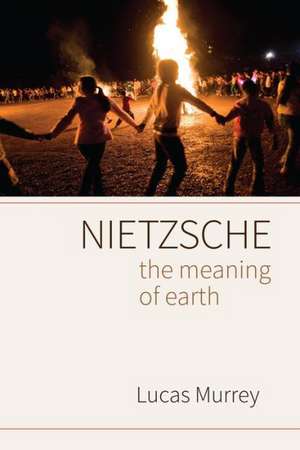
Nietzsche: The Meaning of Earth
Autor Lucas Murreyen Limba Engleză Hardback – 25 mar 2015
Murrey develops here a new picture of Greece, reminding readers how money emerged and rapidly developed in Greece during the sixth century B.C.E. The event of monetization created the new art form of tragedy: money-tyrants struggling against the forces of earth and communities who consequently suffered isolation, blindness, and death. As Murrey points out, Nietzsche (unconsciously) retrieves the battle among money, nature, and community and adapts its lessons to our time. Additionally, Nietzsche's philosophy not only adapts the wisdom of Dionysus to question the unlimited "glow and fuel" of a "ponderous herd" of money-tyrants today, but it also draws attention to Greece's warnings about the lethal danger of the eyes in myth, cult, and theatre.
This work introduces a much needed vision of Nietzschean thought, and it emphasizes the relevance of an interdisciplinary approach combining philosophy with literary studies and psychology with religious and visual/media studies. When applied to our present circumstance, the approach of this book reveals how a dangerous visual culture, through its support of the limitlessness of money, is harming our relationship with nature and each other.
Preț: 522.88 lei
Preț vechi: 767.98 lei
-32%
Puncte Express: 784
Carte tipărită la comandă
Livrare economică 27 noiembrie-11 decembrie
Livrare prin curier în România Termenul estimat este afișat lângă disponibilitate.
Transport gratuit pentru acest produs Plată online sau ramburs, în funcție de opțiunile comenzii.
Retur gratuit în 14 zile Comandă securizată și suport în română.
Specificații
ISBN-13: 9781611461541
ISBN-10: 1611461545
Pagini: 190
Dimensiuni: 160 x 236 x 18 mm
Greutate: 0.41 kg
Editura: Bloomsbury Publishing
Colecția Lehigh University Press
Locul publicării:New York, United States
ISBN-10: 1611461545
Pagini: 190
Dimensiuni: 160 x 236 x 18 mm
Greutate: 0.41 kg
Editura: Bloomsbury Publishing
Colecția Lehigh University Press
Locul publicării:New York, United States
Cuprins
1.Introduction
Rise of Mass Culture and the Visualised Chronotope
Emergence of Unlimited Language
Previous Treatments
Summary
Part I
Dionysian Philosophy
2. Evil Eye
"the poisonous eye of ressentiment"
"machinist and decorative artist"3. Apollo and Dionysus
"tragic myth"
"secret celebrations of dramatic mysteries"
"the public cult of tragedy"4. Dionysian Philosophy
"the Hellenic model"
"Incipit tragoedia"5. Fifty Mirrors Around You
"they jingle with their gold"
"Loathsome verbal-swill""fifty mirrors around you""to hear with the eyes"
6. The Meaning of Earth
"a big eye"
"teeth-gnashing and most lonely melancholy""twinkling stars and glow worms"
"the meaning of earth"
Part II
Proto-National Socialism
7. Despair of the German Spirit
"a permanent, loving bond between German and Greek culture"
"confused our gaze searches"
8. Patriotic excitation and aesthetic opulence
"in the terror and sublimities of the recently out-broken war"
"monstrous intrusive powers from the outside"
"Destruction of Greek culture through the Jewish world"
"And if the German should look about hesitantly for a Führer."
9. Blond German Beasts
"false, flickering light"
"happy monsters"
"Not only onward, but also upward should you plant"
10. Purification of the Race
"the wisdom of Him who is not only the God of the Jews"
"the Aryan conquering race"
"Zarathustra . in the Aryan province"
11. Jews/Christians: "The Chosen People Among Peoples"
"Jewish history";=
"vengeful-addict instincts of an unhappy priest"
"If Christianity remains, the Germans will be to blame"
Conclusion
12. Herakleitean Hyper-abstractions
"doubtful even about Herakleitos"
"eternal contradiction, Father of all things"
"the primal problem of tragedy"
"in the ten years of his loneliness"
Coda
The Bordello in Leipzig
Bibliography
Index
Rise of Mass Culture and the Visualised Chronotope
Emergence of Unlimited Language
Previous Treatments
Summary
Part I
Dionysian Philosophy
2. Evil Eye
"the poisonous eye of ressentiment"
"machinist and decorative artist"3. Apollo and Dionysus
"tragic myth"
"secret celebrations of dramatic mysteries"
"the public cult of tragedy"4. Dionysian Philosophy
"the Hellenic model"
"Incipit tragoedia"5. Fifty Mirrors Around You
"they jingle with their gold"
"Loathsome verbal-swill""fifty mirrors around you""to hear with the eyes"
6. The Meaning of Earth
"a big eye"
"teeth-gnashing and most lonely melancholy""twinkling stars and glow worms"
"the meaning of earth"
Part II
Proto-National Socialism
7. Despair of the German Spirit
"a permanent, loving bond between German and Greek culture"
"confused our gaze searches"
8. Patriotic excitation and aesthetic opulence
"in the terror and sublimities of the recently out-broken war"
"monstrous intrusive powers from the outside"
"Destruction of Greek culture through the Jewish world"
"And if the German should look about hesitantly for a Führer."
9. Blond German Beasts
"false, flickering light"
"happy monsters"
"Not only onward, but also upward should you plant"
10. Purification of the Race
"the wisdom of Him who is not only the God of the Jews"
"the Aryan conquering race"
"Zarathustra . in the Aryan province"
11. Jews/Christians: "The Chosen People Among Peoples"
"Jewish history";=
"vengeful-addict instincts of an unhappy priest"
"If Christianity remains, the Germans will be to blame"
Conclusion
12. Herakleitean Hyper-abstractions
"doubtful even about Herakleitos"
"eternal contradiction, Father of all things"
"the primal problem of tragedy"
"in the ten years of his loneliness"
Coda
The Bordello in Leipzig
Bibliography
Index
Recenzii
Lucas Murrey has produced a visionary adaptation of the Nietzschean Dionysiac to illuminate the dysfunctionality of twenty-first century capitalism.
As a new contemporary interpreter of Nietzsche, Lucas Murrey offers a critical analysis of the catastrophes that this German philosopher prophesised. In particular, Murrey's historical placement of Nietzsche that, on the one hand, looks explicitly backward to the poetry of Friedrich Hölderlin and, on the other hand, implicitly forward to the poetry of Stefan George, opens new doors of thought.
A congenial and rigorous new landmark study regarding Nietzsche's understanding of Dionysus in Greek tragedy during his Basel year. Well versed in classical scholarship and challenging in its original insights into ancient and modern visual culture.
Once again, fascinating material. It is exciting to see the meaning of Orwell's unpublished preface 'The Freedom of the Press' enter into the orbit of German philosophy.
As a new contemporary interpreter of Nietzsche, Lucas Murrey offers a critical analysis of the catastrophes that this German philosopher prophesised. In particular, Murrey's historical placement of Nietzsche that, on the one hand, looks explicitly backward to the poetry of Friedrich Hölderlin and, on the other hand, implicitly forward to the poetry of Stefan George, opens new doors of thought.
A congenial and rigorous new landmark study regarding Nietzsche's understanding of Dionysus in Greek tragedy during his Basel year. Well versed in classical scholarship and challenging in its original insights into ancient and modern visual culture.
Once again, fascinating material. It is exciting to see the meaning of Orwell's unpublished preface 'The Freedom of the Press' enter into the orbit of German philosophy.