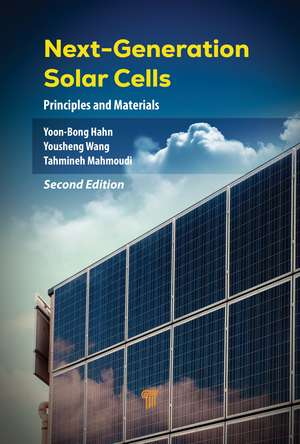
Next-Generation Solar Cells: Principles and Materials (Second Edition)
Autor Yoon-Bong Hahn, Yousheng Wang, Tahmineh Mahmoudien Limba Engleză Hardback – 17 aug 2026
In this second edition, Chapter 13, Next-Generation Photovoltaics for Indoor Energy Harvesting, has been added, which thoroughly examines indoor photovoltaic (IPV) technologies and presents a comparative analysis of established systems, such as amorphous silicon, III-V, CdTe, and CIGS solar cells, as well as emerging alternatives, including organic, dye-sensitized, and perovskite solar cells. In addition to this chapter, solutions to the problems given in each chapter have also been included in this edition.
Preț: 1402.23 lei
Preț vechi: 1710.03 lei
-18% Nou
Puncte Express: 2103
Carte tipărită la comandă
Livrare economică 07-21 decembrie
Livrare prin curier în România Termenul estimat este afișat lângă disponibilitate.
Transport gratuit pentru acest produs Plată online sau ramburs, în funcție de opțiunile comenzii.
Retur gratuit în 14 zile Comandă securizată și suport în română.
Specificații
ISBN-13: 9789815352177
ISBN-10: 9815352172
Pagini: 420
Ilustrații: 113
Dimensiuni: 152 x 229 mm
Greutate: 0.94 kg
Ediția:2
Editura: Jenny Stanford Publishing
Colecția Jenny Stanford Publishing
ISBN-10: 9815352172
Pagini: 420
Ilustrații: 113
Dimensiuni: 152 x 229 mm
Greutate: 0.94 kg
Ediția:2
Editura: Jenny Stanford Publishing
Colecția Jenny Stanford Publishing
Public țintă
Academic and PostgraduateRecenzii
“This book is a comprehensive and authoritative guide to the latest advancements in solar cell research and related technologies. Impressively, it not only enters into all the important details determining device functionality from both a materials science and a device engineering point of view, but also offers a synthetic but clear description of the main techniques applied for full device characterization, which is essentially an important step in understanding the interdisciplinary field sufficiently. Overall, it is an unmissable volume in the library of a scientist working in the broad field of photovoltaic technologies, grounding on the past, with an open and inspired eye to the future of these essential devices.”
Prof. Alberto Vomiero
Luleå University of Technology, Sweden
“This book releases at a time when the need for a sustainable energy transition is of great importance toward reaching net zero goals. While solar energy will be at the forefront of this drive, the book covers most of the materials technologies that will be key for next-generation devices to be considered. Materials, concepts, devices, and architectures, including characterization techniques are covered in detail, which should be essential reading for graduate courses and researchers in the field.”
Prof. S. Ravi P. Silva
Advanced Technology Institute, University of Surrey, UK
Prof. Alberto Vomiero
Luleå University of Technology, Sweden
“This book releases at a time when the need for a sustainable energy transition is of great importance toward reaching net zero goals. While solar energy will be at the forefront of this drive, the book covers most of the materials technologies that will be key for next-generation devices to be considered. Materials, concepts, devices, and architectures, including characterization techniques are covered in detail, which should be essential reading for graduate courses and researchers in the field.”
Prof. S. Ravi P. Silva
Advanced Technology Institute, University of Surrey, UK
Cuprins
1. Electromagnetic Radiation 2. Physics and Properties of Semiconductors 3. Working Principles and Limitations of Solar Cells 4. Generations of Solar Cells 5. Organic Solar Cells 6. Quantum Dot Solar Cells 7. Organic-Inorganic Hybrid Solar Cells 8. Perovskite Solar Cells 9. Structures, Transport Materials, and Deposition Methods for Perovskite Solar Cells 10. Defects and Ions Migration in Perovskite Solar Cells 11. Quantum Dots, Tandem, and Lead-Free Perovskite Solar Cells 12. Composites-Based Efficient and Stable Perovskite Solar Cells with Interface Engineering 13. Next-Generation Photovoltaics for Indoor Energy Harvesting 14. Characterization of Solar Cell Materials and Devices
Notă biografică
Yoon-Bong Hahn is a Distinguished Professor Emeritus at Jeonbuk National University (JBNU), South Korea, an EMNI Research Fellow, and a Fellow member of the Korean Academy of Science and Technology (KAST), the American Ceramic Society (ACerS), and the International Association of Advanced Materials (IAAM). He worked for LG Metals Research Center before joining JBNU in 1991. His research focuses on the synthesis of metal oxides and graphene-based functional nanomaterials and their applications for solar cells, sensors, and printed electronics. He was recognized as the World’s Top 2% Scientists by Stanford/Elsevier in 2020–2025 and as Top 100 Scientists by the International Biography Center (IBC), UK in 2005, 2011, 2014, and 2015.
Yousheng Wang is an associate professor at the Institute of New Energy Technology, Jinan University, China. He received his MS and PhD in semiconductor and chemical engineering from JBNU, where he later became a postdoctoral fellow. His research focuses on the development of hybrid perovskite composites and their applications for next-generation solar cells, including tandems and indoor photovoltaics.
Tahmineh Mahmoudi is a research scientist at the Department of Chemistry and Environmental Science, RMIT University, Australia. She received her PhD in semiconductor and chemical engineering from JBNU. Her research focuses on metal oxides and graphene-based materials and their applications for hybrid and perovskite solar cells.
Yousheng Wang is an associate professor at the Institute of New Energy Technology, Jinan University, China. He received his MS and PhD in semiconductor and chemical engineering from JBNU, where he later became a postdoctoral fellow. His research focuses on the development of hybrid perovskite composites and their applications for next-generation solar cells, including tandems and indoor photovoltaics.
Tahmineh Mahmoudi is a research scientist at the Department of Chemistry and Environmental Science, RMIT University, Australia. She received her PhD in semiconductor and chemical engineering from JBNU. Her research focuses on metal oxides and graphene-based materials and their applications for hybrid and perovskite solar cells.
Descriere
This book addresses the principles and materials for the development of next-generation solar cells for a sustainable global society. This book targets advanced undergraduate- and graduate-level students, researchers, and everyone with an interest in next-generation solar cells.