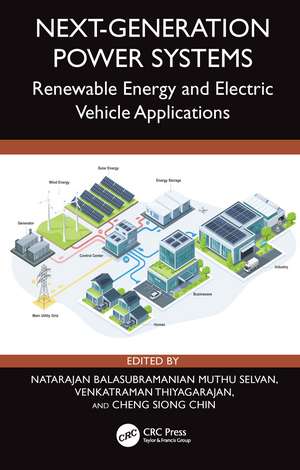
Next-Generation Power Systems: Renewable Energy and Electric Vehicle Applications
Editat de Natarajan Balasubramanian Muthu Selvan, Venkatraman Thiyagarajan, Cheng Siong Chinen Limba Engleză Hardback – 24 aug 2026
Features:
- Extensive Understanding: Offers each section of this book as a series of correlated, self‑contained tutorials
- Application‑Oriented Approach: Mixes basic and advanced analytical material with business logic, case studies, and real‑life applications relevant to industry
- Focus on Disruptive Technologies: Discusses hot topics such as vehicle‑to‑grid (V2G), microgrids, smart charging, digitization, and AI‑based energy management
- Power System Challenges Tackled: Addresses grid stability, power quality, protection, reliability, and standards in high renewable and EV penetration scenarios
- Academic and Industry Relevance: Is appropriate for undergraduate and graduate classes and is used as a reference book for researchers, engineers, and policymakers
Preț: 1023.10 lei
Preț vechi: 1247.68 lei
-18% Nou
Puncte Express: 1535
Carte tipărită la comandă
Livrare economică 07-21 decembrie
Livrare prin curier în România Termenul estimat este afișat lângă disponibilitate.
Transport gratuit pentru acest produs Plată online sau ramburs, în funcție de opțiunile comenzii.
Retur gratuit în 14 zile Comandă securizată și suport în română.
Specificații
ISBN-13: 9781032950778
ISBN-10: 1032950773
Pagini: 531
Ilustrații: 816
Dimensiuni: 156 x 234 mm
Greutate: 0.92 kg
Ediția:1
Editura: CRC Press
Colecția CRC Press
ISBN-10: 1032950773
Pagini: 531
Ilustrații: 816
Dimensiuni: 156 x 234 mm
Greutate: 0.92 kg
Ediția:1
Editura: CRC Press
Colecția CRC Press
Public țintă
General and PostgraduateNotă biografică
Natarajan Balasubramanian Muthu Selvan is an Associate Professor in the Department of Electrical and Electronics Engineering at Sri Sivasubramaniya Nadar College of Engineering (SSN), Chennai, with more than 20 years of teaching experience and over 10 years of dedicated research in the area of power system optimization. Prior to joining SSN, he served at Karunya Institute of Technology and Sciences, Coimbatore, during 2004–2005. He obtained his B.E. (EEE – Distinction) in 2000 and M.B.A. (Finance) in 2002 from Madurai Kamaraj University, followed by an M.E. in 2004 and a Ph.D. in 2013 in Power System Engineering from Anna University, Chennai. His primary research interests include power system optimization, applications of power electronic controllers in power systems, and renewable energy systems. During his doctoral research, he developed enhanced Particle Swarm Optimization algorithms using Gaussian and Cauchy distributions for solving complex power system optimization problems. His Ph.D. thesis was highly commended by eminent examiners from IISc Bangalore and IIT Madras. Dr. Muthu Selvan has published more than 30 research papers in refereed international journals and over 40 papers in national and international conference proceedings. He is a recognized Ph.D. supervisor at Anna University and has successfully guided four doctoral scholars in the areas of power electronics and power systems. He has received a funded research grant of ₹5.5 lakhs from SSN Trust for the project on real-time deep learning–based swarm intelligence. He is a Senior Member of IEEE, Life Member of ISTE, Fellow of the Institution of Engineers (India), and a Chartered Engineer. He has received prestigious professional awards, organized several conferences and AICTE-sponsored programs, delivered keynote lectures, and actively serves as a reviewer for international journals and technical publications.
Venkatraman Thiyagarajan, Associate Professor in the Department of Electrical and Electronics Engineering, Sri Sivasubramaniya Nadar College of Engineering, Chennai, has about 15 years of teaching experience. He received his B.E. degree in Electrical and Electronics Engineering with distinction and M.E. degree in Power Systems Engineering with distinction from Anna University, Chennai. He received his Ph.D. degree from the Division of Power System Engineering, College of Engineering Guindy (CEG), Anna University, Chennai. He has published 45 research papers in refereed international journals and 75 research papers in the proceedings of various international conferences. He has coordinated and organized various national‑level workshops and international conferences. He has received several best paper awards for his research papers at various international conferences. He is a recognized supervisor for Anna University. His areas of research include Power Converters, Stability, and Control of Electric Power Grids, Renewable Energy Systems, and Microgrid. He is the reviewer for many international journals. He is a senior member of The Institute of Electrical and Electronics Engineers and a member of The Institution of Engineers, India.
Cheng Siong Chin is a Chair Professor in Intelligent Systems Modelling and Simulation at Newcastle University and an Adjunct Professor at Chongqing University, School of Automotive Engineering. He received his Ph.D. in Applied Control Engineering at Research Robotics Centre at Nanyang Technological University (NTU) in 2008 and his M.Sc. (Distinction) in Advanced Control and Systems Engineering from The University of Manchester in 2001. Before moving into academia, he worked in the consumer electronics industry for a few years. He obtained six Economic Development Board (EDB)‑Industrial Postgraduate Programme (IPP) and two Singapore Maritime Institute (SMI) grants from the Singapore government in intelligent systems design, simulation, and predictive analytics as a PI and Co‑PI. He has made more than 170 publications including 5 authored books, and has 2 Singapore Patent Applications and 3 US Patents. He also received DCASE2019 Judges’ Award in IEEE AASP Challenge on DCASE2019. He is an Associate Editor for IEEE Access Journal, Applied Artificial Intelligence, and IEEE Transportation Electrification Community (TEC) eNewsletter, and is an editorial board member of Electronics. He has served as General Chair, Keynote Speaker, Session Chair, and Technical Committee Member at numerous international conferences.
Venkatraman Thiyagarajan, Associate Professor in the Department of Electrical and Electronics Engineering, Sri Sivasubramaniya Nadar College of Engineering, Chennai, has about 15 years of teaching experience. He received his B.E. degree in Electrical and Electronics Engineering with distinction and M.E. degree in Power Systems Engineering with distinction from Anna University, Chennai. He received his Ph.D. degree from the Division of Power System Engineering, College of Engineering Guindy (CEG), Anna University, Chennai. He has published 45 research papers in refereed international journals and 75 research papers in the proceedings of various international conferences. He has coordinated and organized various national‑level workshops and international conferences. He has received several best paper awards for his research papers at various international conferences. He is a recognized supervisor for Anna University. His areas of research include Power Converters, Stability, and Control of Electric Power Grids, Renewable Energy Systems, and Microgrid. He is the reviewer for many international journals. He is a senior member of The Institute of Electrical and Electronics Engineers and a member of The Institution of Engineers, India.
Cheng Siong Chin is a Chair Professor in Intelligent Systems Modelling and Simulation at Newcastle University and an Adjunct Professor at Chongqing University, School of Automotive Engineering. He received his Ph.D. in Applied Control Engineering at Research Robotics Centre at Nanyang Technological University (NTU) in 2008 and his M.Sc. (Distinction) in Advanced Control and Systems Engineering from The University of Manchester in 2001. Before moving into academia, he worked in the consumer electronics industry for a few years. He obtained six Economic Development Board (EDB)‑Industrial Postgraduate Programme (IPP) and two Singapore Maritime Institute (SMI) grants from the Singapore government in intelligent systems design, simulation, and predictive analytics as a PI and Co‑PI. He has made more than 170 publications including 5 authored books, and has 2 Singapore Patent Applications and 3 US Patents. He also received DCASE2019 Judges’ Award in IEEE AASP Challenge on DCASE2019. He is an Associate Editor for IEEE Access Journal, Applied Artificial Intelligence, and IEEE Transportation Electrification Community (TEC) eNewsletter, and is an editorial board member of Electronics. He has served as General Chair, Keynote Speaker, Session Chair, and Technical Committee Member at numerous international conferences.
Cuprins
1. Introduction to Electric Vehicles and Renewable Energy Integration in Power Systems: Obstacles, Advancements, and Prospects 2. DC-DC Converter Design and Motor Selection for Electric Vehicle Applications 3. A Cascaded Quadratic Boost DC-DC Converter for Renewable Energy Integration 4. Low Switch Count Multilevel Inverter Topologies for Electric Vehicle Traction Inverters 5. Advanced Power Electronic Converters for Power System Applications 6. Energy Storage Systems in Renewable Energy Grids 7. Smart Grids and Next-Generation Power System Architectures 8. Demand-Side Management Strategies for Intelligent Energy Systems 9. Hybrid Deep Learning and Fuzzy Logic Approaches for Improved Wind Energy Forecasting 10. Integrating Robotics with Renewable Energy: Innovations, Challenges, and Future Trends 11. Cutting-Edge Renewable Energy Technologies for Power Systems 12. Comparative Analysis of AC and DC Electric Vehicle Charging Systems with Renewable Energy Integration 13. Power System Planning for Electric Vehicles 14. Battery Management Systems for Electric Vehicles 15. Green Energy-Driven Transportation Infrastructure for Fuel Cell Hydrogen Electric Vehicles 16. IIoT and Digital Twin Technologies to Improve Energy Efficiency and Lower Carbon Footprint 17. Power System Planning for electric Vehicles: Design analysis and Testing of Electric Powertrain for Electric Vehicles
Descriere
Next-Generation Power Systems: Renewable Energy and Electric Vehicle Applications is a comprehensive resource that addresses emerging issues facing the power system industry in their drive toward more sustainable, reliable, and flexible power generation.