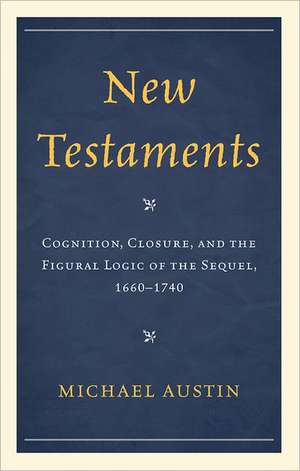
New Testaments: Cognition, Closure, and the Figural Logic of the Sequel, 1660–1740
Autor Michael Austinen Limba Engleză Hardback – 17 noi 2011
Preț: 524.64 lei
Preț vechi: 815.59 lei
-36%
Puncte Express: 787
Carte tipărită la comandă
Livrare economică 07-21 decembrie
Livrare prin curier în România Termenul estimat este afișat lângă disponibilitate.
Transport gratuit pentru acest produs Plată online sau ramburs, în funcție de opțiunile comenzii.
Retur gratuit în 14 zile Comandă securizată și suport în română.
Specificații
ISBN-13: 9781611493641
ISBN-10: 1611493641
Pagini: 180
Dimensiuni: 161 x 241 x 17 mm
Greutate: 0.4 kg
Editura: Bloomsbury Publishing
Colecția University of Delaware Press
Locul publicării:New York, United States
ISBN-10: 1611493641
Pagini: 180
Dimensiuni: 161 x 241 x 17 mm
Greutate: 0.4 kg
Editura: Bloomsbury Publishing
Colecția University of Delaware Press
Locul publicării:New York, United States
Cuprins
Acknowledgments
Introduction
Chapter 1: Narrative Closure as a Cognitive Problem
Chapter 2: God's Sequel
Chapter 3: "His Great Duel, Not of Arms": Davidic Typologyand Rhetorical Combat in Paradise Regained
Chapter 4: The Figural Logic of the Sequel and the Unity of The Pilgrim's Progress
Chapter 5: "Jesting with the Truth": Figura, Trace, and theBoundaries of Fiction in Robinson Crusoe and its Sequels
Chapter 6: Everybody's Story: Pamela as Type
Conclusion
End Notes
Works Cited
Introduction
Chapter 1: Narrative Closure as a Cognitive Problem
Chapter 2: God's Sequel
Chapter 3: "His Great Duel, Not of Arms": Davidic Typologyand Rhetorical Combat in Paradise Regained
Chapter 4: The Figural Logic of the Sequel and the Unity of The Pilgrim's Progress
Chapter 5: "Jesting with the Truth": Figura, Trace, and theBoundaries of Fiction in Robinson Crusoe and its Sequels
Chapter 6: Everybody's Story: Pamela as Type
Conclusion
End Notes
Works Cited