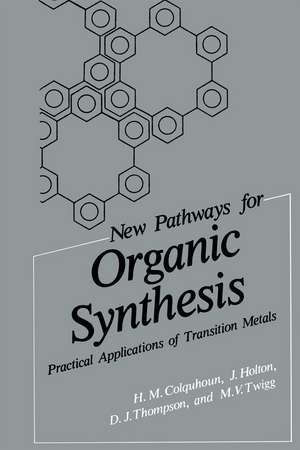
New Pathways for Organic Synthesis
Autor H. M. Colquhoun, J. Holton, D. J. Thompson, M. V. Twiggen Limba Engleză Paperback – oct 2011
Preț: 385.21 lei
Puncte Express: 578
Carte tipărită la comandă
Livrare economică 19 noiembrie-03 decembrie
Livrare prin curier în România Termenul estimat este afișat lângă disponibilitate.
Transport gratuit de la 400.00 lei Plată online sau ramburs, în funcție de opțiunile comenzii.
Retur gratuit în 14 zile Comandă securizată și suport în română.
Specificații
ISBN-13: 9781461296539
ISBN-10: 1461296536
Pagini: 472
Ilustrații: 468 p.
Dimensiuni: 152 x 229 x 26 mm
Greutate: 0.68 kg
Ediția:Softcover reprint of the original 1st ed. 1984
Editura: Springer
Locul publicării:New York, NY, United States
ISBN-10: 1461296536
Pagini: 472
Ilustrații: 468 p.
Dimensiuni: 152 x 229 x 26 mm
Greutate: 0.68 kg
Ediția:Softcover reprint of the original 1st ed. 1984
Editura: Springer
Locul publicării:New York, NY, United States
V-ar putea interesa
-
 -18%Preț: 1274.70 lei1554.51 lei
 -
 -18%Preț: 1270.88 lei1549.86 lei
 -
 CarbonylationH. M. Colquhoun-18%Preț: 917.99 lei1119.50 lei
 -
 -18%Preț: 1272.58 lei1551.92 lei
 -
 PolyampholytesSarkyt E. Kudaibergenov-15%Preț: 666.59 lei784.23 lei
 -
 Kinetics of Catalytic ReactionsM. Albert Vannice-15%Preț: 664.47 lei781.73 lei
 -
 Mechanical CatalysisGerhard Swiegers-9%Preț: 841.20 lei924.40 lei
 -
 Soft Mechanochemical SynthesisG. V. Avvakumov-15%Preț: 662.05 lei778.88 lei
 -
 Preț: 374.51 lei
 -
 Preț: 385.96 lei
 -
 Surface and Nanomolecular CatalysisRyan Richards-18%Preț: 1709.57 lei2084.84 lei
Public țintă
ResearchCuprins
1. Introduction.- 2. Formation of Carbon—Carbon Bonds.- 2.1. Formation of Carbon—Carbon Single Bonds.- 2.2. Formation of Carbon—Carbon Double Bonds.- 3. Formation of Carbocyclic Compounds.- 3.1. Introduction.- 3.2. Formation of Three-Membered Rings.- 3.3. Formation of Four-Membered Rings.- 3.4. Formation of Five-Membered Rings.- 3.5. Formation of Six-Membered Rings.- 3.6. Formation of Seven-Membered Rings.- 3.7. Formation of Eight-Membered Rings.- 3.8. Formation of Large Rings (?9).- 4. Formation of Heterocyclic Compounds.- 4.1. Introduction.- 4.2. Nitrogen Heterocycles.- 4.3. Oxygen Heterocycles.- 4.4. Sulfur Heterocycles.- 4.5. Cyclic Compounds Containing Two Hetero Atoms.- 5. Isomerization of Alkenes.- 5.1. Introduction.- 5.2. Thermodynamic Considerations.- 5.3. Isolation of Organometallic Intermediates.- 5.4. Mechanisms of Catalytic Alkene Isomerization.- 5.5. Formation of a,?-Unsaturated Compounds.- 5.6. Formation of Conjugated Dienes.- 5.7. Migration into Conjugation with Aromatic Rings.- 5.8. Formation of Aromatic Compounds—Isoaromatization.- 6. Direct Introduction and Removal of Carbonyl Groups.- 6.1. Preliminaries.- 6.2. Preparation of Carboxylic Acids, Esters, and Related Derivatives.- 6.3. Preparation of Aldehydes.- 6.4. Preparation of Ketones.- 6.5. Preparation of Isocyanates.- 6.6. Decarbonylation of Aldehydes and Acyl Halides.- 7. Reduction.- 7.1. Introduction.- 7.2. Reduction of Triple Bonds.- 7.3. Reduction of Double Bonds (Nonaromatic).- 7.4. Reduction of Aromatic Systems.- 7.5. Reduction of Carbonyl Groups.- 7.6. Reduction of Nitro, Nitrile, and Other Nitrogen-Containing Functional Groups.- 7.7. Asymmetric Hydrogenation.- 7.8. Hydrogenolysis.- 8. Oxidation.- 8.1. Formation of Alcohols.- 8.2. Formation of 1,2 Diols and Amino Alcohols.- 8.3.Acetoxylation.- 8.4. Epoxidation.- 8.5. Formation of Aldehydes and Ketones.- 8.6. Formation of Acids.- 8.7. Formation of Esters.- 8.8. Dehydrogenation.- 9. Preparing and Handling Transition Metal Catalysts.- 9.1. Introduction.- 9.2. Preparation of Catalysts.- 9.3. Metal Acetylacetonates.- 9.4. Arene Metal Tricarbonyls—ArM(CO)3 (M = Cr, Mo, or W).- 9.5. Transition Metal Carbonyls.- 9.6. Recovery of Precious Metals.- 9.7. Handling Air-Sensitive Compounds.- References.- Compound Index.