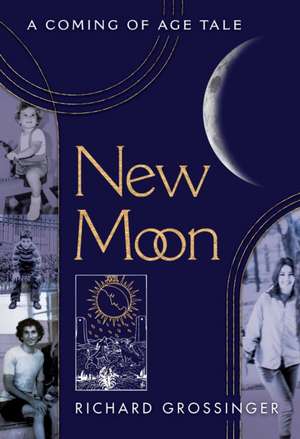
New Moon
Autor Richard Grossingeren Limba Engleză Paperback – 11 mar 2027
• Traces a timeline of 1944–1965 to show the author’s growth from elementary school to college while concretely mapping his psychological development
• Explains how Freudian analysis, Jungian reading, dream interpretation, and tarot divination help decode fear, alienation, and trauma
• Situates family conflict, camp life, baseball, and the threat of nuclear war as laboratories for identity development, spirituality, and social awareness
New Moon is an autobiographical novel that tracks the “enchantments” through which one passes in a life. It begins with Richard Grossinger’s 1950s American childhood (board games, candy bars, cherished toys, baseball) and is followed by his New York school daze (grade school at P.S. 6, "group" in Central Park, Freudian psychoanalysis, Grossinger’s Hotel in the Catskills, Color War at Camp Chipinaw, and ’50s rock ’n’ roll).
Then comes the watershed of his early 1960s adolescence (prep school at Horace Mann, creative writing, teen dating, the mysteries of tarot and divination), culminating in mid-sixties initiation (college at Amherst, spiritual and political baptisms, nascent romance, the beginnings of confronting the shadow, and the onset of adult life).
By presenting coming of age as a series of enchantments that break and re-form over time, New Moon offers you a model for reviewing your own childhood, individuation, and spiritual quest as a single, continuous path.
Preț: 190.46 lei
Preț vechi: 345.75 lei
-45% Precomandă
Puncte Express: 286
Carte nepublicată încă
Livrare prin curier în România Precomanda se expediază când titlul devine disponibil.
Transport gratuit de la 400.00 lei Plată online sau ramburs, în funcție de opțiunile comenzii.
Retur gratuit în 14 zile Comandă securizată și suport în română.
Doresc să fiu notificat când acest titlu va fi disponibil:
Se trimite...
Specificații
ISBN-13: 9798888506288
Pagini: 672
Ilustrații: 16 b&w illustrations
Dimensiuni: 165 x 241 mm
Greutate: 0.73 kg
Ediția:3rd Edition, Revised and Expanded Edition
Editura: Inner Traditions/Bear & Company
Colecția Park Street Press
Pagini: 672
Ilustrații: 16 b&w illustrations
Dimensiuni: 165 x 241 mm
Greutate: 0.73 kg
Ediția:3rd Edition, Revised and Expanded Edition
Editura: Inner Traditions/Bear & Company
Colecția Park Street Press
Notă biografică
Richard Grossinger is the curator of Sacred Planet Books at Inner Traditions and the cofounder and former publisher of North Atlantic Books with his wife, Lindy Hough. He holds a PhD in ecological anthropology and has written over 40 books on alternative medicine, cosmology, embryology, and consciousness, including Embryos, Galaxies, and Sentient Beings; The Night Sky: Soul and Cosmos; and Bottoming Out the Universe. He lives in Portland, Maine.
Extras
THE BEGINNING OF TIME
My oldest memory is of seeing a blue Easter egg in a bush where branches met at the trunk. I had already found that one, but the man had rehidden it.
I came back clutching it as he laughed.
That chalky blue is anterior to my life.
But who was the man? Where was there a yard with such a bush?
In my first memory of ordinary time, Nanny stood in the alcove grinding oranges on a juice-maker. She had taken them from the icebox and placed them by the machine. She was cutting them in half and setting the halves, one by one, on a white spinning knob in a stationary steel bowl. I remember the knob as hard plastic, but that is a false memory. It was porcelain-coated metal like the era’s toilet bowls and sinks.
“This electric one is so much easier,” Nanny said. “It does all the work.” As she worked through her pile, she sang, a verse for every two drained oranges. “One, two, buckle my shoe. Three, four, open the door.”
When an orange’s flow shrank to a dribble, she tossed the flattened rind into a garbage can she had moved from under the sink. “Five, six, pick up sticks.” Then she sliced another.
“These are juice oranges, Valencias” she explained to the boy watching from his high-chair. “They have a bit of a bite, but you can eat and even section them, especially if you like sour tastes. And they make good juice. Navels are bred for eating, so they’re sweeter and their skin is smoother and brighter colored. They’re really too sweet to make juice.”
She probably thought that I didn’t understand, but I remember her words almost exactly to this day; they inform how I eat oranges and drink orange juice. Our oldest memories make the deepest impressions because the world is fresh. The brain stores them for the longest time.
“Seven, eight, lay them straight.” There were now two left by the juice-maker.
Out of her pitcher, which was nearly full, she poured juice through a small hand-held strainer into a glass with decal flowers. The strainer’s mesh caught most of the pits and pulp.
She set the glass in the highchair’s tray, holding it till I took it from her. I raised it to my mouth and sipped. As I drank the fresh-squeezed fruit, I trapped pulp bubbles with my tongue and burst them against the roof of my mouth. Orange taste flooded my mind. “Nine, ten, a big fat hen.”
A photograph of a downtown New York avenue in the autumn I was born shows pedestrians in shaggy topcoats descending to their knees or ankles. Men sport beige and brown fedoras, some with cloth ribbons where crown meets brim; women wear similar fedoras, a few with f lowers attached to their ribbons. Other women wear chaplets, bonnets, or pillboxes with veils. Men and women alike tilt their hats.
Automobiles resemble the cabriolets, roadsters, sedans, and coupes of the 1930s, especially their concession to Art Deco fashions. To the modern eye they look like mounted houses and domes on tires, spares bolted ornamentally to their rears. To a boy’s eye then they seemed like giant robotic beetles with twin monocles and mouth-like grills of chromed steel ready to vacuum up any inattentive pedestrians that get in their way.
Single- and double-decker buses and two-toned taxis, most of them bright lemon-yellow on top, clog commutes, but in the old vintage print they are shades of motionless gray.
My parents later claimed that I pointed to each car on the street and identified it: “Studeybager, Olds, Bluick, Dammler, Cadiyack, Delahee.” I lost the knowledge by age four.
Our ground-floor apartment faced Park Avenue on 95th Street. In the living room, I crawled on carpeting between stuffed chairs and tables and down the center aisle. At the room’s end stood bureaus with ivory figurines, flat goblets of colored oil and, above them, golden frames with etchings of long-whiskered dancing men.
My playbox had metal trucks and cars, crayons, rubber farm animals, stuffed clowns, donkey dolls, and pearly white shmoos—bottle-shaped creatures that opened to reveal one inside another inside another. Treasure balls bought at the florist unraveled with tiny plastic airplanes, jeweled rings, and other jacks-like prizes. (Originally made from the bones of animals, jacks and balls go back to the Paleolithic. I didn’t know that then, of course, but I loved disentangling pieces of penny junk from tightly wrapped yarn.)
Nanny slept in a corner of my room. She dressed me, made my food, set me down for naps, and put me to bed at night. She saw ghosts in the courtyard and germs everywhere. She sponged and mopped surfaces even after she had already cleaned them. She washed me repeatedly, then scrubbed me in the bathtub. She sang to spirits and cast evil eyes at strangers. She was a witch who loved me but a witch all the same.
In the afternoon I lay in my crib, waiting for her to come fetch me. I explored the contours of my chest and legs. My knees, feet, and elbows thrashed and snagged at quilt, blanket, and sheets. I chased and caught my balls in their tiny sack.
Along the crack between ceiling and wall I saw the crevice to another universe.
The animals on my quilt were loyal—Zebra, Tiger, and Bear. I animated them from underneath, causing them to tussle, then make nice, moving the covers with my hands and pressing creatures against each other. Then I rolled over into sleep.
I awoke babbling, the room drained to purple, the opera singer practicing in the courtyard. I pictured the lady on the cover of a record album, hands extended upward, gold shells on her forehead and dangling from her face and body, her eyes staring blankly. When I got older I saw that her name began with the impossible letters “Xt.” The same album was in my friends’ houses, and we called it “Voice of the Exabye.” (“Voice of Xtabay”—pronounced “iSh-tabai”—short “i”—was the Capital Release of Peruvian soprano Yma Sumac, famous for her vocal range.)
After naptime, I helped Nanny make dinner, unzipping the furry pods of lima beans and plunking pale green seeds, fat to tiny, into a pot. I delighted in their pings.
After dinner, Nanny put me in bed. Then another morning began another day.
Daddy wore brown suits and beat-up hats, smoked Camels, and worked at an advertising agency downtown. He sang in Hebrew, “Anakhnu modim. . . .” and “Shama Yisra-el.” I remember waiting the whole afternoon to see him, then breaking free of Nanny’s grip, running down the hall and throwing my arms around him as he came through the front door. He exclaimed in surprise, for it was the longest I had ever stayed on my feet, and hoisted me in the air. He smelled of other worlds and not our cloistral home.
One night, his taxi driver helped him carry a huge box into the dining room and set it by a wall. Daddy thanked the man and gave him a dollar. Then as we watched, he tore and unwound the cardboard and wriggled loose a standing cabinet. He pushed it against the wall. He opened the top of the cabinet and showed us a gramophone inside. From the bottom back of the cabinet he untied a cord with a plug and put its flat prongs into slits near the floor. “You are about to hear,” he announced, “the sounds of Columbia Records and RCA Victor.”
He undid the buckles on his briefcase and took out a record jacket—a cardboard envelope with a picture of a man on its cover. From the envelope he removed a tan sleeve with a record. He put the sleeve on a chair and clicked a nob; the victrola’s turntable began to spin rapidly—I know now it was 78 times a minute. He retrieved the sleeve and carefully slid a large black disk from it—records cracked as readily as eggshells then. He placed it on the gramophone’s turntable and lowered a tonearm into sound.
Many a year ago in old Sorrento
A certain ditty was quite the thing.
Whenever a mother rocked her baby in Sorrento
This little ditty she used to sing:
Then it got silly:
Chi-baba, Chi-baba, Chihuahua
Enjilava kooka la goomba
Chi-baba, Chi-baba, Chihuahua
My bambino go to sleep
“Perry Como,” Daddy said. “He knows how to belt out a ballad. Second only to Crosby and Sinatra.”
When the needle reached the end of the song, the speaker began to hiss, Daddy clicked off the turntable, removed the record, put it back in its sleeve, and replaced it. He re-started the spinning platform and set the needle on the outer rung of the disk. First there was music; then singers began:
“Cruising down the river / on a Sunday afternoon. . . .” I was transported; I had never heard such a beautiful song: “the one you love, / the sun above / waiting for the moon. . . .”
The sound joined this world to others; all you needed to do is change its syllables to a language of Toliman or the Pleiades, which are not as different as you might think. I don’t see (nor did I then) an ordinary river like the one on the jacket, but a cobblestone canal, its banks swarming with adults at a carnival. Through a gap in the song swam a giant turtle.
My oldest memory is of seeing a blue Easter egg in a bush where branches met at the trunk. I had already found that one, but the man had rehidden it.
I came back clutching it as he laughed.
That chalky blue is anterior to my life.
But who was the man? Where was there a yard with such a bush?
In my first memory of ordinary time, Nanny stood in the alcove grinding oranges on a juice-maker. She had taken them from the icebox and placed them by the machine. She was cutting them in half and setting the halves, one by one, on a white spinning knob in a stationary steel bowl. I remember the knob as hard plastic, but that is a false memory. It was porcelain-coated metal like the era’s toilet bowls and sinks.
“This electric one is so much easier,” Nanny said. “It does all the work.” As she worked through her pile, she sang, a verse for every two drained oranges. “One, two, buckle my shoe. Three, four, open the door.”
When an orange’s flow shrank to a dribble, she tossed the flattened rind into a garbage can she had moved from under the sink. “Five, six, pick up sticks.” Then she sliced another.
“These are juice oranges, Valencias” she explained to the boy watching from his high-chair. “They have a bit of a bite, but you can eat and even section them, especially if you like sour tastes. And they make good juice. Navels are bred for eating, so they’re sweeter and their skin is smoother and brighter colored. They’re really too sweet to make juice.”
She probably thought that I didn’t understand, but I remember her words almost exactly to this day; they inform how I eat oranges and drink orange juice. Our oldest memories make the deepest impressions because the world is fresh. The brain stores them for the longest time.
“Seven, eight, lay them straight.” There were now two left by the juice-maker.
Out of her pitcher, which was nearly full, she poured juice through a small hand-held strainer into a glass with decal flowers. The strainer’s mesh caught most of the pits and pulp.
She set the glass in the highchair’s tray, holding it till I took it from her. I raised it to my mouth and sipped. As I drank the fresh-squeezed fruit, I trapped pulp bubbles with my tongue and burst them against the roof of my mouth. Orange taste flooded my mind. “Nine, ten, a big fat hen.”
A photograph of a downtown New York avenue in the autumn I was born shows pedestrians in shaggy topcoats descending to their knees or ankles. Men sport beige and brown fedoras, some with cloth ribbons where crown meets brim; women wear similar fedoras, a few with f lowers attached to their ribbons. Other women wear chaplets, bonnets, or pillboxes with veils. Men and women alike tilt their hats.
Automobiles resemble the cabriolets, roadsters, sedans, and coupes of the 1930s, especially their concession to Art Deco fashions. To the modern eye they look like mounted houses and domes on tires, spares bolted ornamentally to their rears. To a boy’s eye then they seemed like giant robotic beetles with twin monocles and mouth-like grills of chromed steel ready to vacuum up any inattentive pedestrians that get in their way.
Single- and double-decker buses and two-toned taxis, most of them bright lemon-yellow on top, clog commutes, but in the old vintage print they are shades of motionless gray.
My parents later claimed that I pointed to each car on the street and identified it: “Studeybager, Olds, Bluick, Dammler, Cadiyack, Delahee.” I lost the knowledge by age four.
Our ground-floor apartment faced Park Avenue on 95th Street. In the living room, I crawled on carpeting between stuffed chairs and tables and down the center aisle. At the room’s end stood bureaus with ivory figurines, flat goblets of colored oil and, above them, golden frames with etchings of long-whiskered dancing men.
My playbox had metal trucks and cars, crayons, rubber farm animals, stuffed clowns, donkey dolls, and pearly white shmoos—bottle-shaped creatures that opened to reveal one inside another inside another. Treasure balls bought at the florist unraveled with tiny plastic airplanes, jeweled rings, and other jacks-like prizes. (Originally made from the bones of animals, jacks and balls go back to the Paleolithic. I didn’t know that then, of course, but I loved disentangling pieces of penny junk from tightly wrapped yarn.)
Nanny slept in a corner of my room. She dressed me, made my food, set me down for naps, and put me to bed at night. She saw ghosts in the courtyard and germs everywhere. She sponged and mopped surfaces even after she had already cleaned them. She washed me repeatedly, then scrubbed me in the bathtub. She sang to spirits and cast evil eyes at strangers. She was a witch who loved me but a witch all the same.
In the afternoon I lay in my crib, waiting for her to come fetch me. I explored the contours of my chest and legs. My knees, feet, and elbows thrashed and snagged at quilt, blanket, and sheets. I chased and caught my balls in their tiny sack.
Along the crack between ceiling and wall I saw the crevice to another universe.
The animals on my quilt were loyal—Zebra, Tiger, and Bear. I animated them from underneath, causing them to tussle, then make nice, moving the covers with my hands and pressing creatures against each other. Then I rolled over into sleep.
I awoke babbling, the room drained to purple, the opera singer practicing in the courtyard. I pictured the lady on the cover of a record album, hands extended upward, gold shells on her forehead and dangling from her face and body, her eyes staring blankly. When I got older I saw that her name began with the impossible letters “Xt.” The same album was in my friends’ houses, and we called it “Voice of the Exabye.” (“Voice of Xtabay”—pronounced “iSh-tabai”—short “i”—was the Capital Release of Peruvian soprano Yma Sumac, famous for her vocal range.)
After naptime, I helped Nanny make dinner, unzipping the furry pods of lima beans and plunking pale green seeds, fat to tiny, into a pot. I delighted in their pings.
After dinner, Nanny put me in bed. Then another morning began another day.
Daddy wore brown suits and beat-up hats, smoked Camels, and worked at an advertising agency downtown. He sang in Hebrew, “Anakhnu modim. . . .” and “Shama Yisra-el.” I remember waiting the whole afternoon to see him, then breaking free of Nanny’s grip, running down the hall and throwing my arms around him as he came through the front door. He exclaimed in surprise, for it was the longest I had ever stayed on my feet, and hoisted me in the air. He smelled of other worlds and not our cloistral home.
One night, his taxi driver helped him carry a huge box into the dining room and set it by a wall. Daddy thanked the man and gave him a dollar. Then as we watched, he tore and unwound the cardboard and wriggled loose a standing cabinet. He pushed it against the wall. He opened the top of the cabinet and showed us a gramophone inside. From the bottom back of the cabinet he untied a cord with a plug and put its flat prongs into slits near the floor. “You are about to hear,” he announced, “the sounds of Columbia Records and RCA Victor.”
He undid the buckles on his briefcase and took out a record jacket—a cardboard envelope with a picture of a man on its cover. From the envelope he removed a tan sleeve with a record. He put the sleeve on a chair and clicked a nob; the victrola’s turntable began to spin rapidly—I know now it was 78 times a minute. He retrieved the sleeve and carefully slid a large black disk from it—records cracked as readily as eggshells then. He placed it on the gramophone’s turntable and lowered a tonearm into sound.
Many a year ago in old Sorrento
A certain ditty was quite the thing.
Whenever a mother rocked her baby in Sorrento
This little ditty she used to sing:
Then it got silly:
Chi-baba, Chi-baba, Chihuahua
Enjilava kooka la goomba
Chi-baba, Chi-baba, Chihuahua
My bambino go to sleep
“Perry Como,” Daddy said. “He knows how to belt out a ballad. Second only to Crosby and Sinatra.”
When the needle reached the end of the song, the speaker began to hiss, Daddy clicked off the turntable, removed the record, put it back in its sleeve, and replaced it. He re-started the spinning platform and set the needle on the outer rung of the disk. First there was music; then singers began:
“Cruising down the river / on a Sunday afternoon. . . .” I was transported; I had never heard such a beautiful song: “the one you love, / the sun above / waiting for the moon. . . .”
The sound joined this world to others; all you needed to do is change its syllables to a language of Toliman or the Pleiades, which are not as different as you might think. I don’t see (nor did I then) an ordinary river like the one on the jacket, but a cobblestone canal, its banks swarming with adults at a carnival. Through a gap in the song swam a giant turtle.
Cuprins
Acknowledgments
Introduction to the Third Edition: From Teen Trope
to Lunation Fable
The 1996 Edition: Blurbs from Fellow Authors
and Excerpts from Reviews
The 2016 Edition: Facebook Reviews
Part One: The Child in the City (1944–1954)
1 The Beginning of Time
2 P.S. 6 and Bill-Dave
3 Dr. Fabian
4 Camaraderie
5 Camp Chipinaw
6 Grossinger’s
7 Riddles and Clues
8 Antipodes
9 Sorcery
Part Two: Latency (1954–1956)
1 Color War
2 The Clue in the Embers
Part Three: The Kid from Grossinger’s (1956–1960)
1 Horace Mann
2 Dr. Friend
3 Please Don’t Leave the Party Yet
4 Adolescence
Part Four: Teenager in Love (1960–1962)
1 Witnessing
2 Androgyny
3 Moon River
4 Graduation
5 Teen Tour
Part Five: Initiation (September 1962–April 1964)
1 Amherst
2 Helene
3 Phi Psi
4 The Rainbow
Part Six: The Ceremony (April 1964–June 1965)
1 The Panic
2 The Tarot
3 Halloween
4 Kelly
5 Why Can’t It Be Like This All The Time?
Part Seven: New Moon (June 1965–November 1965)
1 Aspen
2 Angels
Introduction to the Third Edition: From Teen Trope
to Lunation Fable
The 1996 Edition: Blurbs from Fellow Authors
and Excerpts from Reviews
The 2016 Edition: Facebook Reviews
Part One: The Child in the City (1944–1954)
1 The Beginning of Time
2 P.S. 6 and Bill-Dave
3 Dr. Fabian
4 Camaraderie
5 Camp Chipinaw
6 Grossinger’s
7 Riddles and Clues
8 Antipodes
9 Sorcery
Part Two: Latency (1954–1956)
1 Color War
2 The Clue in the Embers
Part Three: The Kid from Grossinger’s (1956–1960)
1 Horace Mann
2 Dr. Friend
3 Please Don’t Leave the Party Yet
4 Adolescence
Part Four: Teenager in Love (1960–1962)
1 Witnessing
2 Androgyny
3 Moon River
4 Graduation
5 Teen Tour
Part Five: Initiation (September 1962–April 1964)
1 Amherst
2 Helene
3 Phi Psi
4 The Rainbow
Part Six: The Ceremony (April 1964–June 1965)
1 The Panic
2 The Tarot
3 Halloween
4 Kelly
5 Why Can’t It Be Like This All The Time?
Part Seven: New Moon (June 1965–November 1965)
1 Aspen
2 Angels
Recenzii
“This is a strong, deeply moving book. I can’t think of another example in which the details and particularities of childhood have been evoked so fully, with such painstaking care and precision.”
“Using the haunted lives which inhabited the famous Katskills resort as a backdrop, Richard Grossinger writes a brilliant novel about a young man’s passage into adulthood. New Moon is a departure for the Jewish-American novel as well—no longer obsessed with Old World issues and not finding solace in the illusion of an American Promised Land.”
“New Moon is something new under the sun, a real psychoanalytic autobiography.”
“A memoir of baseball, high school, and Jewish New York in the ’50s, New Moon is also a portrait of a defenseless consciousness uncovering itself and the world simultaneously. The spellbinding prose and terrifying intimacy of Richard Grossinger’s book puts it, for me, in the company of Frederick Exley’s A Fan’s Notes and Annie Dillard’s An American Childhood. An unforgettable reading experience.”
“In this remarkably courageous and unsparing self-examination, Richard Grossinger explores the labyrinths of panic and fear that lay beneath the Paradise-like surface of a privileged childhood. Part magic, part myth, part dream, part prayer, New Moon is a liquid mirror that leads straight to the depths of the unconscious.”
“At once a memoir, an account of psychoanalysis, and a both savage and loving account of New York in the ’50s, New Moon is a work with many layers and a unique tone, reminiscent of Robert Musil’s A Man Without Qualities in its blend of analytical realism, melancholia, and acute psychoanalytic and philosophical penetration.”
“A strange and remarkable self-evaluation in the form of a novel—illuminating, tender, moving, evocative . . . any number of adjectives of praise would be appropriate.”
“Since the days when I depended on the magazine Io to expand and verify a lot of what I was beginning to learn of the deep dark universe, I have found Richard Grossinger’s empirical analysis of American Culture unerring. New Moon, a memoir of Grossinger’s early life, starts out in the Land of Giants and emerges onto 5th Avenue, the mainstreet of Metropolis. In its observational acuity it is great anthropology—as a tale of growing it is strangely charming and funny and scary.”
“Using the haunted lives which inhabited the famous Katskills resort as a backdrop, Richard Grossinger writes a brilliant novel about a young man’s passage into adulthood. New Moon is a departure for the Jewish-American novel as well—no longer obsessed with Old World issues and not finding solace in the illusion of an American Promised Land.”
“New Moon is something new under the sun, a real psychoanalytic autobiography.”
“A memoir of baseball, high school, and Jewish New York in the ’50s, New Moon is also a portrait of a defenseless consciousness uncovering itself and the world simultaneously. The spellbinding prose and terrifying intimacy of Richard Grossinger’s book puts it, for me, in the company of Frederick Exley’s A Fan’s Notes and Annie Dillard’s An American Childhood. An unforgettable reading experience.”
“In this remarkably courageous and unsparing self-examination, Richard Grossinger explores the labyrinths of panic and fear that lay beneath the Paradise-like surface of a privileged childhood. Part magic, part myth, part dream, part prayer, New Moon is a liquid mirror that leads straight to the depths of the unconscious.”
“At once a memoir, an account of psychoanalysis, and a both savage and loving account of New York in the ’50s, New Moon is a work with many layers and a unique tone, reminiscent of Robert Musil’s A Man Without Qualities in its blend of analytical realism, melancholia, and acute psychoanalytic and philosophical penetration.”
“A strange and remarkable self-evaluation in the form of a novel—illuminating, tender, moving, evocative . . . any number of adjectives of praise would be appropriate.”
“Since the days when I depended on the magazine Io to expand and verify a lot of what I was beginning to learn of the deep dark universe, I have found Richard Grossinger’s empirical analysis of American Culture unerring. New Moon, a memoir of Grossinger’s early life, starts out in the Land of Giants and emerges onto 5th Avenue, the mainstreet of Metropolis. In its observational acuity it is great anthropology—as a tale of growing it is strangely charming and funny and scary.”
Descriere
A coming-of-age memoir linking Freudian analysis, New York City, and esoteric practice across the fifties and sixties