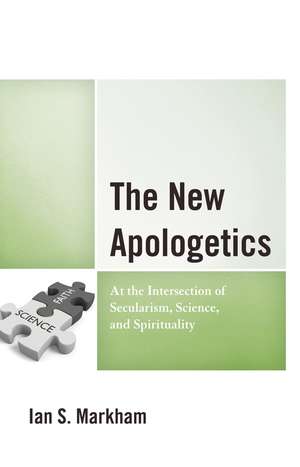
The New Apologetics: At the Intersection of Secularism, Science, and Spirituality
Autor Ian S. Markhamen Limba Engleză Hardback – 27 mar 2020
| Toate formatele și edițiile | Preț | Express |
|---|---|---|
| Paperback (1) | 244.61 lei 6-8 săpt. | |
| Bloomsbury Publishing – 11 noi 2022 | 244.61 lei 6-8 săpt. | |
| Hardback (1) | 696.89 lei 6-8 săpt. | |
| Bloomsbury Publishing – 27 mar 2020 | 696.89 lei 6-8 săpt. |
Preț: 696.89 lei
Preț vechi: 849.87 lei
-18%
Puncte Express: 1045
Preț estimativ în valută:
123.33€ • 144.14$ • 107.08£
123.33€ • 144.14$ • 107.08£
Carte tipărită la comandă
Livrare economică 19 februarie-05 martie
Preluare comenzi: 021 569.72.76
Specificații
ISBN-13: 9781978711341
ISBN-10: 1978711344
Pagini: 256
Dimensiuni: 161 x 228 x 23 mm
Greutate: 0.52 kg
Editura: Bloomsbury Publishing
Colecția Fortress Academic
Locul publicării:New York, United States
ISBN-10: 1978711344
Pagini: 256
Dimensiuni: 161 x 228 x 23 mm
Greutate: 0.52 kg
Editura: Bloomsbury Publishing
Colecția Fortress Academic
Locul publicării:New York, United States
Cuprins
A Thought Exercise
1. Living in the Shadow of Deism
2. Superstition: The Concept and the Weapon
3. A Spiritually Infused Universe
4. The Necessary Prolegomenon: The Legitimacy of Trust
5. The Incarnation and the Trinity: Theological Reasoning in the Christian Tradition
6. Sacramentality: The Basis
7. Apostolic Succession: The Authority
8. Angels and the Communion of Saints
9. Inclusion, Justice, and the New Apologetics: Objections and Replies
Concluding Reflections
1. Living in the Shadow of Deism
2. Superstition: The Concept and the Weapon
3. A Spiritually Infused Universe
4. The Necessary Prolegomenon: The Legitimacy of Trust
5. The Incarnation and the Trinity: Theological Reasoning in the Christian Tradition
6. Sacramentality: The Basis
7. Apostolic Succession: The Authority
8. Angels and the Communion of Saints
9. Inclusion, Justice, and the New Apologetics: Objections and Replies
Concluding Reflections
Recenzii
Ian Markham has a natural gift for writing fresh, engaging, and lively theology. His work is always pertinent for the churches and public theology, and in this brilliant book he focuses on the urgent task that faces apologetics in our age. With sciences and secularism seemingly in unassailable ascendancy, what is the future for spirituality, religion, and theology? Ian Markham marks out new terrain for the engagement of theologians, and in the process, stakes some striking new claims for faith that can form the basis for a renewed public theology. This is a fascinating book from one of the finest exponents of contextual public theology.
It is a real joy to read Ian Markham's ever charitable and ever clear prose as he pushes his readers to recognize that the 'mood' of modern skepticism depends on a mechanistic view of causality - a mechanistic view that the best of modern scientific writing has moved beyond. Once we see that this is so, then for Markham, we are free to-nay, compelled to- take seriously the rational and imaginative power of a universe infused with divine presence, populated by the angelic and by the communion of saints. The argument is striking and a first rate example of apologetics from the Anglican liberal tradition.
Markham takes an old theme - so often found in liberal theologies - and invests new life into every theme he examines. On almost every page he manages to consider an argument, or answer a question, with freshness and insight. Indeed, parts of this book are quite extraordinary, and always deeply provocative.
I am not sure I agree with everything he writes, but Markham has written a substantial, remarkably enjoyable study with genuine implications for how theological liberalism might continue to be relevant in the coming years.
Rev. Ian Markham presents an intriguing argument focused on a new approach to supporting Christianity. Specifically, his argument in favor of a spiritually-infused universe offers a different perspective on the connection between the fields of science and religion. As a science and religion scholar, I am pleased with how he carefully outlines the perceived conflict between these two fields and am optimistic that his argument could push this dialogue into a new and fruitful direction.
It is a real joy to read Ian Markham's ever charitable and ever clear prose as he pushes his readers to recognize that the 'mood' of modern skepticism depends on a mechanistic view of causality - a mechanistic view that the best of modern scientific writing has moved beyond. Once we see that this is so, then for Markham, we are free to-nay, compelled to- take seriously the rational and imaginative power of a universe infused with divine presence, populated by the angelic and by the communion of saints. The argument is striking and a first rate example of apologetics from the Anglican liberal tradition.
Markham takes an old theme - so often found in liberal theologies - and invests new life into every theme he examines. On almost every page he manages to consider an argument, or answer a question, with freshness and insight. Indeed, parts of this book are quite extraordinary, and always deeply provocative.
I am not sure I agree with everything he writes, but Markham has written a substantial, remarkably enjoyable study with genuine implications for how theological liberalism might continue to be relevant in the coming years.
Rev. Ian Markham presents an intriguing argument focused on a new approach to supporting Christianity. Specifically, his argument in favor of a spiritually-infused universe offers a different perspective on the connection between the fields of science and religion. As a science and religion scholar, I am pleased with how he carefully outlines the perceived conflict between these two fields and am optimistic that his argument could push this dialogue into a new and fruitful direction.