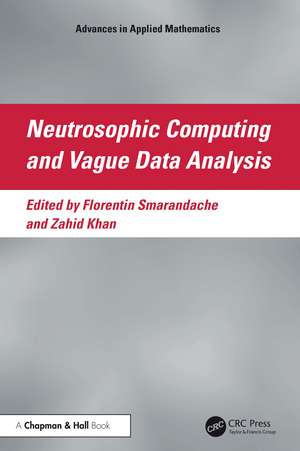
Neutrosophic Computing and Vague Data Analysis: Advances in Applied Mathematics
Editat de Florentin Smarandache, Zahid Khanen Limba Engleză Hardback – 7 iul 2026
The book highlights the limitations of traditional mathematical and statistical models in handling the complexity and uncertainty inherent in modern systems. While existing frameworks have contributed to uncertainty modeling, they often fail to treat indeterminacy as a distinct and independent component of information. Neutrosophic theory addresses this gap, providing a robust foundation for analyzing and optimizing systems characterized by indeterminacy.
Key Features:
- Computational Toolboxes: Practical tools for estimating unknown values, simulating results, and making decisions using neutrosophic models. These computational approaches enable practitioners to analyze systems that are too complex for traditional analytical methods.
- Applications across Disciplines: Detailed examples and case studies demonstrating the use of neutrosophic models in science, engineering, medical diagnostics, environmental modeling, economics, and decision-making under uncertainty.
- Accessibility and Adaptability: By focusing on computational approaches, the book aims to make neutrosophic theory more accessible and applicable to a wider audience, including researchers, practitioners, and students.
Din seria Advances in Applied Mathematics
- 9%
 Preț: 2021.28 lei
 - 8%
 Preț: 504.66 lei
 - 18%
 Preț: 900.57 lei
 - 18%
 Preț: 734.28 lei
 - 18%
 Preț: 734.28 lei
 - 18%
 Preț: 723.81 lei
 - 15%
 Preț: 485.34 lei
 - 18%
 Preț: 944.32 lei
 - 15%
 Preț: 630.34 lei
 - 15%
 Preț: 575.76 lei
 - 18%
 Preț: 1070.67 lei
 - 18%
 Preț: 1465.22 lei
 - 9%
 Preț: 977.87 lei
 - 15%
 Preț: 559.16 lei
 - 18%
 Preț: 853.65 lei
 - 15%
 Preț: 617.08 lei
 - 18%
 Preț: 890.63 lei
 - 18%
 Preț: 723.11 lei
 - 20%
 Preț: 618.96 lei
 - 18%
 Preț: 912.44 lei
 - 20%
 Preț: 484.86 lei
 - 15%
 Preț: 693.08 lei
 - 18%
 Preț: 780.31 lei
 - 18%
 Preț: 894.05 lei
 - 15%
 Preț: 615.38 lei
 - 18%
 Preț: 964.66 lei
 - 15%
 Preț: 488.59 lei
 - 15%
 Preț: 472.67 lei
 - 15%
 Preț: 694.89 lei
 - 18%
 Preț: 1073.49 lei
 - 8%
 Preț: 428.03 lei
 - 18%
 Preț: 981.07 lei
 - 18%
 Preț: 792.76 lei
 - 15%
 Preț: 468.72 lei
 - 18%
 Preț: 833.98 lei
 - 18%
 Preț: 732.89 lei
Preț: 809.99 lei
Preț vechi: 1071.35 lei
-24%
Puncte Express: 1215
Carte indisponibilă temporar
Doresc să fiu notificat când acest titlu va fi disponibil:
Se trimite...
Specificații
ISBN-13: 9781041162025
ISBN-10: 1041162022
Pagini: 358
Ilustrații: 68
Dimensiuni: 156 x 234 mm
Greutate: 0.82 kg
Ediția:1
Editura: CRC Press
Colecția Chapman and Hall/CRC
Seria Advances in Applied Mathematics
ISBN-10: 1041162022
Pagini: 358
Ilustrații: 68
Dimensiuni: 156 x 234 mm
Greutate: 0.82 kg
Ediția:1
Editura: CRC Press
Colecția Chapman and Hall/CRC
Seria Advances in Applied Mathematics
Public țintă
Postgraduate and Professional Practice & DevelopmentCuprins
1. Matrices of Neutrosophic Numbers: An Overview 2. A Computational Study of Neutrosophic Probability, with Focus on Risk Evaluation 3. Optimization Algorithms in Nonstandard Neutrosophic Environments: A Metaheuristic Approach 4. An Algebraic Approach to Interval-Valued Neutrosophic Oversets and Undersets 5. Neutrosophic Graph Rewriting as a Computational Model 6. A Novel Correlation Coefficient Between Single-Valued Neutrosophic Sets and Its Use in Renewable Energy Source Selection 7. Several Similarity Measures of Trigonometric Functions for Refined Neutrosophic Sets and Their Application in Medical Diagnosis 8. Enhancing Antiviral Drug Repurposing for Future Pandemics with a Linguistic Single-Valued Neutrosophic MAGDM Framework 9. Weighted Adjustable Level and Graded Utility Decision-Making Frameworks Based on Neutrosophic Soft Sets 10. Neutrosophic ISOCOV in Smart and Sustainable Material Selection 11. Latin Square Designs under Indeterminacy: Data Analysis and Applications 12. Neutrosophic Programming Approach for Mixed Allocations in Multivariate-Multiobjective Nonlinear Stratified Sampling Problem with Parabolic Fuzzy Numbers 13. A Neutrosophic Control Chart for the Conway-Maxwell-Poisson Distribution Using Multiple Dependent State Sampling 14. A Hierarchical Framework for Assessing Groundwater Quality Using Evidential Neutrosophic Tree Soft Sets 15. An Innovative Trapezoidal Neutrosophic CRADIS Algorithm Using Multiple-Attribute Group Decision-Making for Sharia Bank Branch Location Selection 16. A Novel Approach for the Shortest Path Computation in Networks Using Quadripartitioned Single-Valued Neutrosophic Refined Numbers
Notă biografică
Florentin Smarandache, PhD, PostDocs, is an Emeritus Professor of Mathematics at the University of New Mexico, United States. He earned his PhD in Mathematics from the State University of Kishinev, and Postdoctoral in Applied Mathematics from Okayama University of Sciences, Japan, and The Guangdong University of Technology, Guangzhou, China. He is the founder of neutrosophy (generalization of dialectics), neutrosophic set, logic, probability and statistics since 1995 and has published hundreds of papers and books on neutrosophic physics, superluminal and instantaneous physics, unmatter, quantum paradoxes, absolute theory of relativity, redshift and blueshift due to the medium gradient and refraction index besides the Doppler effect, paradoxism, outerart, neutrosophy as a new branch of philosophy, Law of Included Multiple-Middle, multispace and multistructure, HyperSoft set, TreeSoft Set, IndetermSoft Set and IndetermHyperSoft Set, SuperHyperGraph, SuperHyperTopology, SuperHyperAlgebra, SuperHyperFunction, Neutrosophic SuperHyperAlgebra, degree of dependence and independence between neutrosophic components, refined neutrosophic set, neutrosophic over-under-off-set, plithogenic set / logic / probability / statistics, symbolic plithogenic algebraic structures, neutrosophic triplet and duplet structures, quadruple neutrosophic structures, extension of algebraic structures to NeutroAlgebra and AntiAlgebra, NeutroGeometry and AntiGeometry, NeutroTopology and AntiTopology, Refined Neutrosophic Topology, Refined Neutrosophic Crisp Topology, Dezert-Smarandache Theory and so on in many peer-reviewed international journals publishers. Additionally he also presented papers and plenary lectures to many international conferences around the world.
Zahid Khan, PhD, is currently working as a scientific co-research fellow in the Department of Quantitative Methods at the University of Pannonia, Hungary. He holds a permanent position as an Associate Professor in the Department of Mathematics and Statistics at Hazara University, Pakistan. He earned his PhD from the University Technology PETRONAS, Malaysia, in 2017. His research interests encompass robust estimation in fuzzy probability distributions, neutrosophic statistics, and statistical methods for industrial process control. Dr. Khan received the Talent Award Scholarship from the Higher Education Commission of Pakistan in 2006, a fellowship from Quaid-i-Azam University in 2007, and another fellowship from University Technology PETRONAS in 2013.
Zahid Khan, PhD, is currently working as a scientific co-research fellow in the Department of Quantitative Methods at the University of Pannonia, Hungary. He holds a permanent position as an Associate Professor in the Department of Mathematics and Statistics at Hazara University, Pakistan. He earned his PhD from the University Technology PETRONAS, Malaysia, in 2017. His research interests encompass robust estimation in fuzzy probability distributions, neutrosophic statistics, and statistical methods for industrial process control. Dr. Khan received the Talent Award Scholarship from the Higher Education Commission of Pakistan in 2006, a fellowship from Quaid-i-Azam University in 2007, and another fellowship from University Technology PETRONAS in 2013.
Descriere
This edited volume provides a comprehensive exploration of neutrosophic methodologies, emphasizing their computational frameworks, theoretical advancements, and practical applications. It aims to make neutrosophic theory more accessible and applicable to a wider audience, including researchers, practitioners, and students.