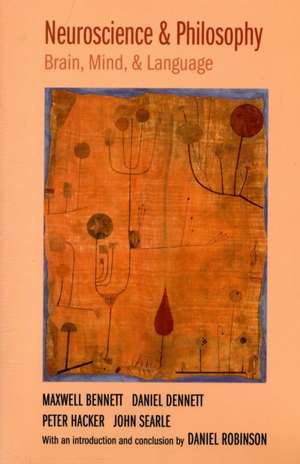
Neuroscience and Philosophy – Brain, Mind and Language
Autor Maxwell Bennett, Daniel Dennett, Peter Hacker, John Searle, Daniel N. Robinsonen Limba Engleză Paperback – 16 apr 2009
Structura volumului Neuroscience and Philosophy – Brain, Mind and Language reflectă natura sa de forum critic, fiind organizat în jurul unui dialog dialectic între neuroștiință și filozofia analitică. Materialul debutează cu tezele extrase din Philosophical Foundations of Neuroscience, unde Maxwell Bennett și Peter Hacker analizează fundamentele conceptuale ale neuroștiinței cognitive, argumentând împotriva „eroarei mereologice” — atribuirea unor funcții psihice întregului creier care aparțin, de fapt, persoanei. Această metodologie a confruntării directe continuă cu replicile lui Daniel Dennett și John Searle, oferind cititorului o perspectivă rară asupra modului în care se ciocnesc paradigmele funcționaliste și cele biologic-naturaliste.
Descoperim aici o progresie riguroasă a argumentelor: de la critica presupozițiilor conceptuale, la contra-argumentele despre localizarea conștiinței, până la răspunsurile finale ale autorilor inițiali. Putem afirma că volumul extinde cadrul propus de Philosophical Foundations of Neuroscience cu date noi din schimbul de replici directe, clarificând distincția dintre limbajul neuroștiințific și cel psihologic. Față de abordarea introductivă din Minding the Brain de Georg Northoff, care se concentrează pe neurofilozofia non-reductivă, volumul de față este mai degrabă o analiză critică a logicii cercetării, chestionând dacă reprezentările și hărțile cerebrale sunt concepte inteligibile sau simple metafore.
Reținem importanța intervenției lui Daniel N. Robinson, care încadrează această dispută într-un context mai larg al naturii umane. Textul nu se limitează la prezentarea unor date empirice, ci investighează modul în care interpretăm aceste date, fiind esențial pentru înțelegerea tensiunii dintre explicația cauzală (biologică) și cea rațională (filozofică).
Preț: 222.83 lei
Carte tipărită la comandă
Livrare economică 05-19 iunie
Specificații
ISBN-10: 0231140452
Pagini: 232
Dimensiuni: 145 x 209 x 13 mm
Greutate: 0.25 kg
Editura: Columbia University Press
V-ar putea interesa
-
 Mind, Method, and Morality: Essays in Honour of Anthony KennyJohn Cottingham-33%Preț: 788.97 lei1184.45 lei
 -
 The Oxford Handbook of William WordsworthRichard Gravil-17%Preț: 982.75 lei1186.38 lei
 -
 Freedom and NeurobiologyJohn SearlePreț: 99.35 lei
 -
 Consciousness and Mental LifeDaniel N. RobinsonPreț: 413.02 lei
 -
 The Time Falling Bodies Take to LightWilliam Irwin ThompsonPreț: 144.97 lei
 -
 The Primitive Mind And Modern CivilizationCharles Roberts Aldrich-18%Preț: 1516.52 lei1849.40 lei
 -
 Philosophy of TechnologyFrederick FerréPreț: 189.18 lei
 -
 The Works of Mary Robinson, Part I Vol 1William D Brewer-18%Preț: 1211.90 lei1477.92 lei
 -
 The Works of Mary Robinson, Part I Vol 2William D Brewer-18%Preț: 1211.28 lei1477.17 lei
 -
 The Works of Mary Robinson, Part I Vol 4William D Brewer-18%Preț: 1202.76 lei1466.79 lei
 -
 Living In-Spirit: An Approach to Life in Our Modern SocietyBenjamin O. IgwePreț: 104.28 lei
 -
 The Jedi FoundationOpie MacLeodPreț: 37.76 lei
 -
 The Conversation of MerachefetC. Joybell CPreț: 60.95 lei
 -
 Filosofia Da LoucuraCleberson Eduardo Da CostaPreț: 77.21 lei
 -
 The Twilight Language of Gorakh BodhShailendra SharmaPreț: 85.75 lei
 -
 The Concept of ConsciousnessEdwin B HoltPreț: 141.37 lei
 -
 Break Your Self Help AddictionBrian D. RidgwayPreț: 91.69 lei
 -
 Head, Heart & Hara: The Soul Centers of West and EastPeter WilbergPreț: 82.51 lei
 -
 Crossing Over and Coming HomeDale Phd, LizPreț: 108.04 lei
 -
 In the Street Between WormholesMR Hayden WaynePreț: 159.97 lei
 -
 Preț: 101.94 lei
 -
 Ghost of SightVision, Donald JamesPreț: 93.51 lei
 -
 Virginia Woolf and NeuropsychiatryMaxwell Bennett-5%Preț: 353.83 lei372.46 lei
De ce să citești această carte
Această carte este indispensabilă celor care doresc să înțeleagă limitele limbajului științific în explicarea minții umane. Cititorul câștigă o perspectivă critică asupra modului în care neuroștiința modernă își formulează teoriile, beneficiind de o dezbatere la cel mai înalt nivel între giganți ai filozofiei contemporane precum Searle și Dennett. Este o lectură care antrenează rigoarea conceptuală și clarifică distincția dintre funcționarea creierului și experiența conștientă.
Despre autor
Volumul reunește un grup de gânditori de elită. Maxwell Bennett este un neurobiolog distins, cunoscut pentru cercetările sale asupra sinapselor, în timp ce Peter Hacker este unul dintre cei mai importanți experți în filozofia lui Wittgenstein. Daniel Dennett și John Searle reprezintă două poli opuși, dar la fel de influenți, în filozofia minții de la sfârșitul secolului XX și începutul secolului XXI, primul fiind un adept al modelului computațional, iar cel de-al doilea un susținător al naturalismului biologic. Daniel N. Robinson, profesor la Oxford și Georgetown, completează echipa, aducând o expertiză vastă în istoria psihologiei și filozofiei.
Notă biografică
Cuprins
The Argument
Selections from Philosophical Foundations of Neuroscience
Neuroscience and Philosophy, by Maxwell R. Bennett
The Rebuttals
Philosophy as Naive Anthropology: Comment on Bennett and Hacker, by Daniel Dennett
Putting Consciousness Back in the Brain: Reply to Bennett and Hacker, Philosophical Foundations of Neuroscience, by John Searle
Reply to the Rebuttals
The Conceptual Presuppositions of Cognitive Neuroscience: A Reply to Critics, by Maxwell R. Bennett and Peter M. S. Hacker
Epilogue, by Maxwell R. Bennett
Still Looking: Science and Philosophy in Pursuit of Prince Reason, by Daniel Robinson
Notes