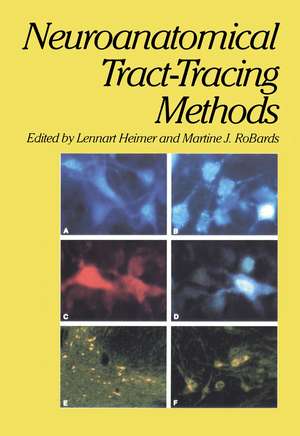
Neuroanatomical Tract-Tracing Methods
Autor Lennart Heimer, Martine J. Robardsen Limba Engleză Paperback – 13 oct 2011
Preț: 634.07 lei
Preț vechi: 745.96 lei
-15%
Puncte Express: 951
Carte tipărită la comandă
Livrare economică 08-22 decembrie
Livrare prin curier în România Termenul estimat este afișat lângă disponibilitate.
Transport gratuit pentru acest produs Plată online sau ramburs, în funcție de opțiunile comenzii.
Retur gratuit în 14 zile Comandă securizată și suport în română.
Specificații
ISBN-13: 9781461331919
ISBN-10: 1461331919
Pagini: 604
Ilustrații: XXIII, 567 p.
Dimensiuni: 170 x 244 x 32 mm
Greutate: 0.95 kg
Ediția:1981
Editura: Springer Us
Colecția Springer
Locul publicării:New York, NY, United States
ISBN-10: 1461331919
Pagini: 604
Ilustrații: XXIII, 567 p.
Dimensiuni: 170 x 244 x 32 mm
Greutate: 0.95 kg
Ediția:1981
Editura: Springer Us
Colecția Springer
Locul publicării:New York, NY, United States
V-ar putea interesa
-
 -31%Preț: 675.99 lei974.95 lei
 -
 Permanent Present TenseSuzanne Corkin-19%Preț: 76.46 lei93.95 lei
 -
 Preț: 108.48 lei
 -
 Brain Function and Psychotropic DrugsHeather Ashton-28%Preț: 423.78 lei587.68 lei
 -
 Neuromania: On the limits of brain sciencePaolo Legrenzi-19%Preț: 102.92 lei127.49 lei
 -
 -20%Preț: 68.81 lei85.66 lei
 -
 -17%Preț: 281.47 lei338.74 lei
 -
 Incognito: The Secret Lives of the BrainDavid EaglemanPreț: 106.96 lei
 -
 Explorations in Learning and the BrainTon De De JongPreț: 364.08 lei
 -
 -15%Preț: 463.52 lei545.32 lei
 -
 Neurobehavioral Disorders of ChildhoodRobert Melillo-5%Preț: 1675.02 lei1763.18 lei
Public țintă
ResearchCuprins
1 Experimental Neuroanatomy: General Approaches and Laboratory Procedures.- I. Introduction.- II. Tract-Tracing Methods.- III. Practical Problems.- IV. Analysis.- V. The Neuroanatomical Laboratory.- VI. Appendix.- 2 Methods for Selective, Restricted Lesion Placement in the Central Nervous System.- I. Introduction.- II. Stereotaxic Technique.- III. Nonselective Lesion Techniques.- IV. Evaluation of the Electrolytic Lesion.- V. Selective Lesion Techniques.- VI. The Interpretation of Lesion Effects.- VII. Appendix: Stereotaxic Atlases.- 3 Methods for Delivering Tracers.- I. Introduction.- II. Pressure Injection.- III. Iontophoretic Injection.- IV. Appendix.- 4 Silver Methods for the Impregnation of Degenerating Axoplasm.- I. Introduction.- II. Theoretical Considerations.- III. Practical Aspects.- IV. General Characteristics of the Silver Methods.- V. Interpretation of Degenerating Fibers and Terminal Degeneration.- VI. Other Degenerative Neuronal Phenomena.- VII. Sources of Error.- VIII. Summary of Advantages and Limitations.- IX. Prospects for the Future.- X. Appendix.- 5 The Autoradiographic Tracing of Axonal Connections in the Central Nervous System.- I. Introduction.- II. The Principles of the Method.- III. Methodology.- IV. Analysis of the Data.- V. Electron Microscopic Autoradiography.- VI. Summary of Advantages and Limitations.- VII. Appendix.- 6 Horseradish Peroxidase: The Basic Procedure.- I. Introduction.- II. Basic Applications.- III. Incorporation and Transport of HRP.- IV. Methodology.- V. General Characteristics of the Different HRP Methods.- VI. Results and Interpretations.- VII. Summary of Advantages and Limitations.- VIII. Appendix.- 7 Horseradish Peroxidase: Intracellular Staining of Neurons.- I. Introduction.- II. Methods.- III. Application of the Technique.- IV. Summary of Advantages and Limitations.- V. Appendix.- 8 Horseradish Peroxidase and Fluorescent Substances and Their Combination with Other Techniques.- I. Introduction.- II. The Tracing of Collateral Projections.- III. HRP and Anterograde Tracing Methods.- IV. HRP and Transmitter-Related Histochemical Procedures.- V. HRP and 2-Deoxyglucose Procedures.- VI. Prospects for the Future.- VII. Appendix.- 9 The Golgi Methods.- I. Introduction.- II. The Rapid Golgi Method.- III. Analysis of the Data.- IV. Presentation of the Data.- V. Variations of the Golgi Method.- VI. Summary of Advantages and Limitations.- VII. Appendix.- 10 Electron Microscopy: Preparation of Neural Tissues for Electron Microscopy.- I. Introduction.- II Basic Procedures for Fixation and Embedding.- III. Variations.- IV. Evaluation of Results with the Light Microscope.- V. Cutting and Staining Ultrathin Sections.- VI. Synthesis.- VIII. Appendix.- 11 Electron Microscopy: Identification and Study of Normal and Degenerating Neural Elements by Electron Microscopy.- I. Introduction.- II. Bridging the Gap between Light and Electron Microscopy.- III. Practical Guidelines for Electron Microscopy.- IV. Identification of Neuronal Elements.- V. Ultrastructure of Degenerating Nerve Fibers.- VI. Morphometry.- 12 Tract Tracing by Electron Microscopy of Golgi Preparations.- I. Introduction.- II. General Description of Techniques.- III. Summary of Advantages and Limitations.- IV. Concluding Comments and Troubleshooting.- V. Appendix.- 13 Fluorescence Histochemical Methods: Neurotransmitter Histochemistry.- I. Introduction.- II Chemical Basis of the Fluorescence Histochemical Methods.- III. Equipment.- IV. Methods Using Formaldehyde or Glyoxylic Acid Condensation.- V. The Selection of Fluorescence Histochemical Methods.- VI. Advantages and Limitations of the Fluorescence Histochemical Method.- VII. Appendix.- 14 Immunocytochemical Methods.- I. Introduction.- II. Types of Immunocytochemical Techniques.- III. The Peroxidase-Antiperoxidase (PAP) Technique.- IV. Variations in PAP Technique.- V. Specificity of the PAP Technique.- VI. Use of the PAP Technique in the Demonstration of Catecholaminergic Neurons.- VII. Use of the PAP Technique in the Localization of Neuropeptides.- VIII Summary of Advantages and Limitations of the PAP Technique.- IX. Conclusions.- 15 The 2-Deoxyglucose Method.- I. Introduction.- II. Basic Principles of the Method.- III. General Applications of the Method.- IV. Methodology for [14C]-2DG.- V. Methodology for [3H]-2DG.- VI. Data Analysis.- VII. Advantages and Limitations.- VIII Appendix.- Epilogue: Some General Advice to the Young Investigator.- Author Index.