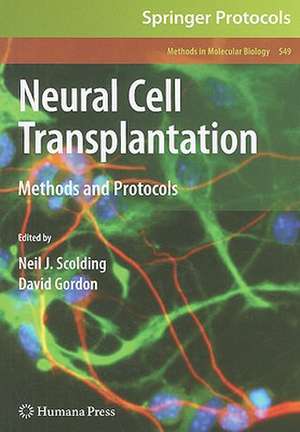
Neural Cell Transplantation
Editat de Neil J Scolding, David Gordonen Limba Engleză Hardback – 7 mai 2009
În volumul Neural Cell Transplantation, ediția 2009, observăm o consolidare a metodologiilor de laborator necesare pentru avansarea cercetării în repararea sistemului nervos central. Această ediție se distinge prin integrarea protocoalelor specifice pentru celulele stem, elementul central al progresului în transplantul neural contemporan. Structura cărții urmează formatul riguros al seriei Methods in Molecular Biology™, debutând cu recenzii despre studiile clinice umane în bolile neurodegenerative și continuând cu secțiuni tehnice detaliate. Remarcăm acoperirea extensivă a metodelor de derivare a progenitorilor oligodendrogliali și caracterizarea prin citometrie în flux a precursorilor neurali. Volumul include capitole noi dedicate utilizării celulelor mezenchimale și a celor din sângele ombilical, oferind o perspectivă aplicată asupra modelelor animale pentru afecțiuni precum scleroza multiplă și ischemia cerebrală. Acoperă aceeași arie tematică precum Neural Stem Cells de Leslie P. Weiner, dar cu o abordare mult mai axată pe protocoale reproductibile pas-cu-pas și soluționarea erorilor frecvente (troubleshooting), față de abordarea teoretică a altor titluri din domeniu. Editorul Neil J Scolding, cunoscut pentru lucrarea sa de referință A-Z of Neurological Practice, transferă aici rigoarea clinică în mediul de laborator. Dacă lucrarea sa anterioară se concentra pe diagnosticul și managementul rapid în neurologia clinică, acest volum fundamentează baza experimentală a terapiilor de mâine. Progresia conținutului, de la izolarea celulelor stem în cultură până la monitorizarea prin rezonanță magnetică (MR) în organisme vii, indică o resursă completă pentru cercetătorul care dorește să stăpânească întreg spectrul transplantului neural.
Preț: 655.82 lei
Preț vechi: 771.55 lei
-15%
Carte disponibilă
Livrare economică 30 octombrie-13 noiembrie
Specificații
ISBN-10: 160327930X
Pagini: 226
Ilustrații: XIV, 226 p. 32 illus.
Dimensiuni: 195 x 269 x 20 mm
Greutate: 0.72 kg
Ediția:2009 edition
Editura: Humana Press Inc.
Locul publicării:Totowa, NJ, United States
V-ar putea interesa
-
 Cell Biology Assays: Essential MethodsJulio E. Celis-25%Preț: 516.68 lei687.23 lei
 -
 -18%Preț: 1707.19 lei2081.94 lei
 -
 Cell BiologistsHolmes-9%Preț: 861.27 lei946.45 lei
 -
 Ultrastructure: An Interactive Virtual Electron MicroscopeJoel E. SchechterPreț: 448.80 lei
 -
 Computer Analysis of Sequence Data Part IIAnnette M. Griffin-15%Preț: 618.39 lei727.52 lei
 -
 About LifePaul S. AgutterPreț: 389.82 lei
 -
 Essentials of ApoptosisXiao-Ming Yin-18%Preț: 994.47 lei1212.76 lei
 -
 Signal Transduction ProtocolsLouis M. Luttrell-15%Preț: 714.46 lei840.55 lei
 -
 Cell MigrationClaire M. Wells-15%Preț: 716.57 lei843.02 lei
 -
 Cell Cycle Checkpoint Control ProtocolsHoward B. Lieberman-15%Preț: 674.11 lei793.07 lei
 -
 G Protein SignalingAlan V Smrcka-15%Preț: 650.46 lei765.25 lei
 -
 Progress in Cell Growth Process ResearchTakumi Hayashi-23%Preț: 1308.04 lei1704.83 lei
 -
 How the Heart DevelopsDonald A. FischmanPreț: 197.69 lei
 -
 The Peter Townsend ReaderAlan WalkerPreț: 311.63 lei
 -
 A-Z of Neurological PracticeAndrew J Larner-5%Preț: 409.47 lei431.02 lei
Public țintă
Professional/practitionerDe ce să citești această carte
Recomandăm acest volum cercetătorilor și neurologilor care au nevoie de protocoale de laborator validate pentru manipularea celulelor stem neurale. Cititorul câștigă acces la tehnici precise de diferențiere și izolare, esențiale pentru dezvoltarea terapiilor regenerative. Este un instrument practic indispensabil datorită notelor tehnice care previn eșecurile experimentale comune în studiul bolilor neurodegenerative.
Despre autor
Neil J. Scolding este un reputat specialist în neurologie, recunoscut pentru contribuțiile sale editoriale care pun în legătură cercetarea fundamentală cu practica clinică. În calitate de editor al seriei de succes Methods in Molecular Biology™, el a coordonat numeroase lucrări axate pe medicina regenerativă. Lucrarea sa anterioară, A-Z of Neurological Practice, este considerată un ghid esențial pentru clinicienii ocupați, demonstrând capacitatea sa de a sintetiza informații complexe într-un format accesibil. Experiența sa în scleroza multiplă și biologia celulelor stem fundamentează rigoarea științifică a acestui manual de transplant neural.
Descriere scurtă
Cutting-edge and easy to use, Neural Cell Transplantation: Methods and Protocols provides the most thorough and essential protocols that will allow new generations of neuroscientists to enter and contribute to this uniquely inspiring field.