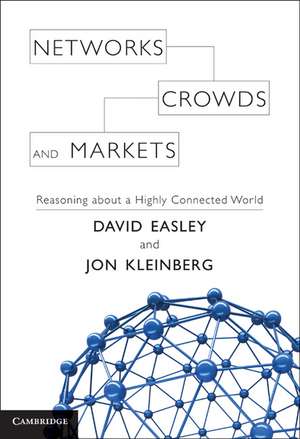
Networks, Crowds, and Markets
Autor Jon Kleinberg, David Easleyen Limba Engleză Hardback – 2 sep 2010
Autorii acestei lucrări fundamentale, David Easley și Jon Kleinberg, ambii profesori distinși la Cornell University, îmbină expertiza din economie și informatică pentru a oferi o bază teoretică riguroasă noului domeniu al științei rețelelor. David Easley aduce perspectiva dinamicii bogăției și a selecției naturale în piețe, în timp ce Jon Kleinberg fundamentează algoritmii care guvernează structurile informaționale moderne. Împreună, aceștia au creat un text care a fost recunoscut rapid de comunitatea academică prin premiul PROSE în 2010. Observăm în paginile acestui volum de referință o metodologie transdisciplinară care reușește să explice fenomene complexe — de la modul în care zvonurile circulă pe internet până la mecanismele din spatele crizelor financiare globale. Spre deosebire de alte introduceri în domeniu, Networks, Crowds, and Markets nu se rezumă la o descriere calitativă, ci folosește un aparat matematic aplicat pentru a răspunde la întrebări despre conectivitate și influență. Lucrarea extinde cadrul propus de Small Worlds de Duncan J. Watts cu date noi și o analiză aprofundată a modului în care deciziile individuale se propagă în rețele sociale și piețe economice. De asemenea, dacă Complex Social Networks de Fernando Vega-Redondo se concentrează pe modelarea stimulentelor economice, volumul de față oferă o perspectivă mai largă, integrând teoria jocurilor și structura grafurilor. Suntem de părere că densitatea informației, susținută de cele 332 de ilustrații și 128 de exerciții, transformă acest manual într-un instrument indispensabil pentru studenții din orice domeniu tehnic sau social. Ritmul este cel al unui curs universitar de înaltă ținută: structurat, logic și ancorat în exemple din lumea reală, de la structura web-ului la piețele de licitații.
Preț: 494.69 lei
Preț vechi: 537.71 lei
-8%
Carte indisponibilă temporar
Specificații
ISBN-10: 0521195330
Pagini: 744
Ilustrații: 332 b/w illus. 128 exercises
Dimensiuni: 183 x 260 x 44 mm
Greutate: 1.51 kg
Editura: Cambridge University Press
Locul publicării:New York, United States
V-ar putea interesa
-
 Preț: 79.69 lei
 -
 NetworksMark Newman-27%Preț: 538.91 lei736.37 lei
 -
 Game Theory: A Very Short IntroductionKen Binmore-18%Preț: 58.61 lei71.63 lei
 -
 Essentials of Econophysics ModellingFrantisek Slanina-11%Preț: 485.37 lei545.37 lei
 -
 Networks: OxfordGuido Caldarelli-36%Preț: 48.67 lei75.59 lei
 -
 The Oxford Handbook of the Economics of NetworksYann Bramoullé-31%Preț: 1198.09 lei1736.97 lei
 -
 When Everyone Knows That Everyone Knows...Steven PinkerPreț: 137.96 lei
 -
 ConnectedJames H. FowlerPreț: 124.22 lei
 -
 -25%Preț: 70.43 lei93.93 lei
 -
 -14%Preț: 128.79 lei148.92 lei
 -
 The ScoreC. Thi NguyenPreț: 194.17 lei
 -
 Preț: 140.58 lei
 -
 The Dark Forest Theory of the InternetBogna KoniorPreț: 86.72 lei
 -
 NexusYuval Noah HarariPreț: 94.97 leiRecomandat
 -
 When Everyone Knows That Everyone Knows . . .Steven PinkerPreț: 184.59 lei
 -
 The Human NetworkMatthew O. Jackson-17%Preț: 60.82 lei73.29 lei
 -
 -17%Preț: 60.87 lei72.99 lei
 -
 Systems UltraGeorgina VossPreț: 130.76 lei
 -
 -20%Preț: 642.40 lei803.00 lei
De ce să citești această carte
Recomandăm această carte oricărui profesionist sau student care dorește să înțeleagă mecanismele invizibile ce guvernează lumea noastră hiper-conectată. Cititorul câștigă o înțelegere profundă a teoriei grafurilor și a teoriei jocurilor aplicate în viața cotidiană. Este un volum esențial pentru a descifra cum se nasc tendințele, cum se prăbușesc piețele și cum funcționează cu adevărat structura socială modernă.
Despre autor
David Easley este profesor de științe sociale și economie la Cornell University, deținând titlul de Henry Scarborough Professor. Recunoscut ca Fellow al Econometric Society, cercetările sale acoperă domenii precum microstructura piețelor și teoria deciziei în medii complexe. Jon Kleinberg este un renumit informatician la aceeași universitate, cunoscut pentru contribuțiile sale majore în analiza rețelelor și algoritmi. Colaborarea lor reprezintă un punct de referință în literatura academică, reușind să pună bazele unei înțelegeri interdisciplinare a sistemelor conectate, de la rețele informatice la cele economice.
Descriere scurtă
Cuprins
Recenzii
'In this remarkable book, David Easley and Jon Kleinberg bring all the tools of computer science, economics, and sociology to bear on one of the great scientific challenges of our time: understanding the structure, function, and dynamics of networks in society. Clearly written and covering an impressive range of topics, Networks, Crowds, and Markets is the ideal starting point for any student aspiring to learn the fundamentals of the emerging field of network science.' Duncan Watts, author of Six Degrees: The Science of a Connected Age
'The field of information networks is an emerging discipline of immense importance that combines graph theory, probability and statistics, microeconomics and facets of the social sciences. Easley and Kleinberg present a panoramic view of this field, from basic graph theory all the way to the state of the art in research.' Prabhakar Raghavan, Head of Yahoo! Labs
'Networks are everywhere, in our social lives, in our economic relations, and in nature; they are now finally arriving to our classrooms. Easley and Kleinberg have written a masterful introduction to networks. This book successfully combines the game theoretic and algorithmic approaches to the study of social, economic and communication networks. It is lively, interesting, readable and accessible. It is a pleasure to teach using this book and never a dull moment for the students.' Daron Acemoglu, Charles P. Kindleberger Professor of Applied Economics, Massachusetts Institute of Technology
'David Easley and Jon Kleinberg have given us a totally new kind of basic economics text, where students learn how to analyze social networks and crowds as well as games and markets. This book covers a remarkable range of topics and offers a broad new vision of what economics can be about.' Roger Myerson, Glen A. Lloyd Distinguished Service Professor of Economics at the University of Chicago and winner of the 2007 Nobel Prize in Economics
'In my three decades plus of teaching, I cannot recall an urge to teach a new undergraduate course like the one I felt upon leafing through this wonderful introduction to everything that is new and important and intellectually challenging in our world.' Christos Papadimitriou, C. Lester Hogan Professor of EECS, University of California, Berkeley
'The elegant explanations in this book allow readers to rapidly gain a deep understanding of how networks work. Without resorting to either advanced math or even a bit of hand-waving, Easley and Kleinberg take us through the essential concepts and intriguing real-world applications.' Lada Adamic, University of Michigan
'This important and inspiring book must not be missing from the computer scientist's bookshelf in the 21st century …' Dr Jochen L. Leidner
'Far from being a terse, technical analysis, this is an elegant and engaging examination of the subject.' The Times Higher Education Supplement
'Networks, Crowds, and Markets offers students an excellent opportunity to relate enduring conceptual material, taught in numerous traditional courses, to their fast-paced and ever changing world. Typically, textbooks have not often done so. This work serves, therefore, not only as motivation for students to appreciate the beauty of the abstract, but also as a model for what textbooks might become in the near future. … Individual instructors will bring their own interests to this lively, well-written text with interesting graphic support and then tailor it to make a course that they are comfortable teaching and one that really comes alive for students.' Mathematical Reviews
'This text offers an integrated, but not superficial, introduction to … new mathematical concepts and their application across a range of social problems … an ideal text for introductory classes. It also holds great promise for people with a strong background in another field who wish to understand some of the key questions addressed by the social sciences.' H. Van Dyke Parunak, reviews.com
'This very interesting and detailed book manages to expose the wide-ranging applications of graph and network theory in a variety of areas such as game theory, auctions, web searches, horse-betting, voting, crowd behavior, trade markets and the spread of diseases. Throughout the book all necessary mathematical background is outlined in an easy to understand way, including the most interesting and curious aspects of the theory such as the Braess paradox, prisoner's dilemma and Arrow's impossibility theorem. The book concludes with a useful index and a detailed bibliography.' Zentralblatt MATH
'Easley, an economist, and Kleinberg, a computer scientist, accomplish the difficult task of making the subject available to students from basically any field without being superficial. Their text was designed as transdisciplinary from the start and will be specifically interesting to physics students who pursue an interdisciplinary career geared toward the social science and econophysics.' Physics Today