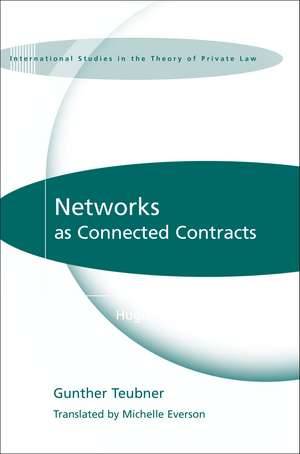
Networks as Connected Contracts: Edited with an Introduction by Hugh Collins: International Studies in the Theory of Private Law
Autor Gunther Teubner Traducere de Michelle Eversonen Limba Engleză Hardback – 27 mai 2011
This book is a translation of Gunther Teubner's classic work on networks, setting out his novel legal concept of 'connected contracts'. In it he explains how this concept addresses the problems posed by networks, such as the question whether the network as a whole can be held legally responsible for damage that it causes to third parties such as customers. A substantial introduction by Hugh Collins explains the analysis of networks in the context of German law and the systems theory from which Teubner approaches the topic. The introduction also explores how far the concept of connected contracts might assist in the common law world, including the UK and the USA, to address the same problems that arise in cases involving networks. As well as making a contribution to comparative law and legal theory, the book will be of interest to scholars interested in contract law, commercial law and the law of business associations.
Din seria International Studies in the Theory of Private Law
- 25%
 Preț: 224.82 lei
 - 27%
 Preț: 389.79 lei
 - 14%
 Preț: 925.04 lei
 - 32%
 Preț: 665.31 lei
 - 37%
 Preț: 839.35 lei
 - 33%
 Preț: 624.35 lei
 - 33%
 Preț: 592.63 lei
 - 36%
 Preț: 626.74 lei
 - 32%
 Preț: 667.84 lei
 - 25%
 Preț: 255.56 lei
 - 32%
 Preț: 798.23 lei
 - 27%
 Preț: 399.68 lei
 - 23%
 Preț: 330.13 lei
 - 30%
 Preț: 537.42 lei
 - 32%
 Preț: 585.15 lei
 - 31%
 Preț: 582.62 lei
Preț: 617.10 lei
Preț vechi: 912.76 lei
-32%
Puncte Express: 926
Carte tipărită la comandă
Livrare economică 30 noiembrie-14 decembrie
Livrare prin curier în România Termenul estimat este afișat lângă disponibilitate.
Transport gratuit pentru acest produs Plată online sau ramburs, în funcție de opțiunile comenzii.
Retur gratuit în 14 zile Comandă securizată și suport în română.
Specificații
ISBN-13: 9781849461740
ISBN-10: 1849461740
Pagini: 314
Dimensiuni: 154 x 236 x 24 mm
Greutate: 0.64 kg
Editura: Bloomsbury Publishing
Colecția Hart Publishing
Seria International Studies in the Theory of Private Law
Locul publicării:London, United Kingdom
ISBN-10: 1849461740
Pagini: 314
Dimensiuni: 154 x 236 x 24 mm
Greutate: 0.64 kg
Editura: Bloomsbury Publishing
Colecția Hart Publishing
Seria International Studies in the Theory of Private Law
Locul publicării:London, United Kingdom
V-ar putea interesa
-
 Sham TransactionsEdwin Simpson-33%Preț: 1282.93 lei1908.80 lei
 -
 -32%Preț: 665.93 lei979.70 lei
 -
 Vorrang der AbfallverwertungPeter J. TettingerPreț: 492.35 lei
 -
 Preț: 381.55 lei
Cuprins
Introduction to Networks as Connected Contracts by Hugh Collins
1 Between Market and Organisation
2 The Inadequacy of Legal Conceptions of Networks
3 Sociological Jurisprudence
4 The Distinctive Properties of Networks
5 The Challenge of Comparative Sociological Jurisprudence
6 The Concept of Connected Contracts
7 Network Effects on Interpretation of Bilateral Contracts
8 Internal Network Liability
9 External Network Liability
10 Conclusion
Introduction: The Aims of Legal Analysis of Networks
Chapter 1
The Network Revolution: New Risks - Unsolved Legal Issues
I. Two 'Irritating' Legal Cases
II. Appropriate Doctrinal Responses?
III. Legally Relevant Networks
IV. The New Economic Relevance of Pre-modern Networks
V. Forms of Network and their Regulatory Problems
VI. Specific Risks of Networks
Chapter 2
Socio-economic Analyses and Legal Characterisation
I. Market Regime: Networks as Contracts?
II. Organisational Regime: Networks as Business Associations?
III. Hybrid Regimes: Networks as Institutionalised Contradictions?
IV. Communitarian Regime: Networks as 'Communities'?
V. Mixed Regime: Networks as a Type of Mixed Contract?
VI. Polycorporate Regime: Networks as Corporate Groups?
VII. Idiosyncratic Regime: 'Network Contract' as a New Legal Concept?
Chapter 3
Networks as Connected Contracts
I. Generalisation of Connected Contracts and their Re-specification for Networks
II. Structural and Functional Equivalances
III. A Productive 'Unsustainable' Contradiction
IV. The Legal Construct of Reality: the Dual Constitution as Contract and Association
V. Legal Consequences: Selective Attribution to Contractual Partners and to the Network
VI. Legal Problems of Institutionalised Networking
Chapter 4
The Effects of Networks on Bilateral Contracts
I. Differentiated Discounts
II. Structural Contradiction: Bilateral Exchange versus Multilateral Connectivity
III. The Purpose of the Network as the Yardstick for Duties of Loyalty
IV. Selected Duties of Loyalty toward the Network
V. Profit Sharing?
VI. Risk Distribution? Network Purpose and the Judicial Review of Standard Form Contracts
Chapter 5
Piercing Liability Within the Network: The Special Relationship between Members of the Network who Are Not Contractual Partners
I. Free Riding in the Network
II. Structural Contradiction: Competition versus Co-operation
III. Piercing Within the Network?
IV. Piercing Liability within Parallel Contracts
V. Extra-Contractual Duties of Loyalty
VI. Protective Obligations, Performance Obligations, Promotion Obligations
VII. Analogies to Company Law: Derivative Action within the Contractual Network?
VIII. Hierarchical Multilateral Network
Chapter 6
External Liability of Networks: Expanding the Range of Responsibility
I. Franchising in Services: 'Organised Irresponsibility'
II. Structural Contradiction: Unitas Multiplex
III. External Liability of Networks
IV. Decentralised Network Liability
V. Selected Constellations of Liability
1 Between Market and Organisation
2 The Inadequacy of Legal Conceptions of Networks
3 Sociological Jurisprudence
4 The Distinctive Properties of Networks
5 The Challenge of Comparative Sociological Jurisprudence
6 The Concept of Connected Contracts
7 Network Effects on Interpretation of Bilateral Contracts
8 Internal Network Liability
9 External Network Liability
10 Conclusion
Introduction: The Aims of Legal Analysis of Networks
Chapter 1
The Network Revolution: New Risks - Unsolved Legal Issues
I. Two 'Irritating' Legal Cases
II. Appropriate Doctrinal Responses?
III. Legally Relevant Networks
IV. The New Economic Relevance of Pre-modern Networks
V. Forms of Network and their Regulatory Problems
VI. Specific Risks of Networks
Chapter 2
Socio-economic Analyses and Legal Characterisation
I. Market Regime: Networks as Contracts?
II. Organisational Regime: Networks as Business Associations?
III. Hybrid Regimes: Networks as Institutionalised Contradictions?
IV. Communitarian Regime: Networks as 'Communities'?
V. Mixed Regime: Networks as a Type of Mixed Contract?
VI. Polycorporate Regime: Networks as Corporate Groups?
VII. Idiosyncratic Regime: 'Network Contract' as a New Legal Concept?
Chapter 3
Networks as Connected Contracts
I. Generalisation of Connected Contracts and their Re-specification for Networks
II. Structural and Functional Equivalances
III. A Productive 'Unsustainable' Contradiction
IV. The Legal Construct of Reality: the Dual Constitution as Contract and Association
V. Legal Consequences: Selective Attribution to Contractual Partners and to the Network
VI. Legal Problems of Institutionalised Networking
Chapter 4
The Effects of Networks on Bilateral Contracts
I. Differentiated Discounts
II. Structural Contradiction: Bilateral Exchange versus Multilateral Connectivity
III. The Purpose of the Network as the Yardstick for Duties of Loyalty
IV. Selected Duties of Loyalty toward the Network
V. Profit Sharing?
VI. Risk Distribution? Network Purpose and the Judicial Review of Standard Form Contracts
Chapter 5
Piercing Liability Within the Network: The Special Relationship between Members of the Network who Are Not Contractual Partners
I. Free Riding in the Network
II. Structural Contradiction: Competition versus Co-operation
III. Piercing Within the Network?
IV. Piercing Liability within Parallel Contracts
V. Extra-Contractual Duties of Loyalty
VI. Protective Obligations, Performance Obligations, Promotion Obligations
VII. Analogies to Company Law: Derivative Action within the Contractual Network?
VIII. Hierarchical Multilateral Network
Chapter 6
External Liability of Networks: Expanding the Range of Responsibility
I. Franchising in Services: 'Organised Irresponsibility'
II. Structural Contradiction: Unitas Multiplex
III. External Liability of Networks
IV. Decentralised Network Liability
V. Selected Constellations of Liability
Recenzii
This is an interesting book. It is at once a good introduction to the German law of contracts and torts; a study of sociological jurisprudence; and a thought-provoking exploration of modern commercial relations... A huge benefit in the book is the excellent introduction by Hugh Collins.
The extensive bibliography Teubner presents is testament to his extraordinary learning. For a scholar seeking to explore the wilder shores of contractual relations, this book would be an excellent place to start.
For anyone wanting to get to grips with contractual networks, this impressive book is essential reading.
...highly recommended to those who might be interested in the law of obligations, with a specific emphasis on the law of business organisations.
The extensive bibliography Teubner presents is testament to his extraordinary learning. For a scholar seeking to explore the wilder shores of contractual relations, this book would be an excellent place to start.
For anyone wanting to get to grips with contractual networks, this impressive book is essential reading.
...highly recommended to those who might be interested in the law of obligations, with a specific emphasis on the law of business organisations.
Notă biografică
Gunther Teubner is Professor Emeritus of Private Law and Legal Sociology at the Faculty of Law, Goethe-University Frankfurt am Main, Germany.