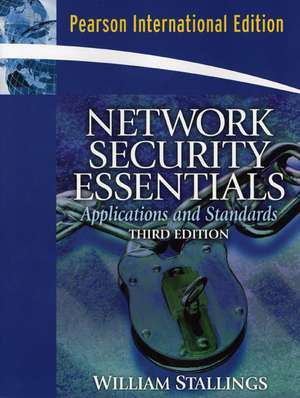
Network Security Essentials: Applications and Standards: International Edition
Autor William Stallingsen Limba Engleză Paperback – 30 iun 2006
Considerăm că valoarea practică a acestui manual este cel mai bine ilustrată de secțiunea de proiecte din Appendix B, unde cititorul este ghidat să implementeze algoritmi de criptare și să simuleze atacuri de rețea pentru a înțelege vulnerabilitățile reale. Network Security Essentials: Applications and Standards, Global Edition nu rămâne la nivelul teoriei abstracte, ci forțează aplicarea standardelor actuale în scenarii de utilizare specifice. Remarcăm o structură riguroasă, organizată în trei piloni: bazele criptografiei (criptare simetrică și chei publice), aplicații de securitate la nivel de transport și e-mail, și securitatea sistemelor, incluzând firewall-uri și detecția intrușilor.
Ca și Sarhan M. Musa în Network Security and Cryptography, autorul William Stallings distilează experiență reală în principii acționabile, însă pune un accent mult mai puternic pe protocoalele standardizate precum IPsec și securitatea wireless. Apreciem în mod deosebit actualizarea conținutului pentru a reflecta realitățile moderne, introducând capitole dedicate securității în Cloud și controlului accesului la rețea (NAC). În contextul operei sale vaste, această lucrare servește drept o extensie aplicată a volumului Data and Computer Communications, concentrându-se strict pe protecția datelor, spre deosebire de Operating Systems: Internals and Design Principles, Global Edition care analizează securitatea de la nivelul nucleului sistemului de operare. Progresia materialului este logică, pornind de la mecanismele matematice elementare și culminând cu managementul securității la nivel de infrastructură globală.
Preț: 411.32 lei
Cartea se retipărește
Specificații
ISBN-10: 0132303787
Pagini: 432
Dimensiuni: 178 x 235 mm
Greutate: 0.61 kg
Ediția:3Nouă
Editura: Pearson Education
Colecția Pearson Education
Locul publicării:Upper Saddle River, United States
V-ar putea interesa
-
 -20%Preț: 895.08 lei1118.86 lei
 -
 -20%Preț: 900.03 lei1125.04 lei
 -
 5G Wireless: A Comprehensive IntroductionWilliam StallingsPreț: 508.40 lei
 -
 Deep LearningIan Goodfellow-21%Preț: 684.46 lei865.01 lei
 -
 -18%Preț: 923.83 lei1126.62 lei
 -
 Preț: 454.97 lei
 -
 -5%Preț: 1168.39 lei1229.88 lei
 -
 -5%Preț: 484.29 lei509.78 lei
 -
 -20%Preț: 697.25 lei871.56 lei
 -
 -15%Preț: 426.01 lei501.19 lei
 -
 -20%Preț: 1327.38 lei1659.23 lei
 -
 Foundations of Electromagnetic CompatibilityBogdan Adamczyk-9%Preț: 824.19 lei905.70 lei
 -
 5G Radio Access Network ArchitectureSasha Sirotkin-20%Preț: 774.80 lei968.50 lei
 -
 Lpic-1 Linux Professional Institute Certification Study GuideChristine Bresnahan-20%Preț: 321.79 lei402.24 lei
 -
 Introduction to Synthetic Aperture Radar: Concepts and PracticeE. David Jansing-29%Preț: 595.33 lei839.96 lei
 -
 Data and Computer CommunicationsWilliam Stallings-11%Preț: 638.48 lei717.39 lei
 -
 -15%Preț: 666.73 lei784.39 lei
 -
 -18%Preț: 1484.31 lei1810.13 lei
 -
 MATLAB Simulations for Radar Systems DesignBassem R. Mahafza-18%Preț: 1502.55 lei1832.38 lei
 -
 Applied Signal ProcessingSadasivan Puthusserypady-23%Preț: 819.49 lei1064.28 lei
 -
 Python Data Analysis - Third EditionAvinash Navlani-20%Preț: 242.02 lei302.53 lei
 -
 PRIN ART NEURAL NETWORK (4TH ED)Graupe Daniel-20%Preț: 940.36 lei1175.45 lei
 -
 -18%Preț: 639.13 lei779.42 lei
De ce să citești această carte
Recomandăm această lucrare profesioniștilor IT și studenților care au nevoie de o înțelegere tehnică a modului în care standardele de securitate sunt implementate în rețelele moderne. Cititorul câștigă competențe direct aplicabile în configurarea sistemelor securizate, învățând nu doar cum funcționează criptografia, ci și cum să utilizeze corect protocoale precum TLS sau firewall-urile pentru a proteja resursele unei organizații.
Despre autor
William Stallings este o figură centrală în literatura tehnică dedicată arhitecturii calculatoarelor și rețelelor, având în portofoliu 41 de cărți publicate de-a lungul a peste 20 de ani de activitate. Cu o carieră ce îmbină roluri de management tehnic în firme de înaltă tehnologie cu activitatea de consultanță independentă pentru clienți guvernamentali și corporații, Stallings reușește să traducă complexitatea standardelor în resurse educaționale accesibile. Expertiza sa este recunoscută internațional, fiind de mai multe ori premiat pentru calitatea manualelor sale de către Textbook and Academic Authors Association.
Descriere
For one-semester courses on Network Security for computer science, engineering, and CIS majors.
This text provides a practical, up-to-date, and comprehensive survey of network-based and Internet-based security applications and standards. It includes a concise treatment of the discipline of cryptography, covering algorithms and protocols underlying network security applications, encryption, hash functions, digital signatures, and key exchange.
Cuprins
1. Introduction
1.1 The OSI Security Architecture
1.2 Security Attacks
1.3 Security Services
1.4 Security Mechanisms
1.5 A Model for Internetwork Security
1.6 Internet Standards the Internet Society
1.7 Outline of This Book
1.8 Recommended Reading
1.9 Internet and Web Resources
I. CRYPTOGRAPHY
2. Symmetric Encryption and Message Confidentiality
2.1 Symmetric Encryption Principles
2.2 Symmetric Encryption Algorithms
2.3 Cipher Block Modes of Operation
2.4 Location of Encryption Devices
2.5 Key Distribution
2.6 Recommended Reading and Web Sites
2.7 Key Terms, Review Questions, and Problems
3. Public-Key Cryptography and Message Authentication
3.1 Approaches to Message Authentication
3.2 Secure Hash Functions and HMAC
3.3 Public Key Cryptography Principles
3.4 Public-Key Cryptography Algorithms
3.5 Digital Signatures
3.6 Key Management
3.7 Recommended Reading and Web Sites
3.8 Key Terms, Review Questions, and Problems
Appendix 3A Prime Numbers and Modular Arithmetic
II. NETWORK SECURITY APPLICATIONS
4. Authentication Applications
4.1 Kerberos
4.2 X.509 Directory Authentication Service
4.3 Public Key Infrastructure
4.4 Recommended Reading and Web Sites
4.4 Key Terms, Review Questions, and Problems
Appendix 4A: Kerberos Encryption Techniques
5. Electronic Mail Security
5.1 Pretty Good Privacy (PGP)
5.2 S/MIME
5.3 Recommended Web Sites
5.4 Key Terms, Review Questions, and Problems
Appendix 5A: Data Compression Using ZIP
Appendix 5B: Radix-64 Conversion
Appendix 5C: PGP Random Number Generation
6. IP Security
6.1 IP Security Overview
6.2 IP Security Architecture
6.3 Authentication Header
6.4 Encapsulating Security Payload
6.5 Combining Security Associations
6.6 Key Management
6.7 Recommended Reading and Web Sites
6.8 Key Terms, Review Questions, and Problems
Appendix 6A: Internetworking and Internet Protocols
7. Web Security
7.1 Web Security Requirements
7.2 Secure Sockets Layer (SSL) and Transport Layer Security (TLS)
7.3 Secure Electronic Transaction (SET)
7.4 Recommended Reading and Web Sites
7.5 Key Terms, Review Questions, and Problems
8. Network Management Security
8.1 Basic Concepts of SNMP
8.2 SNMPv1 Community Facility
8.3 SNMPv3
8.4 Recommended Reading and Web Sites
8.5 Key Terms, Review Questions, and Problems
III. SYSTEM SECURITY
9. INTRUDERS
9.1 Intruders
9.2 Intrusion Detection
9.3 Password Management
9.4 Recommended Reading and Web Sites
9.5 Key Terms, Review Questions, and Problems
Appendix 9A The Base-Rate Fallacy
10. MALICIOUS SOFTWARE
10.1 Viruses and Related Threats
10.2 Virus Countermeasures
10.3 Distributed Denial of Service Attacks
10.4 Recommended Reading and Web Sites
10.5 Key Terms, Review Questions, and Problems
11. FIREWALLS
11.1 Firewall Design Principles
11.2 Trusted Systems
11.3 Common Criteria for Information Technology Security Evaluation
11.4 Recommended Reading and Web Sites
11.5 Key Terms, Review Questions, and Problems
APPENDICES
A. Standards Cited in this Book
B. Some Aspects of Number Theory
B.1 Prime and Relatively Prime Numbers
B.2 Modular Arithmetic
C. Projects for Teaching Network Security
C.1 Research Projects
C.2 Programming Projects
C.3 Reading/Report Assignments
Glossary
References
Index
List of Acronyms
Notă biografică
He has six times received the prize for best Computer Science and Engineering textbook of the year from the Textbook and Academic Authors Association.
Bill has designed and implemented both TCP/IP-based and OSI-based protocol suites on a variety of computers and operating systems, ranging from microcomputers to mainframes. As a consultant, he has advised government agencies, computer and software vendors, and major users on the design, selection, and use of networking software and products.
Dr. Stallings holds a Ph.D. from M.I.T. in Computer Science and a B.S. from Notre Dame in Electrical Engineering.
Caracteristici
• Unified presentation of intruders and viruses shows students the distinct threats and similarities of hackers and viruses, in order to promote a greater understanding of both topics.
• Coverage of both PGP and S/MIME for electronic mail security familiarizes students with the two most important approaches to e-mail security, enabling them to gain an understanding of both schemes at a detailed technical level.
• Treatment of firewalls explores this integral part of any network security capability.
• Concise overview of cryptography, authentication, and digital signatures gives students a solid yet concise look at the fundamental algorithms and techniques underlying network security.
• Chapter-end homework problems introduce students to new concepts and techniques, and reinforce material in the text with more than 100 problems.
• Optional research projects guide students, via a series of assignments, through researching a particular topic on the Internet and writing a report.
• Optional programming projects enable students to cover a broad range of topics and implement them in any suitable language on any platform.
• Reading/Report assignments direct students to read and then write a short report on an assigned paper listed in the literature.
• Internet mailing list enables instructors using the text to exchange information, suggestions, and questions with each other and the author.
• Accessible presentation of authentication tools and applications includes Kerberos and X.509v3 digital certificates.
• Instructor's Resource Center (0131562126) — is a password-protected area of the Prentice Hall online catalog that enables instructors to download presentation and assessment resources quickly. This text features:
- Lecture PowerPoints— This chapter-by-chapter outline highlights the key points from each chapter using the text illustrations for an effective and visual presentation.
- Solutions Manual — For all review questions and homework problems in the book.
- Text Figures —PDF files with all the figures in the text.
- PDF Files — Reproductions of all figures and tables from the book.
- NetSec Project Manual — The NetSec project manual provides project assignments in the following categories:
- PART ONE: Research Projects
- PART TWO: Programming Projects
- PART THREE: Laboratory Projects
- PART FOUR: Reading/Report Assignments
- PART FIVE: Writing Assignments
• Student Resource Site -- Access a wealth of computer science-related information including mathematics reviews, how-to documents, research resources, and career explorations maintained by the author.
Caracteristici noi
• NEW—Expanded coverage of the Advanced Encryption Standard (AES) is offered.
• NEW—New material includes coverage of Public Key Infrastructure (PKI), distributed denial of service (DDoS), and common criteria for information technology security, which is a standard for trusted computer systems.
• NEW—Writing assignments now found in the instructor’s material help students learn and expand instructors’ options.
• NEW—Programming assignments found at the end of each chapter can be programmed in any language.
• NEW—A new set of laboratory exercises has been added to the instructor package, adding a new dimension to what can be offered to the instructor.
• NEW—The number of end-of-chapter homework problems has been increased by about 50%.
• Companion Website -- Access textbook-related resources and support materials for students and instructors maintained by the author.
• Student Resource Site -- Access a wealth of computer science-related information including mathematics reviews, how-to documents, research resources, and career explorations maintained by the author.