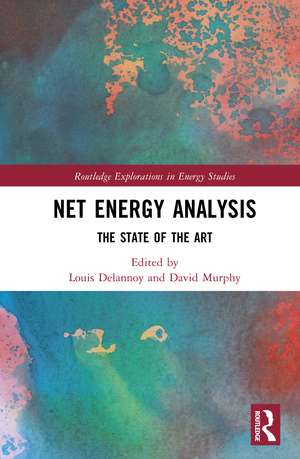
Net Energy Analysis: The State of the Art: Routledge Explorations in Energy Studies
Editat de Louis Delannoy, David J. Murphyen Limba Engleză Hardback – 10 aug 2026
Modern societies are built upon energy and, more precisely, net energy—the energy available after accounting for the energy required to build, operate, and maintain the energy system. NEA provides the science to assess net energy and its implications, often through the concept of energy return on investment (EROI). Over the past five decades, NEA has expanded from early EROI studies into a toolkit spanning process-based accounting, input–output analysis, hybrid methods, and system-wide assessments. This toolkit is increasingly used to evaluate transition pathways, yet the field still lacks a comprehensive synthesis. Net Energy Analysis: The State of the Art brings together leading scholars to clarify the definitions, concepts, metrics, and methods that define contemporary NEA, while also exploring connections with adjacent fields such as evolutionary biology, industrial ecology, and ecological economics. Part I examines different interpretations of NEA, tracing its development from historical foundations to its relevance in financial markets and economics. Part II focuses on converging methodologies, including process-based approaches, input–output analysis, and a taxonomy of net energy metrics. Parts III and IV move into more advanced applications and emerging frontiers, such as system-level EROI estimation and the integration of net energy concepts into integrated assessment models (IAMs), among others.
The book will be a useful resource for students in energy and sustainability, while also offering both new and experienced scholars a concise summary of key debates and the latest cutting-edge contributions relevant to their research.
The Open Access version of this book, available at http://www.taylorfrancis.com, has been made available under a Creative Commons [Attribution-Non Commercial-No Derivatives (CC BY-NC-ND)] 4.0 license.
Din seria Routledge Explorations in Energy Studies
-
 Preț: 382.00 lei
 - 18%
 Preț: 1118.66 lei
 -
 Preț: 382.72 lei
 -
 Preț: 381.06 lei
 -
 Preț: 442.42 lei
 -
 Preț: 324.49 lei
 -
 Preț: 424.32 lei
 -
 Preț: 378.75 lei
 -
 Preț: 380.35 lei
 -
 Preț: 424.32 lei
 - 18%
 Preț: 1115.17 lei
 -
 Preț: 418.66 lei
 -
 Preț: 413.43 lei
 -
 Preț: 445.98 lei
 -
 Preț: 444.29 lei
 -
 Preț: 417.56 lei
 -
 Preț: 421.21 lei
 -
 Preț: 421.03 lei
 - 11%
 Preț: 342.59 lei
 - 18%
 Preț: 1012.58 lei
 -
 Preț: 422.40 lei
 -
 Preț: 421.49 lei
 - 18%
 Preț: 1061.96 lei
 -
 Preț: 411.69 lei
 -
 Preț: 415.25 lei
 - 11%
 Preț: 369.04 lei
 - 18%
 Preț: 1113.07 lei
 - 18%
 Preț: 1117.60 lei
 - 18%
 Preț: 1119.00 lei
 - 23%
 Preț: 1487.41 lei
 - 18%
 Preț: 1117.25 lei
Preț: 1106.97 lei
Preț vechi: 1463.07 lei
-24% Nou
Puncte Express: 1660
Carte indisponibilă temporar
Doresc să fiu notificat când acest titlu va fi disponibil:
Se trimite...
Specificații
ISBN-13: 9781032983530
ISBN-10: 1032983531
Pagini: 360
Ilustrații: 88
Dimensiuni: 156 x 234 mm
Greutate: 0.83 kg
Ediția:1
Editura: Taylor & Francis
Colecția Routledge
Seria Routledge Explorations in Energy Studies
Locul publicării:Oxford, United Kingdom
ISBN-10: 1032983531
Pagini: 360
Ilustrații: 88
Dimensiuni: 156 x 234 mm
Greutate: 0.83 kg
Ediția:1
Editura: Taylor & Francis
Colecția Routledge
Seria Routledge Explorations in Energy Studies
Locul publicării:Oxford, United Kingdom
Public țintă
Academic, Postgraduate, and Undergraduate AdvancedCuprins
List of figures
List of tables
List of Contributors
Acknowledgements
Part 1 - Interpretations of Net Energy Analysis
Chapter 1. What is Net Energy Analysis, and why is it more useful than ever?
Louis Delannoy and David J. Murphy
Chapter 2. Historical Roots of Net Energy Analysis and Energy Return on Investment
Charles A.S. Hall
Chapter 3. What Net Energy Analysis Can and Cannot Tell Financial Analysts
Louis Delannoy and Jan-Pieter Oosterom
Chapter 4. What Net Energy Analysis Can and Cannot Tell Economists
Charles Guay-Boutet and Alban Pellegris
Part 2 - Net Energy Analysis: A Primer
Chapter 5. A Taxonomy of Net Energy Metrics
Michael Carbajales-Dale
Chapter 6. Methodologies for Calculating Energy Return Ratios using Process-Based Approaches
Marco Raugei
Chapter 7. Methodologies for Calculating Energy Return Ratios using Input-Output Based Approaches
Emmanuel Aramendia, Matthew K. Heun and Paul E. Brockway
Part 3 - Net Energy Analysis: Advanced Applications
Chapter 8. Extended-Exergy based Energy Return on Investment
Marcus Vinicius da Silva Neves, Alexandre Szklo and Roberto Schaeffer
Chapter 9. Systemwide Energy Return on Investment for Power Systems
Hasret Şahin, A. A. Solomon and Christian Breyer
Chapter 10. Energy Return on Investment at the Societal Level: A Novel Comprehensive Measure
Marco Vittorio Ecclesia, João Santos, Paul E. Brockway and Tiago Domingos
Chapter 11. Dynamic Energy return on Energy Investment of the System in Mitigation Pathways
Tristan Martin, Iñigo Capellán-Pérez, Juan Manuel Campos-Rodríguez and Carlos de Castro Carranza
Part 4 - Charting New Frontiers for Net Energy Analysis
Chapter 12. The Role of Agricultural Systems in the Energy Transition to a New Solar Based Economy from a Net Energy Analysis Perspective
Enric Tello
Chapter 13. EROI and Ecological Macroeconomics: A Commodity-by-Industry Approach
Martin Sers
Chapter 14. Industrial Energy in IAMs: Looking for Richer Biophysical Foundations in Modelling Accounting Structures
Michele Manfroni, Hugo Le Boulzec, Baptiste Andrieu, Louis Delannoy, Francois Verzier, Sandrine Mathy and Olivier Vidal
Chapter 15. New Frontiers for Net Energy Analysis: Law and the Sociometabolic Regime Shift
Benoît Schmaltz
Chapter 16. The Implications of Net Energy Decline for Global Futures: Bringing Together Net Energy Analysis and Marxist Political Ecology
Michael J. Albert
Chapter 17. The Equal Fitness Paradigm: a thermodynamic synthesis in evolutionary biology
Timothy McWhirter
List of tables
List of Contributors
Acknowledgements
Part 1 - Interpretations of Net Energy Analysis
Chapter 1. What is Net Energy Analysis, and why is it more useful than ever?
Louis Delannoy and David J. Murphy
Chapter 2. Historical Roots of Net Energy Analysis and Energy Return on Investment
Charles A.S. Hall
Chapter 3. What Net Energy Analysis Can and Cannot Tell Financial Analysts
Louis Delannoy and Jan-Pieter Oosterom
Chapter 4. What Net Energy Analysis Can and Cannot Tell Economists
Charles Guay-Boutet and Alban Pellegris
Part 2 - Net Energy Analysis: A Primer
Chapter 5. A Taxonomy of Net Energy Metrics
Michael Carbajales-Dale
Chapter 6. Methodologies for Calculating Energy Return Ratios using Process-Based Approaches
Marco Raugei
Chapter 7. Methodologies for Calculating Energy Return Ratios using Input-Output Based Approaches
Emmanuel Aramendia, Matthew K. Heun and Paul E. Brockway
Part 3 - Net Energy Analysis: Advanced Applications
Chapter 8. Extended-Exergy based Energy Return on Investment
Marcus Vinicius da Silva Neves, Alexandre Szklo and Roberto Schaeffer
Chapter 9. Systemwide Energy Return on Investment for Power Systems
Hasret Şahin, A. A. Solomon and Christian Breyer
Chapter 10. Energy Return on Investment at the Societal Level: A Novel Comprehensive Measure
Marco Vittorio Ecclesia, João Santos, Paul E. Brockway and Tiago Domingos
Chapter 11. Dynamic Energy return on Energy Investment of the System in Mitigation Pathways
Tristan Martin, Iñigo Capellán-Pérez, Juan Manuel Campos-Rodríguez and Carlos de Castro Carranza
Part 4 - Charting New Frontiers for Net Energy Analysis
Chapter 12. The Role of Agricultural Systems in the Energy Transition to a New Solar Based Economy from a Net Energy Analysis Perspective
Enric Tello
Chapter 13. EROI and Ecological Macroeconomics: A Commodity-by-Industry Approach
Martin Sers
Chapter 14. Industrial Energy in IAMs: Looking for Richer Biophysical Foundations in Modelling Accounting Structures
Michele Manfroni, Hugo Le Boulzec, Baptiste Andrieu, Louis Delannoy, Francois Verzier, Sandrine Mathy and Olivier Vidal
Chapter 15. New Frontiers for Net Energy Analysis: Law and the Sociometabolic Regime Shift
Benoît Schmaltz
Chapter 16. The Implications of Net Energy Decline for Global Futures: Bringing Together Net Energy Analysis and Marxist Political Ecology
Michael J. Albert
Chapter 17. The Equal Fitness Paradigm: a thermodynamic synthesis in evolutionary biology
Timothy McWhirter
Notă biografică
Louis Delannoy is Researcher at the Royal Swedish Academy of Sciences and the Stockholm Resilience Centre, Sweden. He combines methods derived from social ecological systems and ecological economics to study how crises historically take shape, how they are perceived, and how to respond to them.
David J. Murphy is Professor of Environmental Studies at St. Lawrence University (USA), where he teaches courses in renewable energy and life-cycle assessment and examines the intersections of energy systems, economics, and the environment.
David J. Murphy is Professor of Environmental Studies at St. Lawrence University (USA), where he teaches courses in renewable energy and life-cycle assessment and examines the intersections of energy systems, economics, and the environment.
Recenzii
“The net energy surplus we draw out of nature is the fuel of the economic process. This volume provides indispensable concepts and tools for understanding and quantifying this original surplus upon which economies depend.”
– Giorgos Kallis, ICREA Professor at ICTA-UAB
“Net energy analysis provides unique insights into the connections among energy systems, the economy, and the environment. Net Energy Analysis: The State of the Art is an excellent introduction to this important methodology, including how its conceptual foundations can help guide the clean energy transition.”
– Cutler J. Cleveland, Professor at Boston University
“This rich, amazing volume provides the most comprehensive synthesis to date of the significance of net energy in human affairs. Louis Delannoy and David Murphy have put together a truly impressive collection of contributions. The reader learns from history, about concepts, methods, and applications to new exciting frontiers ranging from evolutionary biology and agriculture to macroeconomics and law. Highly recommended and a must read for those engaged with energy transition pathways.”
– Professor Carl Folke, The Beijer Institute and the Stockholm Resilience Centre
“Energy underpins almost all social and economic outcomes. Its extraction from nature is a key driver behind human pressures on biospheric and climatic systems. This volume presents a plethora of current perspectives on a key aspect of energy, i.e. the fraction that can be harnessed to provide useful services. An essential read for everyone aiming to understand the (un)sustainability of social metabolism.”
– Helmut Haberl, Professor at the Institute of Social Ecology, BOKU University, Vienna
“Energy is central to human societies. This book on Net Energy Analysis provides a fantastic resource on the whole breadth of the field. It covers the conceptual basics as well as many practical applications from diverse fields, ranging from the social sciences, to ecology and the energy transition.”
– Axel Kleidon, Group Leader at Max Planck Institute for Biogeochemistry
“As societies confront the intertwined challenges of decarbonization, resource constraints, and social cohesion, understanding net energy is more important than ever. This outstanding volume provides a timely and rigorous synthesis of Net Energy Analysis, establishing a crucial reference for the next generation of research on sustainable socio-economic transformations.”
– Simone d’Alessandro, Professor at the Department of Economics and Management of the University of Pisa
– Giorgos Kallis, ICREA Professor at ICTA-UAB
“Net energy analysis provides unique insights into the connections among energy systems, the economy, and the environment. Net Energy Analysis: The State of the Art is an excellent introduction to this important methodology, including how its conceptual foundations can help guide the clean energy transition.”
– Cutler J. Cleveland, Professor at Boston University
“This rich, amazing volume provides the most comprehensive synthesis to date of the significance of net energy in human affairs. Louis Delannoy and David Murphy have put together a truly impressive collection of contributions. The reader learns from history, about concepts, methods, and applications to new exciting frontiers ranging from evolutionary biology and agriculture to macroeconomics and law. Highly recommended and a must read for those engaged with energy transition pathways.”
– Professor Carl Folke, The Beijer Institute and the Stockholm Resilience Centre
“Energy underpins almost all social and economic outcomes. Its extraction from nature is a key driver behind human pressures on biospheric and climatic systems. This volume presents a plethora of current perspectives on a key aspect of energy, i.e. the fraction that can be harnessed to provide useful services. An essential read for everyone aiming to understand the (un)sustainability of social metabolism.”
– Helmut Haberl, Professor at the Institute of Social Ecology, BOKU University, Vienna
“Energy is central to human societies. This book on Net Energy Analysis provides a fantastic resource on the whole breadth of the field. It covers the conceptual basics as well as many practical applications from diverse fields, ranging from the social sciences, to ecology and the energy transition.”
– Axel Kleidon, Group Leader at Max Planck Institute for Biogeochemistry
“As societies confront the intertwined challenges of decarbonization, resource constraints, and social cohesion, understanding net energy is more important than ever. This outstanding volume provides a timely and rigorous synthesis of Net Energy Analysis, establishing a crucial reference for the next generation of research on sustainable socio-economic transformations.”
– Simone d’Alessandro, Professor at the Department of Economics and Management of the University of Pisa
Descriere
This book offers a comprehensive synthesis of recent advances in Net Energy Analysis (NEA), bridging gaps in the literature, integrating insights from multiple disciplines, and providing practical tools for future research.