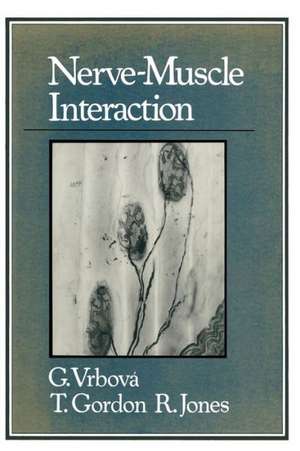
Nerve-Muscle Interaction
Autor Gerta Vrbováen Limba Engleză Paperback – mai 2012
Preț: 373.40 lei
Puncte Express: 560
Carte tipărită la comandă
Livrare economică 23 noiembrie-07 decembrie
Livrare prin curier în România Termenul estimat este afișat lângă disponibilitate.
Transport gratuit de la 400.00 lei Plată online sau ramburs, în funcție de opțiunile comenzii.
Retur gratuit în 14 zile Comandă securizată și suport în română.
Specificații
ISBN-13: 9789401095433
ISBN-10: 9401095434
Pagini: 248
Ilustrații: XIII, 233 p. 37 illus.
Dimensiuni: 155 x 235 x 14 mm
Greutate: 0.38 kg
Ediția:Softcover reprint of the original 1st ed. 1978
Editura: Springer
Locul publicării:Dordrecht, Netherlands
ISBN-10: 9401095434
Pagini: 248
Ilustrații: XIII, 233 p. 37 illus.
Dimensiuni: 155 x 235 x 14 mm
Greutate: 0.38 kg
Ediția:Softcover reprint of the original 1st ed. 1978
Editura: Springer
Locul publicării:Dordrecht, Netherlands
V-ar putea interesa
-
 Restorative Neurology of Spinal Cord InjuryMilan R. Dimitrijevic-26%Preț: 693.18 lei936.34 lei
 -
 Children of TimeAnne H WeaverPreț: 142.45 lei
 -
 Illustrated Guide to Home Biology ExperimentsRobert Bruce ThompsonPreț: 221.52 lei
Public țintă
ResearchCuprins
1 Early muscle development.- 1.1 Early stages of muscle fibre development.- 1.2 Lack of specialization of myotubes.- 1.3 The dependance of the structural integrity of the developing muscle fibres on innervation.- 2 Development of the motor nerves and their encounter with muscle fibres.- 2.1 Origin of motor nerve fibres and their growth into the periphery.- 2.2 Development of nerves and muscles and their interdependence.- 2.3 Development of stable nerve-muscle connections.- 2.4 Are nerve-muscle connections specified?.- 2.5 Conclusions.- 3 Development of the neuromuscular junction.- 3.1 Distribution of ACh receptors during early development.- 3.2 Stabilization of chemosensitivity at the neuromuscular junction.- 3.3 Development of the subneural apparatus.- 3.4 Formation of stable nerve-muscle connections.- 3.5 Changes of chemosensitivity outside the endplate.- 3.6 Maintenance of endplate chemosensitivity.- 3.7 Pattern of innervation of muscle fibres.- 3.8 Conclusions.- 4 Differentiation of skeletal muscle fibres.- 4.1 The muscles of lower vertebrates and birds.- 4.2 Mammalian muscles.- 4.3 How is differentiation into different fibre types induced?.- 4.4 Conclusions.- 5 The effects of denervation on muscle fibre properties and the regulation of chemosensitivity.- 5.1 Morphological changes following denervation.- 5.2 Metabolic changes in denervated muscles.- 5.3 Changes in contractile properties of denervated muscle.- 5.4 Changes in electrical properties of the membrane on denervation.- 5.5 Changes of chemosensitivity at the endplate.- 5.6 Conclusions.- 6 Re-innervation of the muscle by its motor nerve.- 6.1 Nerve growth.- 6.2 Establishment of nerve-muscle connections by the regenerating nerve fibre.- 6.3 Maturation of the regenerated axon and recovery of the muscle.- 6.4 Effects of muscle on normal and regenerating motor nerve terminals.- 6.5 Conclusion.- 7 The mammalian motor unit.- 7.1 Specialization of motoneurones.- 7.2 Matching properties of different motoneurones to the muscle fibres they supply.- 7.3 Specialization of the vascular bed of slow and fast mammalian muscles.- 7.4 How is the matching of muscle fibres to their motoneurones brought about?.- 7.5 Development of the motor unit.- 7.6 Conclusions.- 8 Plasticity in the neuromuscular system.- 8.1 Can different skeletal muscle fibres be transformed from one type to another?.- 8.2 Can the characteristic properties of neurones and their terminals be altered?.- 8.3 Specificity of nerve-muscle connections.- 8.4 Conclusions.- 9 Some examples of disturbances of nerve-muscle interactions.- 9.1 Disturbances caused by a change in the function of the motoneurone.- 9.2 Consequences of disease of the motoneurone, or axon.- 9.3 Disturbance due to disease of the neuromuscular junction.- 9.4 Disease of the muscle.- 9.5 Retrograde influences on the motoneurone.- References.