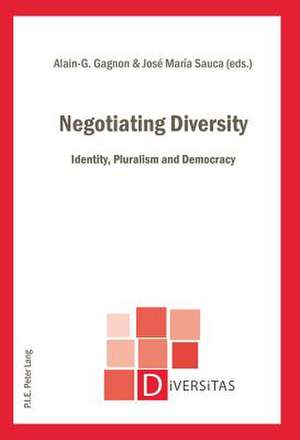
Negotiating Diversity: Diversitas, cartea 18
Editat de Alain-G. Gagnon, José María Saucaen Limba Engleză Paperback – 24 iun 2014
Din seria Diversitas
-
 Preț: 341.65 lei
- 22%
 Preț: 401.36 lei
- 9%
 Preț: 327.43 lei
-
 Preț: 231.31 lei
- 5%
 Preț: 381.87 lei
-
 Preț: 238.06 lei
-
 Preț: 335.11 lei
-
 Preț: 287.13 lei
-
 Preț: 280.76 lei
-
 Preț: 306.09 lei
-
 Preț: 369.94 lei
-
 Preț: 395.88 lei
-
 Preț: 452.30 lei
-
 Preț: 273.09 lei
-
 Preț: 330.01 lei
-
 Preț: 303.00 lei
-
 Preț: 387.76 lei
- 23%
 Preț: 545.88 lei
-
 Preț: 389.55 lei
-
 Preț: 314.70 lei
-
 Preț: 408.77 lei
-
 Preț: 373.39 lei
-
 Preț: 255.64 lei
- 8%
 Preț: 256.48 lei
- 5%
 Preț: 438.11 lei
-
 Preț: 322.77 lei
- 10%
 Preț: 279.22 lei
-
 Preț: 325.80 lei
Preț: 324.99 lei
Preț vechi: 356.63 lei
-9%
Puncte Express: 487
Carte indisponibilă temporar
Livrare prin curier în România Termenul estimat este afișat lângă disponibilitate.
Transport gratuit de la 400.00 lei Plată online sau ramburs, în funcție de opțiunile comenzii.
Retur gratuit în 14 zile Comandă securizată și suport în română.
Specificații
ISBN-13: 9782875741714
ISBN-10: 2875741713
Pagini: 260
Dimensiuni: 152 x 221 x 19 mm
Greutate: 0.36 kg
Editura: Peter Lang Gmbh, Internationaler Verlag Der W
Seria Diversitas
ISBN-10: 2875741713
Pagini: 260
Dimensiuni: 152 x 221 x 19 mm
Greutate: 0.36 kg
Editura: Peter Lang Gmbh, Internationaler Verlag Der W
Seria Diversitas
V-ar putea interesa
-
 The Philosophy of International LawSamantha Besson-10%Preț: 364.11 lei406.00 lei
-
 Looking Backward 2000-1887Edward Bellamy-19%Preț: 58.10 lei71.69 lei
-
 Discourse on the Origin of InequalityJean-Jacques Rousseau-19%Preț: 51.69 lei64.17 lei
-
 Utopianism: A Very Short IntroductionLyman Tower Sargent-20%Preț: 57.07 lei71.06 lei
-
 Globalizing Justice: The Ethics of Poverty and PowerRichard W. Miller-12%Preț: 305.53 lei348.41 lei
-
 The Philosophy of Sociality: The Shared Point of ViewRaimo Tuomela-16%Preț: 335.85 lei398.42 lei
-
 Political Philosophy: An Historical IntroductionMichael WhitePreț: 361.35 lei
-
 Marx's Discourse with HegelN. Levine-15%Preț: 731.55 lei860.64 lei
-
 Selected WritingsJeremy BenthamPreț: 267.35 lei
-
 Integrative Economic EthicsUlrich PeterPreț: 457.97 lei
-
 Zizek and PoliticsMatthew Sharpe-17%Preț: 234.79 lei281.48 lei
-
 Rawls's 'A Theory of Justice': A Reader's GuideDr Frank Lovett-17%Preț: 176.36 lei212.80 lei
-
 Chronicles of Consensual TimesSteven Corcoran-36%Preț: 249.67 lei392.37 lei
-
 Enduring InjusticeJeff Spinner-Halev-26%Preț: 156.42 lei210.26 lei
-
 A Thousand MachinesGerald RaunigPreț: 115.66 lei
-
 The OptimistLaurence ShorterPreț: 78.01 lei
-
 Introducing Political PhilosophyDave RobinsonPreț: 64.50 lei
-
 Preț: 95.83 lei
Notă biografică
Alain-G. Gagnon holds the Canada Research Chair in Québec and Canadian Studies at the Université du Québec à Montréal. His most recent books include, as author: <I>The Case for Multinational Federalism </I>(2010) and <I>Minority Nations in the Age of Uncertainty </I>(2014), as co-author: <I>Federalism, Citizenship and Quebec </I>(2007) and as co-editor: <I>Federal Democracies </I>(2011) as well as <I>Political Autonomy and Divided Societies </I>and <I>Multinational Federalism </I>(2012).<BR> José María Sauca is professor of Philosophy of Law at Carlos III University of Madrid where he leads the Research Group on Law and Justice. He is also director of <I>Eunomia. Revista en Cultura de la Legalidad</I>. He is the author of « La contribution de la Commission Bouchard-Taylor au modèle interculturel du Québec » in E. Brouillet & L.-P. Lampron, <I>La mobilisation du droit et la protection des collectivités minoritaires </I>(2013) and « Eskualde eta nortasuna: Kanadako ikasgaiak » in <I>Eleria. Euskal Herriko Legelarien Aldizkaria </I>(2011). He is also the author of <I>Identidad y Derecho. Nuevas perspectivas para viejos debates </I>(2010) and <I>Estado de Derecho y decisiones judiciales </I>(with C. Redondo & P. Andrés, 2009) and co-editor with Isabel Wences of <I>Lecturas de la </I><I>sociedad civil </I>(2007).
Cuprins
Contents: Ramón Máiz: The Normative Theory of Federalism and the Idea of Nation - François Rocher: The Federal Ideal. Empirical and Normative Explorations - Alain-G. Gagnon: Empowerment through Different Means. Nationalism and Federalism in the Canadian Context - José María Sauca: The Canadian School of Diversity's New Influences on the Theory of Collective Rights in Spain. A Critical Review of Seymour's Contribution - Jocelyn Maclure: After the Bouchard-Taylor Commission. Religious Accommodation and Human Rights in Quebec - José Woehrling: Federalism and the Protection of Rights and Freedoms. Affinities and Antagonism - Ascensión Elvira: Rights Beyond the State. The European Union and the European Court of Human Rights - Eduardo J. Ruiz Vieytez: On the (Human) Rights to Self-Determination and National Conflicts - Gérard Bouchard: What is Interculturalism? - Joxerramon Bengoetxea: Multiculturalism and Legal Pluralism. European Perspectives - María Isabel Wences: Interculturalism and Republicanism. Is Dialogue Possible?