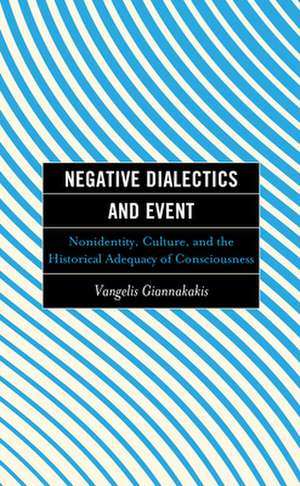
Negative Dialectics and Event: Nonidentity, Culture, and the Historical Adequacy of Consciousness: Continental Philosophy and the History of Thought
Cuvânt înainte de Brian O’Connor Autor Vangelis Giannakakisen Limba Engleză Hardback – 4 noi 2021
Din seria Continental Philosophy and the History of Thought
- 27%
 Preț: 256.31 lei
 - 25%
 Preț: 287.98 lei
 - 33%
 Preț: 624.95 lei
 - 32%
 Preț: 552.46 lei
 - 31%
 Preț: 503.35 lei
 - 33%
 Preț: 518.70 lei
 - 36%
 Preț: 526.24 lei
 - 31%
 Preț: 463.70 lei
 - 36%
 Preț: 552.65 lei
 - 35%
 Preț: 624.20 lei
 - 36%
 Preț: 525.78 lei
 - 32%
 Preț: 490.44 lei
 - 23%
 Preț: 221.62 lei
 - 32%
 Preț: 597.00 lei
 - nou
 Preț: 209.19 lei
 - nou
 Preț: 564.98 lei
Preț: 524.91 lei
Preț vechi: 815.75 lei
-36%
Puncte Express: 787
Carte tipărită la comandă
Livrare economică 04-18 decembrie
Livrare prin curier în România Termenul estimat este afișat lângă disponibilitate.
Transport gratuit pentru acest produs Plată online sau ramburs, în funcție de opțiunile comenzii.
Retur gratuit în 14 zile Comandă securizată și suport în română.
Specificații
ISBN-13: 9781793638861
ISBN-10: 1793638861
Pagini: 198
Dimensiuni: 160 x 227 x 19 mm
Greutate: 0.45 kg
Editura: Bloomsbury Publishing
Colecția Lexington Books
Seria Continental Philosophy and the History of Thought
Locul publicării:New York, United States
ISBN-10: 1793638861
Pagini: 198
Dimensiuni: 160 x 227 x 19 mm
Greutate: 0.45 kg
Editura: Bloomsbury Publishing
Colecția Lexington Books
Seria Continental Philosophy and the History of Thought
Locul publicării:New York, United States
Descriere
History is replete with false and unfulfilled promises, as well as singular acts of courage, resilience, and ingenuity. These episodes have led to significant changes in the way people think and act in the world or have set the stage for such transformations in the form of rational expectations in theory and the hopeful anticipations of dialectical imagination.
Negative Dialectics and Event: Nonidentity, Culture, and the Historical Adequacy of Consciousness revisits some of Theodor W. Adorno's most influential writings and theoretical interventions to argue not only that his philosophy is uniquely suited to bring such events into sharp relief and reflect on their entailments but also that an effective historical consciousness today would be a consciousness awake to the events that interpellate and shape it into existence.
More broadly, Vangelis Giannakakis presents a compelling argument in support of the view that the critical theory developed by the first generation of the Frankfurt School still has much to offer in terms of both cultivating insights into contemporary human experience and building resistance against states of affairs that impede human flourishing and happiness.
Negative Dialectics and Event: Nonidentity, Culture, and the Historical Adequacy of Consciousness revisits some of Theodor W. Adorno's most influential writings and theoretical interventions to argue not only that his philosophy is uniquely suited to bring such events into sharp relief and reflect on their entailments but also that an effective historical consciousness today would be a consciousness awake to the events that interpellate and shape it into existence.
More broadly, Vangelis Giannakakis presents a compelling argument in support of the view that the critical theory developed by the first generation of the Frankfurt School still has much to offer in terms of both cultivating insights into contemporary human experience and building resistance against states of affairs that impede human flourishing and happiness.
Cuprins
Foreword by Brian O'Connor
Acknowledgments
Permissions
Prologue
Part One: Philosophy and the Concept of Nonidentity
I. Negative Dialectics and the Historical Adequacy of Consciousness
Part Two: Politics and the Notion of Event
II. Adorno, Badiou and the Politics of Breaking Out
III. May '68 and Adorno, Theoretical Refractions in the Time of Revolt
Part Three: Society, Cultural Criticism and Historical Consciousness
IV. The Relevance of the Theory of Pseudo-Culture
V. The Erosion of Historical Consciousness and the New Old Barbarism
Epilogue
Bibliography
Index
About the author
Acknowledgments
Permissions
Prologue
Part One: Philosophy and the Concept of Nonidentity
I. Negative Dialectics and the Historical Adequacy of Consciousness
Part Two: Politics and the Notion of Event
II. Adorno, Badiou and the Politics of Breaking Out
III. May '68 and Adorno, Theoretical Refractions in the Time of Revolt
Part Three: Society, Cultural Criticism and Historical Consciousness
IV. The Relevance of the Theory of Pseudo-Culture
V. The Erosion of Historical Consciousness and the New Old Barbarism
Epilogue
Bibliography
Index
About the author
Recenzii
The originality of the book lies not only in the critical re-reading of [...] lesser-studied works [by Adorno] but also in the way Giannakakis juxtaposes them with the philosophy of the contemporary French thinker Alain Badiou, in particular his theory of the 'event'. Giannakakis' central argument is that a combined reading of Adorno and Badiou - two philosophers originating from ostensibly divergent traditions - can yield a deeper understanding of certain pressing problems in contemporary capitalist society and perhaps even gesture toward possible solutions.
Can dialectical thought still carve our late capitalist reality at its joints? In this bold, lucid, and searching book, Vangelis Giannakakis revisits the writings of Theodor W. Adorno to make a compelling case for negative dialectics as a vital intellectual resource in the face of our 'new old barbarism.' He does so by recalling, from different angles, the imperative to think together negation and novelty-and by bringing Adorno into an unexpected if fruitful dialogue with the philosophy of Alain Badiou. An important intervention for all those persuaded that the first axiom of a critical, emancipatory philosophy is: society must not be defended.
What is the connection between a critical, historical experience and the concept of the event? In his superb and penetrating study of Adorno and Badiou, Vangelis Giannakakis articulates a compelling and novel response to this question. Through illuminating explorations of the concepts of experience, the nonidentical, the shudder and the event, Giannakakis outlines a new path for Critical Theory in the 21st Century. This fine book is itself an event, a breakout from totality into undiminished experience.
Can dialectical thought still carve our late capitalist reality at its joints? In this bold, lucid, and searching book, Vangelis Giannakakis revisits the writings of Theodor W. Adorno to make a compelling case for negative dialectics as a vital intellectual resource in the face of our 'new old barbarism.' He does so by recalling, from different angles, the imperative to think together negation and novelty-and by bringing Adorno into an unexpected if fruitful dialogue with the philosophy of Alain Badiou. An important intervention for all those persuaded that the first axiom of a critical, emancipatory philosophy is: society must not be defended.
What is the connection between a critical, historical experience and the concept of the event? In his superb and penetrating study of Adorno and Badiou, Vangelis Giannakakis articulates a compelling and novel response to this question. Through illuminating explorations of the concepts of experience, the nonidentical, the shudder and the event, Giannakakis outlines a new path for Critical Theory in the 21st Century. This fine book is itself an event, a breakout from totality into undiminished experience.
Notă biografică
Vangelis Giannakakis is a Research Affiliate and Adjunct Lecturer in Philosophy at Goethe University Frankfurt, Germany.