Cantitate/Preț
Produs

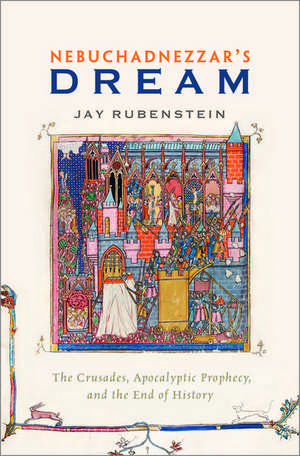
Nebuchadnezzar's Dream: The Crusades, Apocalyptic Prophecy, and the End of History

Autor Jay Rubenstein
en Limba Engleză Hardback – 21 mar 2019

Analizând sursele teologice și istoriografice ale Oxford University Press, reținem modul în care Jay Rubenstein reconstruiește universul mental al secolului al XII-lea în Nebuchadnezzar's Dream. Lucrarea nu se limitează la cronica militară, ci investighează modul în care succesul Primei Cruciade a fost perceput ca o validare a profețiilor biblice, în special a visului regelui Nabucodonosor din Cartea lui Daniel. Autorul demonstrează cum interpretarea statuii cu picioare de lut a oferit cadrul ideologic prin care Europa Medievală a încetat să se mai vadă ca o periferie geografică, asumându-și rolul de centru al planului divin.

Ne-a atras atenția rigoarea cu care Jay Rubenstein urmărește transformarea cruciatului dintr-un simplu actor într-un agent al propriei mântuiri. Această ediție publicată de OUP USA extinde cadrul propus de The Bible and Crusade Narrative in the Twelfth Century de Katherine Katherine Smith cu date noi din perioada de tranziție dintre Prima și a Doua Cruciadă, explorând momentul în care realitatea politică a început să contrazică așteptările apocaliptice. Stilul este analitic și precis, evitând generalizările și ancorând fiecare concluzie în textele teologilor vremii.

În contextul operei sale, Nebuchadnezzar's Dream reprezintă o evoluție naturală de la Armies of Heaven, unde autorul se concentra pe violența și misticismul campaniilor militare. Dacă în Guibert of Nogent Jay Rubenstein analiza psihologia individuală a unui cronicar, aici el ridică miza spre o istorie intelectuală a întregii creștinătăți latine. Rezultatul este o examinare fascinantă a modului în care eșecul militar de mai târziu a forțat o reevaluare a memoriei istorice, temă centrală și în Remembering the Crusades de Nicholas Paul.

Citește tot Restrânge

Preț: 30529 lei

Puncte Express: 458

Carte disponibilă

Livrare economică 14-28 mai


Specificații

ISBN-13: 9780190274207
ISBN-10: 0190274204
Pagini: 304
Ilustrații: 16 color images
Dimensiuni: 236 x 165 x 31 mm
Greutate: 0.57 kg
Editura: Oxford University Press
Colecția OUP USA
Locul publicării:New York, United States

De ce să citești această carte

Recomandăm această lucrare istoricilor și studenților interesați de mentalitățile medievale și de relația dintre escatologie și politică. Cititorul va înțelege cum profețiile biblice au modelat geopolitica secolului al XII-lea și cum eșecul celei de-a Doua Cruciade a pus capăt visului unei unificări spirituale prin forță. Este o analiză esențială pentru a descifra rădăcinile identității occidentale și ale excepționalismului religios.


Despre autor

Jay Rubenstein este un istoric respectat, specializat în perioada medievală, cunoscut pentru abordările sale care combină istoria intelectuală cu cea militară. Opera sa explorează frecvent teme precum misticismul, profețiile apocaliptice și impactul Cruciadelor asupra conștiinței europene. Prin lucrări precum Guibert of Nogent, a demonstrat o capacitate deosebită de a analiza mentalitățile complexe ale vremii, fiind considerat un expert în utilizarea cronicilor medievale pentru a ilumina viața spirituală și politică a secolului al XII-lea.


Descriere

In 1099, the soldiers of the First Crusade, summoned by the Pope and gathered from throughout Christendom, took Jerusalem. As the news of this victory spread throughout Medieval Europe, it felt nothing less than miraculous and dream-like, to such an extent that many believed history itself had been fundamentally altered by the event and that the Rapture was at hand. As a result of military conquest, Christians could see themselves as agents of rather than mere actors in their own salvation.The capture of Jerusalem changed everything. A loosely defined geographic backwater, comprised of petty kingdoms and shifting alliances, Medieval Europe began now to imagine itself as the center of the world. The West had overtaken the East not just on the world's stage but in God's plans. To justify this, its writers and thinkers turned to ancient prophecies, and specifically to one of the most enigmatic passages in the Bible--the dream King Nebuchadnezzar has in the Book of Daniel, of a statue with a golden head and feet of clay. Conventional interpretation of the dream transformed the state into a series of kingdoms, each less glorious than the last, leading inexorably to the end of all earthly realms--in short, to the Apocalypse. The First Crusade signified to Christians that the dream of Nebuchadnezzar would be fulfilled on their terms. Such heady reconceptions continued until the disaster of the Second Crusade and with it the collapse of any dreams of unification or salvation-any notion that conquering the Holy Land and defeating the Infidel could absolve sin. In Nebuchadnezzar's Dream, Jay Rubenstein boldly maps out the steps by which these social, political, economic, and intellectual shifts occurred throughout the 12th century, drawing on those who guided and explained them. The Crusades raised the possibility of imagining the Apocalypse as more than prophecy but actual event. Rubenstein examines how those who confronted the conflict between prophecy and reality transformed the meaning and memory of the Crusades as well as their place in history.

Recenzii

Rubenstein has added a further dimension to our understanding of the crusades and of medieval apocalyptic thought, and for this his book should be welcomed.
...a stimulating study from one of the best specialists of the crusade ideology.
This book displays a wealth of learning and reads like a novel. Jay Rubenstein offers intellectual history in a narrative form, and his book of history is, to a large extent, a book of stories about persons, as much as about ideas.
Nebuchadnezzar's Dream is as informative as it is entertaining. Rubenstein has clear mastery of a substantial corpus of medieval and historiographical sources that allows him to traverse the complex ideas of medieval theologians with grace.

Notă biografică

Jay Rubenstein is Riggsby Director of the Marco Institute for Medieval and Renaissance Studies and Alvin and Sally Beaman Professor of History at the University of Tennessee, Knoxville.