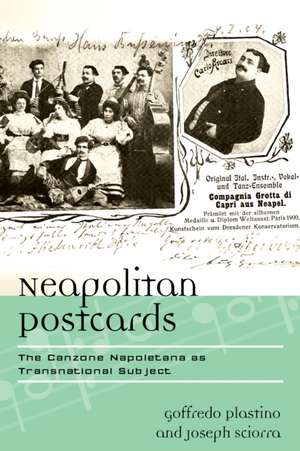
Neapolitan Postcards: The Canzone Napoletana as Transnational Subject: Europea: Ethnomusicologies and Modernities
Editat de Goffredo Plastino, Joseph Sciorraen Limba Engleză Hardback – 22 iun 2016
This book is the first scholarly work that considers the specific complexities of the international Neapolitan Song scenes through case studies from Argentina, England, Greece, and the United States, employing analyses of compositions, iconographical sources, international films, mechanical musical instruments, performances, and recordings devoted to the canzone napoletana.
Din seria Europea: Ethnomusicologies and Modernities
- 33%
 Preț: 808.79 lei
 - 31%
 Preț: 461.59 lei
 - 57%
 Preț: 397.42 lei
 - 37%
 Preț: 724.45 lei
 - 38%
 Preț: 652.35 lei
 - 33%
 Preț: 578.99 lei
 - 35%
 Preț: 594.98 lei
 - 32%
 Preț: 461.03 lei
 - 35%
 Preț: 681.48 lei
 - 36%
 Preț: 679.46 lei
 - 38%
 Preț: 717.54 lei
 - 31%
 Preț: 398.71 lei
 - 34%
 Preț: 415.56 lei
 - 34%
 Preț: 509.17 lei
 - 34%
 Preț: 414.22 lei
 - 35%
 Preț: 468.83 lei
Preț: 692.66 lei
Preț vechi: 1056.49 lei
-34%
Puncte Express: 1039
Carte disponibilă
Livrare economică 02-16 noiembrie
Livrare prin curier în România Termenul estimat este afișat lângă disponibilitate.
Transport gratuit pentru acest produs Plată online sau ramburs, în funcție de opțiunile comenzii.
Retur gratuit în 14 zile Comandă securizată și suport în română.
Specificații
ISBN-13: 9780810881594
ISBN-10: 0810881594
Pagini: 266
Ilustrații: 42 b/w illustrations; 14 tables;
Dimensiuni: 160 x 232 x 24 mm
Greutate: 0.62 kg
Ediția:New.
Editura: Bloomsbury Publishing
Colecția Rowman & Littlefield
Seria Europea: Ethnomusicologies and Modernities
Locul publicării:New York, United States
ISBN-10: 0810881594
Pagini: 266
Ilustrații: 42 b/w illustrations; 14 tables;
Dimensiuni: 160 x 232 x 24 mm
Greutate: 0.62 kg
Ediția:New.
Editura: Bloomsbury Publishing
Colecția Rowman & Littlefield
Seria Europea: Ethnomusicologies and Modernities
Locul publicării:New York, United States
V-ar putea interesa
-
 Some Sunny DayDame Vera LynnPreț: 65.01 lei
 -
 Electric ShockPeter Doggett-17%Preț: 90.43 lei109.06 lei
 -
 The Music of James BondJon Burlingame-24%Preț: 167.45 lei220.61 lei
 -
 -28%Preț: 65.55 lei90.95 lei
 -
 Aled JonesAled Jones-18%Preț: 52.39 lei64.17 lei
 -
 Joe Longthorne - Sugar in the MorningJoe LongthornePreț: 123.68 lei
 -
 Joe DolanRonan CaseyPreț: 137.77 lei
Cuprins
Foreword: Neapolitan Postcards
Martin Stokes
Chapter 1: Echoes of Naples
Goffredo Plastino
Chapter 2: A Mediterranean Triangle: Naples, Smyrna, Athens
Franco Fabbri
Chapter 3: The Neapolitan Sound Goes Around: Mechanical Music Instruments, Talking Machines, and Neapolitan Song (1850-1925)
Anita Pesce
Chapter 4: The Folk Within: On Some Neapolitan Productions in Early Twentieth-Century
Italian-American Records
Giuliana Fugazzotto
Chapter 5: New York City Neapolitan Music from the Calandra Institute's Mark Pezzano Collection
Rosangela Briscese and Joseph Sciorra
Chapter 6: You Can Go Home Again, and Again: Santa Lucia Luntana, the Film
Giorgio Bertellini
Chapter 7: Diasporic Musings on Veracity and Uncertainties of "Core 'ngrato"
Joseph Sciorra
Chapter 8: Napoli in Buenos Aires: From Canzonetta to Tango Canción
Ana Cara
Chapter 9: The Good, the Bad, and the Ugly: Transatlantic Stereotypes 1880s-1950s
Paolo Prato
Chapter 10: Blues in the Bay: The Bluesology of James Senese and Raiz
Alessand
Martin Stokes
Chapter 1: Echoes of Naples
Goffredo Plastino
Chapter 2: A Mediterranean Triangle: Naples, Smyrna, Athens
Franco Fabbri
Chapter 3: The Neapolitan Sound Goes Around: Mechanical Music Instruments, Talking Machines, and Neapolitan Song (1850-1925)
Anita Pesce
Chapter 4: The Folk Within: On Some Neapolitan Productions in Early Twentieth-Century
Italian-American Records
Giuliana Fugazzotto
Chapter 5: New York City Neapolitan Music from the Calandra Institute's Mark Pezzano Collection
Rosangela Briscese and Joseph Sciorra
Chapter 6: You Can Go Home Again, and Again: Santa Lucia Luntana, the Film
Giorgio Bertellini
Chapter 7: Diasporic Musings on Veracity and Uncertainties of "Core 'ngrato"
Joseph Sciorra
Chapter 8: Napoli in Buenos Aires: From Canzonetta to Tango Canción
Ana Cara
Chapter 9: The Good, the Bad, and the Ugly: Transatlantic Stereotypes 1880s-1950s
Paolo Prato
Chapter 10: Blues in the Bay: The Bluesology of James Senese and Raiz
Alessand
Recenzii
The international group of contributors in this book works effectively within this critical framework to investigate unexplored transnational aspects of the intimate, yet globally popular, canzone napoletana.
Repertoires are traditionally studied in relation to their native habitat. Much as that is needed, it does not tell us the whole story. That's because many of them, in time, develop transnational dimensions. An understanding of how, when, and why that happens yields extraordinary insights into the nature of the music itself, and that of the people who, for any number of reasons, choose to establish a relationship with a repertoire which should in principle be foreign to them. This book, devoted to the Neapolitan song tradition, is a brilliant example of this new approach, one that will hopefully set both a standard and a trend.
Neapolitan Postcards announces a paradigm shift just as important as the one initiated by Paul Gilroy's The Black Atlantic two decades ago. These sophisticated essays-themselves trans-Atlantic in origin-tell of a diasporic intimacy centered on Neapolitan music's Mediterranean, African, Arab, and circum-Atlantic creolized sound. I cannot recommend this book too highly.
Repertoires are traditionally studied in relation to their native habitat. Much as that is needed, it does not tell us the whole story. That's because many of them, in time, develop transnational dimensions. An understanding of how, when, and why that happens yields extraordinary insights into the nature of the music itself, and that of the people who, for any number of reasons, choose to establish a relationship with a repertoire which should in principle be foreign to them. This book, devoted to the Neapolitan song tradition, is a brilliant example of this new approach, one that will hopefully set both a standard and a trend.
Neapolitan Postcards announces a paradigm shift just as important as the one initiated by Paul Gilroy's The Black Atlantic two decades ago. These sophisticated essays-themselves trans-Atlantic in origin-tell of a diasporic intimacy centered on Neapolitan music's Mediterranean, African, Arab, and circum-Atlantic creolized sound. I cannot recommend this book too highly.