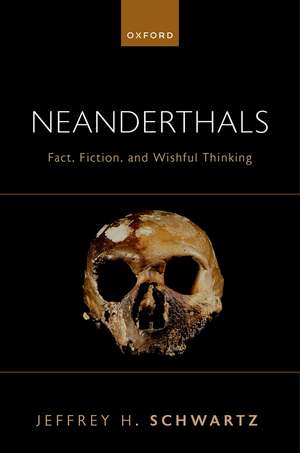
Neanderthals: Fact, Fiction, and Wishful Thinking
Autor Jeffrey H. Schwartzen Limba Engleză Hardback – 12 oct 2026
Preț: 197.39 lei
Preț vechi: 229.39 lei
-14% Nou
Puncte Express: 296
Carte disponibilă
Livrare economică 19-24 noiembrie
Livrare express 30 octombrie-05 noiembrie pentru 66.38 lei
Livrare prin curier în România Termenul estimat este afișat lângă disponibilitate.
Transport gratuit de la 400.00 lei Plată online sau ramburs, în funcție de opțiunile comenzii.
Retur gratuit în 14 zile Comandă securizată și suport în română.
Specificații
ISBN-13: 9780197785409
ISBN-10: 0197785409
Pagini: 280
Ilustrații: 59 illustrations
Dimensiuni: 166 x 243 x 23 mm
Greutate: 0.56 kg
Editura: Oxford University Press
Colecția OUP USA
Locul publicării:New York, United States
ISBN-10: 0197785409
Pagini: 280
Ilustrații: 59 illustrations
Dimensiuni: 166 x 243 x 23 mm
Greutate: 0.56 kg
Editura: Oxford University Press
Colecția OUP USA
Locul publicării:New York, United States
Recenzii
With his decades of learning and expertise, paleontologist Jeffrey Schwartz pushes back against media headlines that [Neanderthals] were "just like us" as he takes a bold stance against the thesis – including by Svante Pääbo - of Paleolithic interbreeding. Beyond the battle between morphology and molecules, Schwartz expertly leads us through the history of taxonomy and evolutionary theory from Darwin to the "Modern Evolutionary Synthesis" to paleogenomics... he shows how received wisdom born of post-war anti-racism has misshaped our understanding of hominid diversity...
This is a fascinating and deeply thought-provoking book about Neanderthals and about how scientific narratives are constructed and sustained. Drawing on decades of work in comparative morphology, genetics, and the history of paleoanthropology, Jeffrey Schwartz revisits some explanations that have acquired authority through repetition. At a time when genetic data are increasingly treated as the ultimate arbiter of human origins, he challenges readers to reconsider some of the most widely accepted assumptions in paleoanthropology. Provocative, engaging, and intellectually stimulating, this book encourages a fresh look at one of the most influential narratives about our evolutionary past.
Schwartz shines a laser onto the history of how we study the fossil evidence for human evolution, showing the main figures and events that have shaped our views of our evolutionary past. With forensic detail, he shows how grouping specimens into major categories, such as Australopithecus and Homo, excludes alternative ways of viewing the evidence. This penetrating analysis should be read by all those involved in classifying fossil hominins and make them question the soundness of their assumptions in reaching their conclusions. In Schwartz's view, the fossil evidence is far more complex (and interesting) than we are prepared to admit. This is a "must read" for researchers studying human evolution.
Schwartz is one of those rare scholars who doesn't just lob bombs-he brings receipts. His characteristic wit shines as he dissects the tainted pemmican of current human evolutionary thinking into its component parts-history, genetics, and morphology. With a taxonomist's attention to detail, he painstakingly delineates how engrained assumptions and bias arose and continues to shape our understanding of our place within nature and our relationship with our supposed closest relatives-Neanderthals. Even if you don't give a Neanderthal's double-arched brow about human evolution, you should read this book-if only to discover how much history shapes scientific thinking.
Jeffrey Schwartz-arguably one of the most experienced palaeoanthropologists in the handling of human fossils-presents a provocative challenge to one of the central narratives of human evolution... he argues that Neanderthals were neither our ancestors nor even our closest evolutionary relatives. What? This conclusion runs counter to the prevailing view, repeated in countless books and scientific papers, that Neanderthals were our closest cousins who interbred with modern humans, leaving a lasting legacy in our genomes. Schwartz builds his case through a meticulous examination of the history of palaeoanthropology, tracing how human fossils have been classified from the nineteenth century to the present.
Jeffrey Schwartz is an outlier. He is not afraid to ask the questions that an adherence to dogma and received wisdom squelch... Schwartz provides new interpretations of fossil and molecular data that question these narratives. Uniquely, Schwartz's interpretations of human-Neanderthal relationships are based on understanding how developmental biology (including molecular biology) not only explain morphological differences between fossils but expose the unrealistic assumptions that underlie claims of human-Neanderthal interbreeding and the inheritance by humans of Neanderthal genes... Schwartz's questions on Neanderthals and human evolution are refreshing. They are deep and are done seriously, earnestly, and honestly. We should not ignore them.
This is a fascinating and deeply thought-provoking book about Neanderthals and about how scientific narratives are constructed and sustained. Drawing on decades of work in comparative morphology, genetics, and the history of paleoanthropology, Jeffrey Schwartz revisits some explanations that have acquired authority through repetition. At a time when genetic data are increasingly treated as the ultimate arbiter of human origins, he challenges readers to reconsider some of the most widely accepted assumptions in paleoanthropology. Provocative, engaging, and intellectually stimulating, this book encourages a fresh look at one of the most influential narratives about our evolutionary past.
Schwartz shines a laser onto the history of how we study the fossil evidence for human evolution, showing the main figures and events that have shaped our views of our evolutionary past. With forensic detail, he shows how grouping specimens into major categories, such as Australopithecus and Homo, excludes alternative ways of viewing the evidence. This penetrating analysis should be read by all those involved in classifying fossil hominins and make them question the soundness of their assumptions in reaching their conclusions. In Schwartz's view, the fossil evidence is far more complex (and interesting) than we are prepared to admit. This is a "must read" for researchers studying human evolution.
Schwartz is one of those rare scholars who doesn't just lob bombs-he brings receipts. His characteristic wit shines as he dissects the tainted pemmican of current human evolutionary thinking into its component parts-history, genetics, and morphology. With a taxonomist's attention to detail, he painstakingly delineates how engrained assumptions and bias arose and continues to shape our understanding of our place within nature and our relationship with our supposed closest relatives-Neanderthals. Even if you don't give a Neanderthal's double-arched brow about human evolution, you should read this book-if only to discover how much history shapes scientific thinking.
Jeffrey Schwartz-arguably one of the most experienced palaeoanthropologists in the handling of human fossils-presents a provocative challenge to one of the central narratives of human evolution... he argues that Neanderthals were neither our ancestors nor even our closest evolutionary relatives. What? This conclusion runs counter to the prevailing view, repeated in countless books and scientific papers, that Neanderthals were our closest cousins who interbred with modern humans, leaving a lasting legacy in our genomes. Schwartz builds his case through a meticulous examination of the history of palaeoanthropology, tracing how human fossils have been classified from the nineteenth century to the present.
Jeffrey Schwartz is an outlier. He is not afraid to ask the questions that an adherence to dogma and received wisdom squelch... Schwartz provides new interpretations of fossil and molecular data that question these narratives. Uniquely, Schwartz's interpretations of human-Neanderthal relationships are based on understanding how developmental biology (including molecular biology) not only explain morphological differences between fossils but expose the unrealistic assumptions that underlie claims of human-Neanderthal interbreeding and the inheritance by humans of Neanderthal genes... Schwartz's questions on Neanderthals and human evolution are refreshing. They are deep and are done seriously, earnestly, and honestly. We should not ignore them.
Notă biografică
Jeffrey H. Schwartz is Professor Emeritus of the Departments of Anthropology and History & Philosophy of Science, and at Resident Fellow at the Center for Philosophy of Science at the University of Pittsburgh. He is also a Research Associate at the Division of Anthropology, The American Museum of Natural History, New York. His research interests include method and theory in evolutionary and developmental biology and genetics, palaeontology, and comparative anatomy.