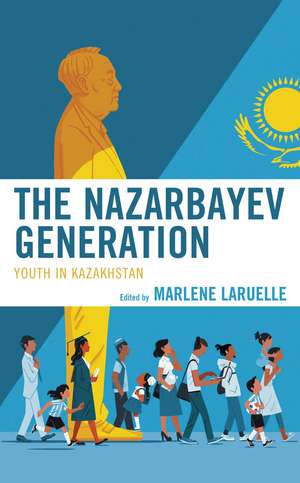
Nazarbayev Generation
Editat de Marlene Laruelleen Limba Engleză Hardback – 30 aug 2019
Preț: 824.93 lei
Preț vechi: 1006.02 lei
-18%
Puncte Express: 1237
Carte tipărită la comandă
Livrare economică 23 noiembrie-07 decembrie
Livrare prin curier în România Termenul estimat este afișat lângă disponibilitate.
Transport gratuit pentru acest produs Plată online sau ramburs, în funcție de opțiunile comenzii.
Retur gratuit în 14 zile Comandă securizată și suport în română.
Specificații
ISBN-13: 9781793609137
ISBN-10: 1793609136
Pagini: 342
Ilustrații: 21 b/w illustrations;22 tables;
Dimensiuni: 157 x 235 x 23 mm
Greutate: 0.65 kg
Editura: Bloomsbury Publishing
Locul publicării:New York, United States
ISBN-10: 1793609136
Pagini: 342
Ilustrații: 21 b/w illustrations;22 tables;
Dimensiuni: 157 x 235 x 23 mm
Greutate: 0.65 kg
Editura: Bloomsbury Publishing
Locul publicării:New York, United States
Cuprins
Introduction: "The Nazarbayev Generation: A Sociological Portrait," by Marlene Laruelle
Part I: Kazakhstani Youth and National Identity
Chapter 1: "Are Youth Different? The Nazarbayev Generation and Public Opinion," by Barbara Junisbai and Azamat Junisbai
Chapter 2: "Youth and National Identity: Then and Now," by Aziz Burkhanov
Chapter 3: "Youth and Civic National Identity," by Dina Sharipova
Chapter 4: "Mankurts, Kazakh 'Russians' and 'Shala' Kazakhs: Language, National Identity, and Ethnicity Revisited," by Diana T. Kudaibergenova
Part II: Youth Voices on Moral Changes
Chapter 5: "'We Love Our Country in Our Own Way': Youth, Gender, and Nationalism," by Ulan Bigozhin
Chapter 6: "'Cognitive Unconscious,' 'Modern Conservatism,' and 'Core Liberal Values' in the Context of Chapter 7: "Youth's National Identity," by Galym Zhussipbek and Zhanar Nagayeva
Chapter 8: "Contours of Ethnonational Landscapes in Three Cities: Youths' Perspectives on Ethnic and Social Integration," by Reuel R. Hanks
Part I
Part I: Kazakhstani Youth and National Identity
Chapter 1: "Are Youth Different? The Nazarbayev Generation and Public Opinion," by Barbara Junisbai and Azamat Junisbai
Chapter 2: "Youth and National Identity: Then and Now," by Aziz Burkhanov
Chapter 3: "Youth and Civic National Identity," by Dina Sharipova
Chapter 4: "Mankurts, Kazakh 'Russians' and 'Shala' Kazakhs: Language, National Identity, and Ethnicity Revisited," by Diana T. Kudaibergenova
Part II: Youth Voices on Moral Changes
Chapter 5: "'We Love Our Country in Our Own Way': Youth, Gender, and Nationalism," by Ulan Bigozhin
Chapter 6: "'Cognitive Unconscious,' 'Modern Conservatism,' and 'Core Liberal Values' in the Context of Chapter 7: "Youth's National Identity," by Galym Zhussipbek and Zhanar Nagayeva
Chapter 8: "Contours of Ethnonational Landscapes in Three Cities: Youths' Perspectives on Ethnic and Social Integration," by Reuel R. Hanks
Part I
Recenzii
What Marlene Laruelle's book does is to help us make sense of this and think critically about Kazakhstan and the reception of globalised norms and liberal values in non-Western societies. Such an intervention is not only informative, but also necessary for anyone trying to make sense of underlying forces shaping our world today.
In this timely volume edited by Marlene Laruelle, various aspects of Nazarbayev's legacy are examined in fifteen separate chapters engaged with understanding Kazakhstani youth attitudes, behaviors, and experiences. Through its multifaceted perspectives on the 50 percent of the country's population that was born during Nazarbayev's reign, the book offers keen insights into the cultural, social, and political context of the current transitional moment. Collectively, the chapters in this book delineate the attitudinal differences between the younger and older generations in Kazakhstan, while also tempering the expectation that the youth will uniformly push for more political liberalization as they gain political and social power in the coming years.
This impressive and timely volume provides us with survey data and cross-disciplinary analysis of Kazakhstan's independence generations. Its focus on social transformations of the last three decades is an important contribution to breaking with established, and increasingly irrelevant, narratives about the region of Central Asia.
In this timely volume edited by Marlene Laruelle, various aspects of Nazarbayev's legacy are examined in fifteen separate chapters engaged with understanding Kazakhstani youth attitudes, behaviors, and experiences. Through its multifaceted perspectives on the 50 percent of the country's population that was born during Nazarbayev's reign, the book offers keen insights into the cultural, social, and political context of the current transitional moment. Collectively, the chapters in this book delineate the attitudinal differences between the younger and older generations in Kazakhstan, while also tempering the expectation that the youth will uniformly push for more political liberalization as they gain political and social power in the coming years.
This impressive and timely volume provides us with survey data and cross-disciplinary analysis of Kazakhstan's independence generations. Its focus on social transformations of the last three decades is an important contribution to breaking with established, and increasingly irrelevant, narratives about the region of Central Asia.