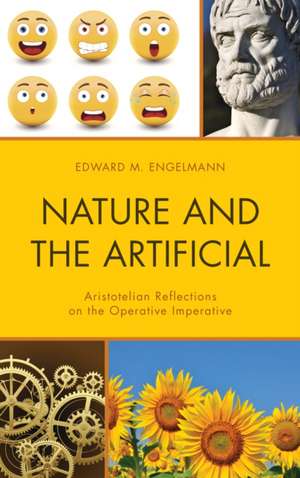
Nature and the Artificial: Aristotelian Reflections on the Operative Imperative
Autor Edward Engelmannen Limba Engleză Hardback – 21 mar 2017
Nature and the Artificial: Aristotelian Reflections on the Operative Imperative reveals the inner logic of the artificial by reflecting it off the metaphysical relationship between nature and techne as conceived by Aristotle and Thomas Aquinas. During early modernity, figures such as Descartes and Bacon transformed this understanding, giving rise to the notion of the "operative imperative." Nature and techne, for the Aristotelian tradition and for us, can only be understood in terms of their dialectical relationship to one another. Aristotle articulates this relationship with the phrase "techne imitates nature." With the operative imperative, however, a certain reversal takes place, whereby techne becomes the paradigm for nature. As Ed Engelmann demonstrates, the operative imperative, together with the phenomenon of the artificial it implies, stands to Aristotelian metaphysics of nature as image is to original.
Anyone who believes that the rise of the artificial in our civilization needs the intensive study it deserves-as well as those who are seeking innovative insights into Aristotelian tradition-will want to read this book.
Preț: 581.31 lei
Preț vechi: 862.85 lei
-33%
Puncte Express: 872
Carte tipărită la comandă
Livrare economică 20 noiembrie-04 decembrie
Livrare prin curier în România Termenul estimat este afișat lângă disponibilitate.
Transport gratuit pentru acest produs Plată online sau ramburs, în funcție de opțiunile comenzii.
Retur gratuit în 14 zile Comandă securizată și suport în română.
Specificații
ISBN-13: 9781498538848
ISBN-10: 1498538843
Pagini: 200
Ilustrații: 2 Tables
Dimensiuni: 154 x 230 x 18 mm
Greutate: 0.42 kg
Editura: Bloomsbury Publishing
Colecția Lexington Books
Locul publicării:New York, United States
ISBN-10: 1498538843
Pagini: 200
Ilustrații: 2 Tables
Dimensiuni: 154 x 230 x 18 mm
Greutate: 0.42 kg
Editura: Bloomsbury Publishing
Colecția Lexington Books
Locul publicării:New York, United States
Cuprins
Chapter 1. Second Acts, Expressive Causality, and Ontological Dependence in the Aristotelian Tradition
Chapter 2. Second Acts and Ontological Unification
Chapter 3. Theoria and Scientific Demonstration in Aristotle
Chapter 4. Aquinas and Duns Scotus on Creation and Things Created
Chapter 5. Mechanism, Substance, and Causality in the Seventeenth Century
Chapter 6. Techne in Aristotle and the Autonomous Artifact
Chapter 7. The Operative Intentional Orientation in Early Modernism
Chapter 8. Computational Theory and the Autonomous Artifact
Chapter 9. The Rise of the Artificial
Chapter 2. Second Acts and Ontological Unification
Chapter 3. Theoria and Scientific Demonstration in Aristotle
Chapter 4. Aquinas and Duns Scotus on Creation and Things Created
Chapter 5. Mechanism, Substance, and Causality in the Seventeenth Century
Chapter 6. Techne in Aristotle and the Autonomous Artifact
Chapter 7. The Operative Intentional Orientation in Early Modernism
Chapter 8. Computational Theory and the Autonomous Artifact
Chapter 9. The Rise of the Artificial
Recenzii
In his very wide ranging book Englemann offers a new and original understanding of the transition from the sciences of Aristotle to the beginnings of the "new sciences" of the 17th century and traces the rise of the artificial as a preferred model for the explanation of nature. The power of the book lies in the details and insights he offers in his close examination of Aristotelianism, early modern science, and the sciences of the artificial. He begins with theories of causation in the middle ages and ends by considering consciousness in machines. A valuable contribution to both philosophy and the history of ideas.
Ed Engelmann's book Nature and the Artificial: Aristotelian Reflections on the Operative Imperative, is an erudite and challenging look at the roots of today's operative, and ultimately artificial intelligence. It traces the history of the Aristotelian worldview, and shows that our current paradigm it relation to it as image to original. It will provoke a much-needed reassessment of that tradition.
Ed Engelmann's book Nature and the Artificial: Aristotelian Reflections on the Operative Imperative, is an erudite and challenging look at the roots of today's operative, and ultimately artificial intelligence. It traces the history of the Aristotelian worldview, and shows that our current paradigm it relation to it as image to original. It will provoke a much-needed reassessment of that tradition.