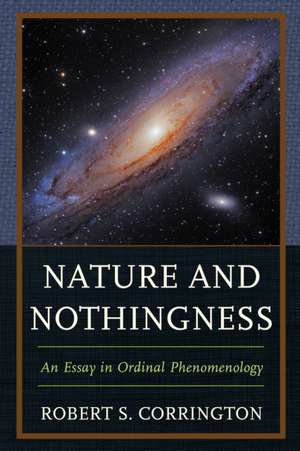
Nature and Nothingness: An Essay in Ordinal Phenomenology
Autor Robert S. Corringtonen Limba Engleză Paperback – 15 oct 2018
| Toate formatele și edițiile | Preț | Express |
|---|---|---|
| Paperback (1) | 249.03 lei 6-8 săpt. | |
| Bloomsbury Publishing – 15 oct 2018 | 249.03 lei 6-8 săpt. | |
| Hardback (1) | 552.46 lei 6-8 săpt. | |
| Bloomsbury Publishing – 23 ian 2017 | 552.46 lei 6-8 săpt. |
Preț: 249.03 lei
Preț vechi: 338.89 lei
-27%
Puncte Express: 374
Preț estimativ în valută:
44.10€ • 51.51$ • 38.31£
44.10€ • 51.51$ • 38.31£
Carte tipărită la comandă
Livrare economică 21 februarie-07 martie
Preluare comenzi: 021 569.72.76
Specificații
ISBN-13: 9781498545198
ISBN-10: 149854519X
Pagini: 186
Dimensiuni: 152 x 220 x 14 mm
Greutate: 0.28 kg
Editura: Bloomsbury Publishing
Colecția Lexington Books
Locul publicării:New York, United States
ISBN-10: 149854519X
Pagini: 186
Dimensiuni: 152 x 220 x 14 mm
Greutate: 0.28 kg
Editura: Bloomsbury Publishing
Colecția Lexington Books
Locul publicării:New York, United States
Cuprins
Chapter One: Religion, Violence, and Nature
Chapter Two: Horror and Totalizing Nothingness
Chapter Three: Nature's Psyche
Chapter Four: Art, Barbarism, and Civilization
Chapter Five: Naturing Nothingness
Chapter Six: Encompassing Nothingness
Chapter Two: Horror and Totalizing Nothingness
Chapter Three: Nature's Psyche
Chapter Four: Art, Barbarism, and Civilization
Chapter Five: Naturing Nothingness
Chapter Six: Encompassing Nothingness
Recenzii
This book is an important continuation of Robert S. Corrington's Ecstatic Naturalism and further expands his thesis on the dangers of tribalism and dogmatic religion within the context of the nothingness that individuals and communities encounter in nature. Corrington's signature aptitude for drawing on a broad range of philosophical, theological, and psychoanalytic thinkers to inform his ideas is especially pronounced in this book, which is one in a series of works on Ecstatic Naturalism that focuses on the inherent challenges and potencies of the Selving process. Nature and Nothingness is a must-read for anyone who is interested in gaining a keener insight into the semiotic richness of the realm of nature that is often underestimated or simply ignored.
With Nature and Nothingness: An Essay in Ordinal Phenomenology, Robert Corrington continues his audacious and at times lyrical inquiry into the dynamic plenitude and potencies of the Orders of Nature, the world we live in. Extending and deepening our understanding of Ecstatic Naturalism and Deep Pantheism, deftly bridging the traditional gaps between American, Continental, and Asian thought, this work demonstrates how much of substance and significance the concept of Nothingness can yield.
With a deep contemplation of nature as betweenizing nature naturing and nature natured, Robert S. Corrington offers this brilliant masterpiece of nothingness and nature as marvelous logarithmic spirals that generates spatio-temporal holes in nature. In Nature and Nothingness: An Essay in Ordinal Phenomenology, Corrington unfolds the complex spirals of nature like a series of panoramic circles of nothingness. Through God-ing/ Selving process, Corrington's nothingness realizes the whole encompassing nothingness without overlooking nature's dukkha (suffering), rupture, tragedy, shadow, horror, and himsa (violence). Totalizing nothingness of religion is being stripped and urged a turning back, involution to naturing nothingness. This dramatic process toward encompassing nothingness takes a comparative methodology via Buddhist-Daoist-Ecstatic Naturalist dialogues. Presenting an ethic of nothingness, the 'how' of nature, this book is Corrington's most practical to date.
In this ground-breaking books, Corrington's insight that the depth of nature as all that is is nothingness is mediated by the American intellectual tradition of interpretation which is the Peircean semiotics. Partly due to his depth language, Corrington has been an unsung hero for the American intellectual tradition. With this book, Corrington at last reaches at the East Asia. This ground-breaking work is a big progress for ecstatic naturalism and American intellectual tradition in that ecstatic naturalism now comes to be an intellectual partner with East Asian thought as well as Buddhism.
With Nature and Nothingness: An Essay in Ordinal Phenomenology, Robert Corrington continues his audacious and at times lyrical inquiry into the dynamic plenitude and potencies of the Orders of Nature, the world we live in. Extending and deepening our understanding of Ecstatic Naturalism and Deep Pantheism, deftly bridging the traditional gaps between American, Continental, and Asian thought, this work demonstrates how much of substance and significance the concept of Nothingness can yield.
With a deep contemplation of nature as betweenizing nature naturing and nature natured, Robert S. Corrington offers this brilliant masterpiece of nothingness and nature as marvelous logarithmic spirals that generates spatio-temporal holes in nature. In Nature and Nothingness: An Essay in Ordinal Phenomenology, Corrington unfolds the complex spirals of nature like a series of panoramic circles of nothingness. Through God-ing/ Selving process, Corrington's nothingness realizes the whole encompassing nothingness without overlooking nature's dukkha (suffering), rupture, tragedy, shadow, horror, and himsa (violence). Totalizing nothingness of religion is being stripped and urged a turning back, involution to naturing nothingness. This dramatic process toward encompassing nothingness takes a comparative methodology via Buddhist-Daoist-Ecstatic Naturalist dialogues. Presenting an ethic of nothingness, the 'how' of nature, this book is Corrington's most practical to date.
In this ground-breaking books, Corrington's insight that the depth of nature as all that is is nothingness is mediated by the American intellectual tradition of interpretation which is the Peircean semiotics. Partly due to his depth language, Corrington has been an unsung hero for the American intellectual tradition. With this book, Corrington at last reaches at the East Asia. This ground-breaking work is a big progress for ecstatic naturalism and American intellectual tradition in that ecstatic naturalism now comes to be an intellectual partner with East Asian thought as well as Buddhism.