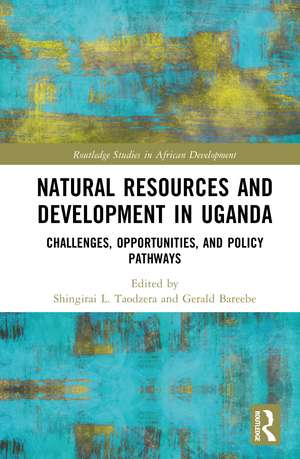
Natural Resources and Development in Uganda: Challenges, Opportunities, and Policy Pathways: Routledge Studies in African Development
Editat de Shingirai L. Taodzera, Gerald Bareebeen Limba Engleză Hardback – 4 mar 2027
Uganda is endowed with a range of valuable renewable and non-renewable natural resources, such as land, freshwater, forestry, minerals, and oil, attracting the interest of commercial entities, policymakers, and development practitioners. This book foregrounds the voices of diverse stakeholders at both the community and national levels to consider the challenges and opportunities within Uganda’s extractive resource sectors. The book critically examines patterns of governance and also the socio-environmental impacts of extraction on human livelihoods, ecosystems, biodiversity, national politics, and international relations.
Drawing on detailed empirical, case-based, and experiential knowledge, this book will be of interest to researchers across the fields of African Studies, Political Science, International Political Economy, Global Development, Anthropology, and Environmental Governance.
Din seria Routledge Studies in African Development
- 18%
 Preț: 1037.30 lei
 -
 Preț: 439.33 lei
 -
 Preț: 204.12 lei
 -
 Preț: 364.20 lei
 - 15%
 Preț: 421.01 lei
 - 18%
 Preț: 1150.52 lei
 - 15%
 Preț: 454.35 lei
 - 15%
 Preț: 416.68 lei
 - 18%
 Preț: 1066.13 lei
 - 15%
 Preț: 422.92 lei
 - 18%
 Preț: 1127.37 lei
 -
 Preț: 240.33 lei
 - 18%
 Preț: 1109.31 lei
 -
 Preț: 425.46 lei
 -
 Preț: 412.96 lei
 -
 Preț: 410.99 lei
 - 18%
 Preț: 1255.33 lei
 -
 Preț: 493.79 lei
 - 5%
 Preț: 397.05 lei
 - 15%
 Preț: 421.37 lei
 - 15%
 Preț: 477.42 lei
 -
 Preț: 439.07 lei
 - 15%
 Preț: 447.37 lei
 -
 Preț: 404.23 lei
 - 18%
 Preț: 1003.26 lei
 - 18%
 Preț: 948.65 lei
 - 18%
 Preț: 1062.99 lei
 - 18%
 Preț: 1057.86 lei
 -
 Preț: 404.33 lei
 - 18%
 Preț: 1112.48 lei
 - 18%
 Preț: 1150.52 lei
 - 18%
 Preț: 1057.86 lei
 - 15%
 Preț: 433.06 lei
 - 18%
 Preț: 1114.04 lei
Preț: 1138.53 lei
Preț vechi: 1484.95 lei
-23% Precomandă
Puncte Express: 1708
Carte nepublicată încă
Livrare prin curier în România Precomanda se expediază când titlul devine disponibil.
Transport gratuit pentru acest produs Plată online sau ramburs, în funcție de opțiunile comenzii.
Retur gratuit în 14 zile Comandă securizată și suport în română.
Doresc să fiu notificat când acest titlu va fi disponibil:
Se trimite...
Specificații
ISBN-13: 9781041316077
ISBN-10: 1041316070
Pagini: 226
Ilustrații: 4
Dimensiuni: 156 x 234 mm
Ediția:1
Editura: Taylor & Francis
Colecția Routledge
Seria Routledge Studies in African Development
Locul publicării:Oxford, United Kingdom
ISBN-10: 1041316070
Pagini: 226
Ilustrații: 4
Dimensiuni: 156 x 234 mm
Ediția:1
Editura: Taylor & Francis
Colecția Routledge
Seria Routledge Studies in African Development
Locul publicării:Oxford, United Kingdom
Public țintă
Academic and PostgraduateCuprins
Introduction: The politics of natural resource governance in Uganda, 1.Customary Institutions and Natural Resource Governance in Uganda: A Multi-Stakeholder Perspective, 2, “The tip of your hoe has cut into my land”: Gendered land conflicts and resource extraction in post-war Northern Uganda, 3.Disability and Exclusion in the Extractive Industries: A Case Study of Stone Quarrying in Kabale, Uganda, 4.From Protection to Control: The UPDF and the Militarization of Wildlife and Fisheries in Uganda, 5. The Effects of Institutional Choice and Local Representation in Uganda’s Local Forest Governance: The Wabigaro Local Forest Reserve Case, Mpigi, 6. Addressing Human-Wildlife Conflict in Uganda: Trust and Coexistence, 7. Petroleum Endowments and North-South Relations: Uganda-USA Relations In Perspective, 8. Lions, Foxes and Hyenas on the Prowl: Elite Capture of Mineral-Endowed Karamoja Region, North-Eastern Uganda, Conclusion: Threats and Pathways in Uganda's Resource Governance
Notă biografică
Shingirai Taodzera
Dr. Taodzera is an Assistant Professor in the Department of African American and African Studies at the University of California, Davis. His research and teaching focus on the political economy of development in East and Southern Africa, with particular emphasis on the governance of extractive natural resources, especially land, oil, and minerals. He received his PhD in International Development from the University of Ottawa in Canada. His first monograph, (In Press) titled “Resourceful Kingdoms: Customary Institutions, Contested Ownership and Community Development in Africa”, will be published by Ohio University Press. The project examines how the inclusion of indigenous customary institutions in the governance of land, minerals, and oil can contribute to political representation, poverty reduction, economic growth, the mitigation of environmental harm, and the achievement of sustainable development in Africa.
Gerald Bareebe
Dr. Bareebe is an Associate Professor in the Department of Politics at York University, Canada. His research and teaching focus on comparative politics of the Global South, civil wars, authoritarian regimes, and post-conflict governance. He holds a PhD in Political Science from the University of Toronto, as well as master’s degrees in International Relations from Makerere University and in Governance and Development from the University of Antwerp, Belgium. His scholarship has appeared in leading peer-reviewed journals including African Affairs, Civil Wars, Commonwealth & Comparative Politics, and the Journal of Democracy, as well as in edited volumes on African and comparative politics. His most recent book, Social Structures and the Making of Museveni's Civil-Authoritarianism in Uganda (Palgrave Macmillan), examines the durability of Yoweri Museveni's regime, showing how residual social structures — monarchies, churches, landed elites, and legacy political parties — that survived decades of political upheaval have continued to constrain authoritarian consolidation and underpin the NRM's enduring hold on power.
Dr. Taodzera is an Assistant Professor in the Department of African American and African Studies at the University of California, Davis. His research and teaching focus on the political economy of development in East and Southern Africa, with particular emphasis on the governance of extractive natural resources, especially land, oil, and minerals. He received his PhD in International Development from the University of Ottawa in Canada. His first monograph, (In Press) titled “Resourceful Kingdoms: Customary Institutions, Contested Ownership and Community Development in Africa”, will be published by Ohio University Press. The project examines how the inclusion of indigenous customary institutions in the governance of land, minerals, and oil can contribute to political representation, poverty reduction, economic growth, the mitigation of environmental harm, and the achievement of sustainable development in Africa.
Gerald Bareebe
Dr. Bareebe is an Associate Professor in the Department of Politics at York University, Canada. His research and teaching focus on comparative politics of the Global South, civil wars, authoritarian regimes, and post-conflict governance. He holds a PhD in Political Science from the University of Toronto, as well as master’s degrees in International Relations from Makerere University and in Governance and Development from the University of Antwerp, Belgium. His scholarship has appeared in leading peer-reviewed journals including African Affairs, Civil Wars, Commonwealth & Comparative Politics, and the Journal of Democracy, as well as in edited volumes on African and comparative politics. His most recent book, Social Structures and the Making of Museveni's Civil-Authoritarianism in Uganda (Palgrave Macmillan), examines the durability of Yoweri Museveni's regime, showing how residual social structures — monarchies, churches, landed elites, and legacy political parties — that survived decades of political upheaval have continued to constrain authoritarian consolidation and underpin the NRM's enduring hold on power.
Descriere
Drawing on detailed empirical, case-based, and experiential knowledge, this book will be of interest to researchers across the fields of African Studies, Political Science, International Political Economy, Global Development, Anthropology, and Environmental Governance.