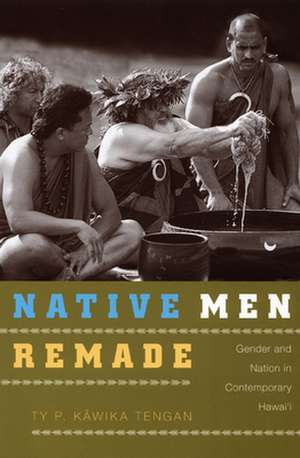
Native Men Remade: Gender and Nation in Contemporary Hawai'i
Autor Ty P. Kawika Tenganen Limba Engleză Paperback – 19 oct 2008
Preț: 240.57 lei
Puncte Express: 361
Preț estimativ în valută:
42.53€ • 50.45$ • 36.82£
42.53€ • 50.45$ • 36.82£
Carte tipărită la comandă
Livrare economică 18 martie-01 aprilie
Specificații
ISBN-13: 9780822343219
ISBN-10: 0822343215
Pagini: 277
Ilustrații: 25 illustrations
Dimensiuni: 155 x 231 x 18 mm
Greutate: 0.43 kg
Editura: Duke University Press
ISBN-10: 0822343215
Pagini: 277
Ilustrații: 25 illustrations
Dimensiuni: 155 x 231 x 18 mm
Greutate: 0.43 kg
Editura: Duke University Press
V-ar putea interesa
-
 The Complete Book of Pilates for MenDaniel LyonPreț: 120.37 lei
 -
 Thats My BoyJenni MurrayPreț: 110.33 lei
 -
 Biddulph, S: ManhoodSteve Biddulph-30%Preț: 89.94 lei128.05 lei
 -
 Feminism and MasculinitiesPeter F. Murphy-24%Preț: 341.97 lei447.98 lei
 -
 Meanings of Manhood in Early Modern EnglandAlexandra Shepard-24%Preț: 392.47 lei518.59 lei
 -
 Preț: 268.11 lei
 -
 Iron JohnRobert Bly-22%Preț: 79.64 lei101.58 lei
 -
 MasculinitiesRaewyn ConnellPreț: 162.05 lei
 -
 Uncommon: Finding Your Path to SignificanceTony DungyPreț: 96.02 lei
 -
 Preț: 114.89 lei
 -
 -23%Preț: 261.55 lei338.79 lei
Cuprins
List of Illustrations; Preface; Acknowledgements1: Introduction: Lele I Ka Po; 2: Engagements with Modernity; 3: Re-membering Nationhood and Koa at the Temple of State; 4: Puukohola: At The Mound Of The Whale; 5: Ka I Mua--Cast in the Mens House; 6: Narrating Kanaka: Talk Story, Place and Identity; 7: Conclusion: The Journeys of Hawaiian MenAppendix; Notes; Glossary of Hawaiian Words; References
Recenzii
"This book concerns a distinctive Hawaiian mens movement dedicated to decolonizing male consciousness by means of ritualized physical disciplines modeled after historically resonant warrior images. The writing is powerful, and the point of view is a compelling blend of interpretive humility and analytical forthrightness. Offering a wealth of insider testimony drawn from detailed interviews and from his own engaged experience in the Hale Mua, Ty P. Kawika Tengan makes contemporary Hawaiian struggles and sensibilities accessible to non-Hawaiians by contextualizing them historically, culturally, and comparatively. This work will interest scholars of gender, race, and postcolonial cultures, as well as both academic and non-specialist readers interested in the contemporary Pacific.--Rena Lederman, Princeton University
"Native Men Remade is a tour de force. Ty P. Kawika Tengan combines participant observation and archival and oral history in a study of the Hale Mua, a group of Hawaiian men who have revived ancient martial arts, carving skills, and rituals. As both member and ethnographer, Tengan engages passionate debates about the emasculation of Hawaiian men by colonialism and tourism, the contested place of men and women in nationalism, and feminist critiques of Hawaiian patriarchy and gender violence. For Hawaiian peoples navigating their future, he suggests there are more islands of hope than of despair.--Margaret Jolly, Head of the Gender Relations Centre, The Australian National University
"The four men on the cover of this important book handsome, proud, engaged in manly activities look like they have stepped out of a picture of Hawaii by John Webber drawn during Captain Cooks final voyage (1776-80).... Tengans beautifully observed and written ethnography gives a compelling sense of being there and passing through the Hale Mua, and the ethnographic narrative is set within the wider context of Hawaiian and colonial history and the associated academic debates around these complex subjects, which he presents with exceptional clarity. This excellent study more than achieves its objective of seeking to create a space in which various theories and methodologies of indigeneity and anthropology articulate new forms of knowledge and understanding of sociocultural process. - Kaori OConnor, Journal of the Royal Anthropological Institute, 2012
"Native Men Remade is a tour de force. Ty P. Kawika Tengan combines participant observation and archival and oral history in a study of the Hale Mua, a group of Hawaiian men who have revived ancient martial arts, carving skills, and rituals. As both member and ethnographer, Tengan engages passionate debates about the emasculation of Hawaiian men by colonialism and tourism, the contested place of men and women in nationalism, and feminist critiques of Hawaiian patriarchy and gender violence. For Hawaiian peoples navigating their future, he suggests there are more islands of hope than of despair.--Margaret Jolly, Head of the Gender Relations Centre, The Australian National University
"The four men on the cover of this important book handsome, proud, engaged in manly activities look like they have stepped out of a picture of Hawaii by John Webber drawn during Captain Cooks final voyage (1776-80).... Tengans beautifully observed and written ethnography gives a compelling sense of being there and passing through the Hale Mua, and the ethnographic narrative is set within the wider context of Hawaiian and colonial history and the associated academic debates around these complex subjects, which he presents with exceptional clarity. This excellent study more than achieves its objective of seeking to create a space in which various theories and methodologies of indigeneity and anthropology articulate new forms of knowledge and understanding of sociocultural process. - Kaori OConnor, Journal of the Royal Anthropological Institute, 2012
Notă biografică
Textul de pe ultima copertă
""Native Men Remade" is a tour de force. Ty P. Kāwika Tengan combines participant observation and archival and oral history in a study of the Hale Mua, a group of Hawaiian men who have revived ancient martial arts, carving skills, and rituals. As both member and ethnographer, Tengan engages passionate debates about the 'emasculation' of Hawaiian men by colonialism and tourism, the contested place of men and women in nationalism, and feminist critiques of Hawaiian patriarchy and gender violence. For Hawaiian peoples navigating their future, he suggests there are 'more islands of hope than of despair.'"--Margaret Jolly, Head of the Gender Relations Centre, The Australian National University
Descriere
An ethnographic study of the recuperation and construction of Hawaiian indigenous masculinity