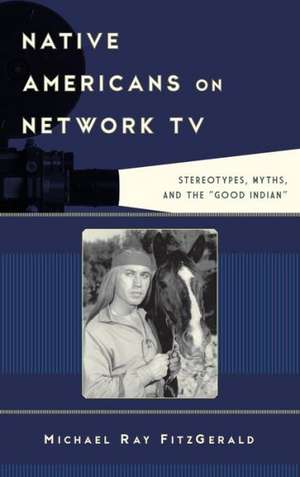
Native Americans on Network TV: Stereotypes, Myths, and the "Good Indian": Film and History
Autor Michael Ray FitzGeralden Limba Engleză Hardback – 24 dec 2013
Din seria Film and History
- 30%
 Preț: 607.84 lei
 - 21%
 Preț: 329.78 lei
 - 32%
 Preț: 583.24 lei
 - 17%
 Preț: 317.88 lei
 - 16%
 Preț: 351.34 lei
 - 20%
 Preț: 332.57 lei
 - 16%
 Preț: 321.97 lei
 - 33%
 Preț: 641.40 lei
 - 30%
 Preț: 535.86 lei
 - 24%
 Preț: 296.61 lei
 - 33%
 Preț: 581.66 lei
 - 33%
 Preț: 577.67 lei
 - 32%
 Preț: 551.24 lei
 - 34%
 Preț: 636.96 lei
 - 32%
 Preț: 584.76 lei
 - 33%
 Preț: 550.17 lei
 - 30%
 Preț: 535.30 lei
 - 16%
 Preț: 320.96 lei
 - 18%
 Preț: 256.91 lei
Preț: 615.16 lei
Preț vechi: 911.60 lei
-33%
Puncte Express: 923
Carte tipărită la comandă
Livrare economică 30 noiembrie-14 decembrie
Livrare prin curier în România Termenul estimat este afișat lângă disponibilitate.
Transport gratuit pentru acest produs Plată online sau ramburs, în funcție de opțiunile comenzii.
Retur gratuit în 14 zile Comandă securizată și suport în română.
Specificații
ISBN-13: 9781442229617
ISBN-10: 1442229616
Pagini: 233
Ilustrații: 40 BW Photos, 3 Tables
Dimensiuni: 162 x 236 x 25 mm
Greutate: 0.54 kg
Editura: Bloomsbury Publishing
Colecția Rowman & Littlefield
Seria Film and History
Locul publicării:New York, United States
ISBN-10: 1442229616
Pagini: 233
Ilustrații: 40 BW Photos, 3 Tables
Dimensiuni: 162 x 236 x 25 mm
Greutate: 0.54 kg
Editura: Bloomsbury Publishing
Colecția Rowman & Littlefield
Seria Film and History
Locul publicării:New York, United States
Descriere
The American Indian has figured prominently in many films and television shows, portrayed variously as a villain, subservient friend, or a hapless victim of progress. Many Indian stereotypes that were derived from European colonial discourse-some hundreds of years old-still exist in the media today. Even when set in the contemporary era, novels, films, and programs tend to purvey rehashed tropes such as Pocahontas or man Friday.
In Native Americans on Network TV: Stereotypes, Myths, and the "Good Indian," Michael Ray FitzGerald argues that the colonial power of the U.S. is clearly evident in network television's portrayals of Native Americans. FitzGerald contends that these representations fit neatly into existing conceptions of colonial discourse and that their messages about the "Good Indian" have become part of viewers' understandings of Native Americans. In this study, FitzGerald offers close examinations of such series as The Lone Ranger, Daniel Boone, Broken Arrow, Hawk, Nakia, and Walker, Texas Ranger.
By examining the traditional role of stereotypes and their functions in the rhetoric of colonialism, the volume ultimately offers a critical analysis of images of the "Good Indian"-minority figures that enforce the dominant group's norms. A long overdue discussion of this issue, Native Americans on Network TV will be of interest to scholars of television and media studies, but also those of Native American studies, subaltern studies, and media history.
In Native Americans on Network TV: Stereotypes, Myths, and the "Good Indian," Michael Ray FitzGerald argues that the colonial power of the U.S. is clearly evident in network television's portrayals of Native Americans. FitzGerald contends that these representations fit neatly into existing conceptions of colonial discourse and that their messages about the "Good Indian" have become part of viewers' understandings of Native Americans. In this study, FitzGerald offers close examinations of such series as The Lone Ranger, Daniel Boone, Broken Arrow, Hawk, Nakia, and Walker, Texas Ranger.
By examining the traditional role of stereotypes and their functions in the rhetoric of colonialism, the volume ultimately offers a critical analysis of images of the "Good Indian"-minority figures that enforce the dominant group's norms. A long overdue discussion of this issue, Native Americans on Network TV will be of interest to scholars of television and media studies, but also those of Native American studies, subaltern studies, and media history.
Recenzii
Many baby boomers grew up watching the Lone Ranger and his sidekick, Tonto. Portraying what media scholar Michael Ray FitzGerald refers to as the 'good Indian,' Tonto often acquiesced to his white friend. The good Indian, the author writes in the introduction, 'helped the white man in his quest to dominate the land.' FitzGerald observes that the US view of Native Americans has been molded by television portrayals of the good Indian, and he supports his argument with evidence from television portrayals of Native Americans in The Lone Ranger, Broken Arrow, Law of the Plainsman, Hawk, Nakia, and Walker, Texas Ranger. He applies George Gerbner's cultivation theory to examine the good Indian in political, cultural, and historical contexts. Contending that American Westerns offer the bulk of television portrayals of Native Americans, FitzGerald examines how Native Americans have been (mis)represented, transformed, and distorted to fit the dominant political elements in US society at any given time. FitzGerald also includes positive stereotypes-for example, Iron Eyes Cody's portrayal of 'the crying Indian,' first used in a public service announcement on Earth Day in 1971. This excellent book is well suited for students in media studies and cultural studies. Summing Up: Recommended. Lower- and upper-division undergraduates; general readers.
This book did not disappoint. [The book is] logically organized, clearly argued, and meticulously researched and documented. . . . The author breaks new critical and analytical ground by applying interdisciplinary methods and by using transcontinental resources to achieve his purpose. . . .There will continue to be a need for vigilant analytical criticism of their portrayals such as that so carefully and thoroughly provided by Michael Ray FitzGerald.
Native Americans on Network TV is a valuable study because it names and analyzes the major representations of Native identity that have appeared on television since the inception of the medium. Although the book discusses seven series in distinct chapters, one of the great strengths of the analysis is that each examination of a series is not a 'stand-alone' discussion.
This book did not disappoint. [The book is] logically organized, clearly argued, and meticulously researched and documented. . . . The author breaks new critical and analytical ground by applying interdisciplinary methods and by using transcontinental resources to achieve his purpose. . . .There will continue to be a need for vigilant analytical criticism of their portrayals such as that so carefully and thoroughly provided by Michael Ray FitzGerald.
Native Americans on Network TV is a valuable study because it names and analyzes the major representations of Native identity that have appeared on television since the inception of the medium. Although the book discusses seven series in distinct chapters, one of the great strengths of the analysis is that each examination of a series is not a 'stand-alone' discussion.