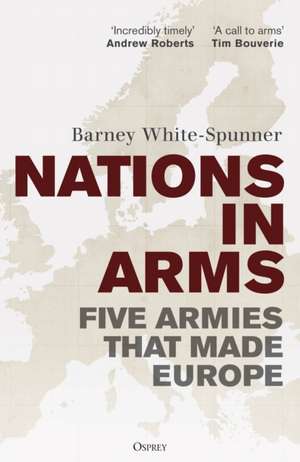
Nations in Arms: Five Armies That Made Europe
Autor Sir Barney White-Spunneren Limba Engleză Hardback – 14 aug 2025
A critical study of five historical armies that offers solutions for how contemporary forces need to change to deal with modern threats.
The most important task of any government is the defence of its state and its citizens. Traditionally governments have used armed forces to do this. Comparative peace in Europe since 1989 led most European governments to lose their focus on defence. However, recent events have proved that war is now as nasty, violent, destructive and prevalent as it has ever been, and governments have had to fundamentally re-think their position.
History gives us several examples of states who have reconstructed their armies successfully, both on the field of battle and also in how they relate to the state which it is their duty to protect. This book is about five armies who have adapted successfully: the 4th-century Roman army of Constantine the Great; the 15th-century Ottoman army of Sultan Mehmet II; Cromwell's New Model Army of the English Civil War; the Prussian Army of the Napoleonic Wars; and the US Army of the Second World War.
Former senior military officer and renowned military historian Barney White-Spunner draws lessons from their experience to establish long-standing principles that are as relevant today as they were in the 4th century. It is a book about armies, their loyalties, their organisation and their souls.
Preț: 117.15 lei
Preț vechi: 156.43 lei
-25%
Puncte Express: 176
Carte disponibilă
Livrare economică 12-26 noiembrie
Livrare express 28 octombrie-03 noiembrie pentru 76.05 lei
Livrare prin curier în România Termenul estimat este afișat lângă disponibilitate.
Transport gratuit de la 400.00 lei Plată online sau ramburs, în funcție de opțiunile comenzii.
Retur gratuit în 14 zile Comandă securizată și suport în română.
Specificații
ISBN-13: 9781472872982
ISBN-10: 1472872983
Pagini: 352
Ilustrații: Eight-page plate section in colour and black and white.
Dimensiuni: 162 x 236 x 36 mm
Greutate: 0.58 kg
Editura: Bloomsbury Publishing
Colecția Osprey Publishing
Locul publicării:London, United Kingdom
ISBN-10: 1472872983
Pagini: 352
Ilustrații: Eight-page plate section in colour and black and white.
Dimensiuni: 162 x 236 x 36 mm
Greutate: 0.58 kg
Editura: Bloomsbury Publishing
Colecția Osprey Publishing
Locul publicării:London, United Kingdom
V-ar putea interesa
-
 The Art of WarSun TzuPreț: 28.01 lei
 -
 -20%Preț: 160.08 lei200.55 leiRecomandat
 -
 TankMark UrbanPreț: 198.09 lei
 -
 Preț: 199.93 lei
 -
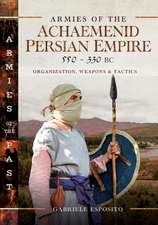 Armies of the Achaemenid Persian Empire, 550-330 BCGabriele EspositoPreț: 194.69 lei
 -
 Armies of the Byzantine Empire, 395-1204Gabriele EspositoPreț: 192.35 lei
 -
 Armies of the Steppe Nomads, 376-1227Gabriele EspositoPreț: 196.76 lei
 -
 Armies of the Hundred Years'' War 1337-1453Gabriele EspositoPreț: 195.87 lei
 -
 The Prussian Army of Frederick the Great, 1740-1786Gabriele EspositoPreț: 195.26 lei
 -
 Renaissance Polish Armies 1492–1569Adrian Jamka-41%Preț: 66.59 lei113.82 lei
 -
 Urban Warfare in the Twenty-First CenturyAnthony KingPreț: 169.23 lei
 -
 The State and the SoldierKori SchakePreț: 172.90 lei
 -
 Armies of the Hellenistic States 323 BC to AD 30Gabriele EspositoPreț: 145.84 lei
 -
 The Armies of the French RevolutionPaul L DawsonPreț: 235.28 lei
 -
 The Art of War and PeaceDavid KilcullenPreț: 192.51 lei
 -
 Supplying the New Model ArmyAndrew AbramPreț: 275.28 lei
 -
 The Modern British ArmyRichard A RinaldiPreț: 142.59 lei
 -
 Preț: 278.65 lei
 -
 Birth of the Byzantine Army 476-641 CE Volume 1Philippe RichardotPreț: 231.78 lei
 -
 Birth of the Byzantine Army 476-641 CE Volume 2Philippe RichardotPreț: 233.23 lei
Cuprins
List of Illustrations
List of Maps
1. What is an Army?
2. The Army of Constantine, 312
3. The Ottoman Army of Mehmet the Conqueror, 1453
4. The New Model Army, 1645
5. Prussia, 1806
6. The U.S. Army, 1941
7. Armies Today
Endnotes
Further Reading and Ideas for Exploration
Bibliography
Acknowledgements
Index
List of Maps
1. What is an Army?
2. The Army of Constantine, 312
3. The Ottoman Army of Mehmet the Conqueror, 1453
4. The New Model Army, 1645
5. Prussia, 1806
6. The U.S. Army, 1941
7. Armies Today
Endnotes
Further Reading and Ideas for Exploration
Bibliography
Acknowledgements
Index
Recenzii
Nations in Arms is a remarkable book, written by one of our very best military historians... It is a great read for historians that rings alarm bells for policy-makers.
Clearly written and convincingly argued, this stylish synthesis represents a call to arms by one of our most distinguished soldiers and historians.
General White-Spunner's thoughtful, well-written, occasionally witty but above all profoundly wise book reminds us how focusing on specific periods of history can cast penetrating light on the nature both of warfare and the human condition. With our current uncertainties over Western security, it is also incredibly timely.
An engrossing study in the importance of adapting military capacity while wars are actually being fought, with five examples of this being done successfully between Constantine the Great and the Second World War.
A must-read for anyone interested in the geopolitical challenges facing us today, and for anyone interested in the politico-military challenges of the past.
Clearly written and convincingly argued, this stylish synthesis represents a call to arms by one of our most distinguished soldiers and historians.
General White-Spunner's thoughtful, well-written, occasionally witty but above all profoundly wise book reminds us how focusing on specific periods of history can cast penetrating light on the nature both of warfare and the human condition. With our current uncertainties over Western security, it is also incredibly timely.
An engrossing study in the importance of adapting military capacity while wars are actually being fought, with five examples of this being done successfully between Constantine the Great and the Second World War.
A must-read for anyone interested in the geopolitical challenges facing us today, and for anyone interested in the politico-military challenges of the past.