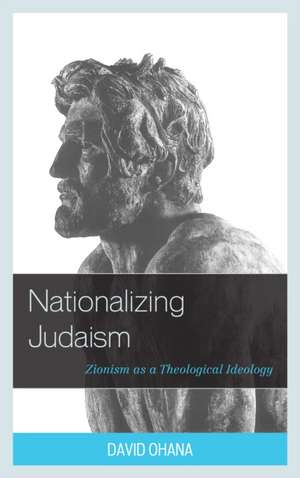
Nationalizing Judaism: Zionism as a Theological Ideology
Autor David Ohana Contribuţii de Ari Barell, Michael Feigeen Limba Engleză Hardback – 5 iun 2017
Nationalizing Judaism covers constituent topics such as Messianism, Utopianism, territorialism, collective memory, and political myths along with the critics that threatened to undermine Zionist appropriations and constructs. Thus, in addition to the 1942 "Million Plan" and territorial redemptionist views, the book discusses fundamental critiques of Messianism penned by the historians Gershom Scholem and Jacob Talmon and de-territorial perceptions of the Levant by the writer and the essayist Jacqueline Kahanoff.
Nationalizing Judiasm closes with the nationalization of the desert, the vision of David Ben-Gurion ("the old man") who proclaimed statehood in 1948, as shown by his funeral and the symbolic memory of his grave. In its attempt to acquire historical legitimation Zionism appropriated themes and myths from the Jewish past, yet these appropriations were differentiated as they had selectively culled elements that suited the national ethos. The book opens with Ben-Gurion's messianic vision and comes full circle with his death in 1973.
Preț: 541.64 lei
Preț vechi: 818.25 lei
-34%
Puncte Express: 812
Carte tipărită la comandă
Livrare economică 01-15 decembrie
Livrare prin curier în România Termenul estimat este afișat lângă disponibilitate.
Transport gratuit pentru acest produs Plată online sau ramburs, în funcție de opțiunile comenzii.
Retur gratuit în 14 zile Comandă securizată și suport în română.
Specificații
ISBN-13: 9781498543606
ISBN-10: 149854360X
Pagini: 240
Dimensiuni: 158 x 239 x 23 mm
Greutate: 0.53 kg
Editura: Bloomsbury Publishing
Colecția Lexington Books
Locul publicării:New York, United States
ISBN-10: 149854360X
Pagini: 240
Dimensiuni: 158 x 239 x 23 mm
Greutate: 0.53 kg
Editura: Bloomsbury Publishing
Colecția Lexington Books
Locul publicării:New York, United States
Cuprins
Introduction
Nationalizing Utopia: The Million Plan: Theological Vision and the Salvation PlanNationalizing Messianism: How was messianism secularized?Nationalizing Myths: Israeli, All Too Israeli: Akkedah, Nimrod, HerodNationalizing Trauma: The Restorative Memory of Bar Kokhba RevoltNationalizing Land: Gershom Scholem's Children and the "Canaanite Messianism" Nationalizing Space: Anti-Messiah: Towards a Levantine SpaceNationalizing Memory: National Funeral, Sacred Grave
Nationalizing Utopia: The Million Plan: Theological Vision and the Salvation PlanNationalizing Messianism: How was messianism secularized?Nationalizing Myths: Israeli, All Too Israeli: Akkedah, Nimrod, HerodNationalizing Trauma: The Restorative Memory of Bar Kokhba RevoltNationalizing Land: Gershom Scholem's Children and the "Canaanite Messianism" Nationalizing Space: Anti-Messiah: Towards a Levantine SpaceNationalizing Memory: National Funeral, Sacred Grave
Recenzii
The author's detailed knowledge of so many facets of modern Israeli history makes this a rich and worthwhile read. . . . this book offers a well-written and researched introduction to certain key intersections between Jewish and Zionist thought and literature.
Pursuing his analysis of aspects of the Israeli identity explored in his previous books (The Origins of Israeli Mythology, and The Shaping of Israeli Identity), David Ohana insightfully scrutinizes here the Zionist appropriation of the Jewish past to build its historical continuity. Putting into practice the Michael Shudson's axiomatic formula "The Present in the past versus the past in the present," Ohana provides in seven chapters a fascinating reading of the main elements of Judaism including the Land, messianism, the sacrifice of Isaac, and the Great Revolt of Bar Kokhba as they have been incorporated into the Israeli agenda.
Building upon his previous studies on Nietzschean inflections of early Zionist thought, the esteemed Israeli historian David Ohana deftly analyzes how Zionism has deployed traditional Jewish religious concepts and values to further nation building and patriotic commitments. He thus echoes the Cassandran chorus that bemoans the alliance of religion and nationalism as a grave threat both to Judaism and the Zionist project.
Pursuing his analysis of aspects of the Israeli identity explored in his previous books (The Origins of Israeli Mythology, and The Shaping of Israeli Identity), David Ohana insightfully scrutinizes here the Zionist appropriation of the Jewish past to build its historical continuity. Putting into practice the Michael Shudson's axiomatic formula "The Present in the past versus the past in the present," Ohana provides in seven chapters a fascinating reading of the main elements of Judaism including the Land, messianism, the sacrifice of Isaac, and the Great Revolt of Bar Kokhba as they have been incorporated into the Israeli agenda.
Building upon his previous studies on Nietzschean inflections of early Zionist thought, the esteemed Israeli historian David Ohana deftly analyzes how Zionism has deployed traditional Jewish religious concepts and values to further nation building and patriotic commitments. He thus echoes the Cassandran chorus that bemoans the alliance of religion and nationalism as a grave threat both to Judaism and the Zionist project.