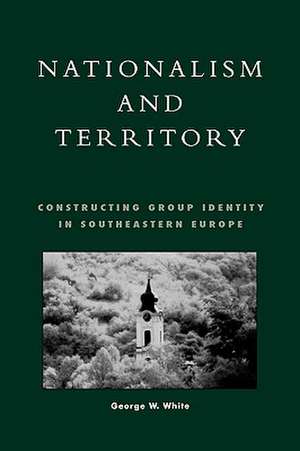
Nationalism and Territory: Constructing Group Identity in Southeastern Europe: Geographical Perspectives on the Human Past
Autor George W. Whiteen Limba Engleză Paperback – 22 mar 2000
Preț: 363.80 lei
Preț vechi: 462.64 lei
-21%
Puncte Express: 546
Carte tipărită la comandă
Livrare economică 12-26 noiembrie
Livrare prin curier în România Termenul estimat este afișat lângă disponibilitate.
Transport gratuit de la 400.00 lei Plată online sau ramburs, în funcție de opțiunile comenzii.
Retur gratuit în 14 zile Comandă securizată și suport în română.
Specificații
ISBN-13: 9780847698097
ISBN-10: 0847698092
Pagini: 328
Dimensiuni: 151 x 229 x 18 mm
Greutate: 0.4 kg
Ediția:0328
Editura: Bloomsbury Publishing
Colecția Rowman & Littlefield
Seria Geographical Perspectives on the Human Past
Locul publicării:New York, United States
ISBN-10: 0847698092
Pagini: 328
Dimensiuni: 151 x 229 x 18 mm
Greutate: 0.4 kg
Ediția:0328
Editura: Bloomsbury Publishing
Colecția Rowman & Littlefield
Seria Geographical Perspectives on the Human Past
Locul publicării:New York, United States
V-ar putea interesa
-
 I Never Knew That about EnglandChristopher Winn-19%Preț: 98.22 lei121.28 lei
 -
 La Vie en bleuRod KedwardPreț: 130.17 lei
 -
 Reconceiving the Renaissance: A Critical ReaderEwan Fernie-19%Preț: 311.12 lei384.98 lei
 -
 Identity of EnglandRobert Colls-19%Preț: 286.81 lei356.01 lei
 -
 The Siege of Leningrad: 900 Days of TerrorDavid Glantz-27%Preț: 67.58 lei92.17 lei
 -
 Modern Italy in Historical PerspectiveDr. Nick Carter-23%Preț: 238.36 lei310.87 lei
 -
 Surviving The Sword: Prisoners of the Japanese 1942-45Brian MacArthur-26%Preț: 79.20 lei106.88 lei
 -
 Crete: The Battle and the ResistanceAntony Beevor-27%Preț: 78.07 lei106.33 lei
 -
 London: A Short HistoryA. N. Wilson-28%Preț: 65.30 lei90.63 lei
 -
 WartimeJuliet Gardiner-24%Preț: 83.09 lei109.20 lei
 -
 Writer At WarVasily Grossman-18%Preț: 76.62 lei93.30 lei
 -
 -42%Preț: 178.85 lei309.78 lei
 -
 Napoleon's Men: The Soldiers of the Revolution and EmpireProf Alan Forrest-38%Preț: 294.63 lei473.44 lei
 -
 The French Revolution and the PeopleDr David Andress-38%Preț: 321.88 lei516.48 lei
 -
 The StuartsJohn Miller-40%Preț: 143.98 lei241.51 lei
 -
 The Death of Kings: Royal Deaths in Medieval EnglandDr Michael R. Evans-42%Preț: 178.98 lei306.52 lei
Cuprins
Chapter 1 List of Figures
Chapter 2 Acknowledgments
Chapter 3 Place Name Terminology
Chapter 4 1. Introduction
Chapter 5 2. The Nation in its Spatial Context
Chapter 6 3. Southeastern European Nationalism in its Temporal and Spatial Context
Chapter 7 4. Hungary and the Hungarians
Chapter 8 5. Romania and the Romanians
Chapter 9 6. Serbia and the Serbs
Chapter 10 7. Conclusion
Chapter 11 Selected Bibliography
Chapter 12 Index
Chapter 13 About the Author
Chapter 2 Acknowledgments
Chapter 3 Place Name Terminology
Chapter 4 1. Introduction
Chapter 5 2. The Nation in its Spatial Context
Chapter 6 3. Southeastern European Nationalism in its Temporal and Spatial Context
Chapter 7 4. Hungary and the Hungarians
Chapter 8 5. Romania and the Romanians
Chapter 9 6. Serbia and the Serbs
Chapter 10 7. Conclusion
Chapter 11 Selected Bibliography
Chapter 12 Index
Chapter 13 About the Author
Recenzii
This book is highly recommended to readers interested in national identity and/or central and south-eastern Europe. The book is well-written, and offers a highly detailed and fascinating account of some of the root causes of historical and contemporary conflicts in the region. Nationalism and Territory is a commendable geographically- and historically-based study of selected contemporary geopolitical problems in central and south-eastern Europe, and a very good addition to the literature on factors shaping national identity.
This eloquently written book is clearly thought provoking and refreshing. This theoretical insight combined with the intriguing empirical analyses of nationalism and identity in the three Eastern European countries make White's book important and thought provoking reading that needs to be considered not only for those focusing on Eastern Europe itself, but for all studies of nation. The latter is a merit that has the potential to make White's book a modern classic....
An interesting interweaving of detailed historical material with pieces of poetry and maps showing location of 'significant' places and territorial shifts in the history of these nations. The factual material is enriched by the author's interpretation of the importance of the said territories and places. All this makes interesting reading.
This book indentifies an important and often times neglected issue in the discussion over nation and nationalism.
One of the major contributions of this book is that White carefully distinguishes through an examination of the literature, art, and music; the location of monuments and institutions; and the history of a country, what parts of its territory are core, semi-core, and periphery. This is of great relevance to political scientists who have recently turned their attention to the special role territorial disputes play in the onset of war. In principle, White's work permits a more precise measurment of whether a particular territorial claim will give rise to war by examining whether the disputed territory falls within the core, semi-core, or periphery.
This is a fascinating and thoughtful book.
Usefully complements recent work which has explored the relationship between landscapes and national identities in Western Europe. This is an accessible work which contains much interesting material (along with over 40 high-quality maps) and it serves as a useful introduction to South-eastern Europe.
A valuable contribution to the growing literature on territorial boundaries, national identity, and ethnic conflict. Students of international relations should find compelling White's insights about the connection between ethnic cleansing and the significance of territory to national identity.
This eloquently written book is clearly thought provoking and refreshing. This theoretical insight combined with the intriguing empirical analyses of nationalism and identity in the three Eastern European countries make White's book important and thought provoking reading that needs to be considered not only for those focusing on Eastern Europe itself, but for all studies of nation. The latter is a merit that has the potential to make White's book a modern classic....
An interesting interweaving of detailed historical material with pieces of poetry and maps showing location of 'significant' places and territorial shifts in the history of these nations. The factual material is enriched by the author's interpretation of the importance of the said territories and places. All this makes interesting reading.
This book indentifies an important and often times neglected issue in the discussion over nation and nationalism.
One of the major contributions of this book is that White carefully distinguishes through an examination of the literature, art, and music; the location of monuments and institutions; and the history of a country, what parts of its territory are core, semi-core, and periphery. This is of great relevance to political scientists who have recently turned their attention to the special role territorial disputes play in the onset of war. In principle, White's work permits a more precise measurment of whether a particular territorial claim will give rise to war by examining whether the disputed territory falls within the core, semi-core, or periphery.
This is a fascinating and thoughtful book.
Usefully complements recent work which has explored the relationship between landscapes and national identities in Western Europe. This is an accessible work which contains much interesting material (along with over 40 high-quality maps) and it serves as a useful introduction to South-eastern Europe.
A valuable contribution to the growing literature on territorial boundaries, national identity, and ethnic conflict. Students of international relations should find compelling White's insights about the connection between ethnic cleansing and the significance of territory to national identity.