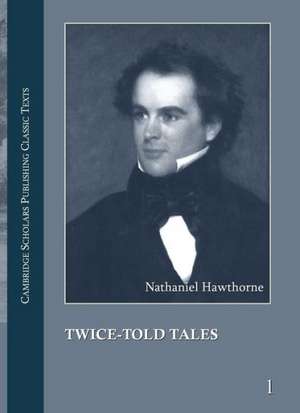
Nathaniel Hawthorne: The Complete Works in 13 Volumes: CSP Classic Texts
Autor Nathaniel Hawthorne Nick Ba Lawrenceen Limba Engleză Paperback – 31 aug 2009

Preț: 1153.45 lei
Preț vechi: 1580.06 lei
-27%
Puncte Express: 1730
Carte indisponibilă temporar
Doresc să fiu notificat când acest titlu va fi disponibil:
Se trimite...
Specificații
ISBN-13: 9781443813167
ISBN-10: 1443813168
Pagini: 10
Dimensiuni: 150 x 220 mm
Greutate: 0 kg
Ediția:New.
Editura: Cambridge Scholars Publishing
Seria CSP Classic Texts
ISBN-10: 1443813168
Pagini: 10
Dimensiuni: 150 x 220 mm
Greutate: 0 kg
Ediția:New.
Editura: Cambridge Scholars Publishing
Seria CSP Classic Texts
Notă biografică
Nick Lawrence is Associate Professor in the Department of English and Comparative Literary Studies at the University of Warwick. He is co-editor, with Marta Werner, of Ordinary Mysteries: The Common Journal of Nathaniel and Sophia Hawthorne (American Philosophical Society) and has recently published articles on Whitman, Hawthorne, Frank O'Hara, Ronald Johnson, and American gothic. His research interests include American literature and culture from the nineteenth century to the present, especially within an international context; Hawthorne and Whitman; Marxism, the Frankfurt School and critical media theory; post-9/11 literary and graphic culture; and contemporary avant-garde poetry and poetics.
Descriere
Descriere de la o altă ediție sau format:
Nathaniel Hawthorne graduated from Bowdoin College in 1825 and returned home to Salem, Massachusetts. Over the next nearly twenty years, he mostly resided at the family home, with his mother and sisters, and worked on his writing in his second story bedroom-study. During that time, he kept a series of notebooks, now called the American Notebooks, which were an important source for some of the stories in his first two volumes-Twice-Told Tales (1837) and Mosses from an Old Manse (1845)-and even for some of the later novels. Mainly, however, the American Notebooks served as a writer's repository where Hawthorne could let his imagination wander freely, without having to worry about being called unconventional, weird, depressive, or even mad. Some of Hawthorne's best and most experimental writing can be found in his journal fragments, none of which are more than a paragraph, and the majority are simply a sentence or two. This remarkable new book extracts approximately 9,000 words of fragments from the over 800,000 words of Hawthorne's published American, English, French, and Italian notebooks to reveal, for the first time, Hawthorne as a radical literary experimenter and proto-modernist. 'To have one event operate in several places-as, for example, if a man's head were to be cut off in the town, men's heads to drop off in several other towns.' 'Little gnomes dwelling in hollow teeth; they find a tooth that has been plugged with gold; and it serves them as a gold mine.'
Nathaniel Hawthorne graduated from Bowdoin College in 1825 and returned home to Salem, Massachusetts. Over the next nearly twenty years, he mostly resided at the family home, with his mother and sisters, and worked on his writing in his second story bedroom-study. During that time, he kept a series of notebooks, now called the American Notebooks, which were an important source for some of the stories in his first two volumes-Twice-Told Tales (1837) and Mosses from an Old Manse (1845)-and even for some of the later novels. Mainly, however, the American Notebooks served as a writer's repository where Hawthorne could let his imagination wander freely, without having to worry about being called unconventional, weird, depressive, or even mad. Some of Hawthorne's best and most experimental writing can be found in his journal fragments, none of which are more than a paragraph, and the majority are simply a sentence or two. This remarkable new book extracts approximately 9,000 words of fragments from the over 800,000 words of Hawthorne's published American, English, French, and Italian notebooks to reveal, for the first time, Hawthorne as a radical literary experimenter and proto-modernist. 'To have one event operate in several places-as, for example, if a man's head were to be cut off in the town, men's heads to drop off in several other towns.' 'Little gnomes dwelling in hollow teeth; they find a tooth that has been plugged with gold; and it serves them as a gold mine.'