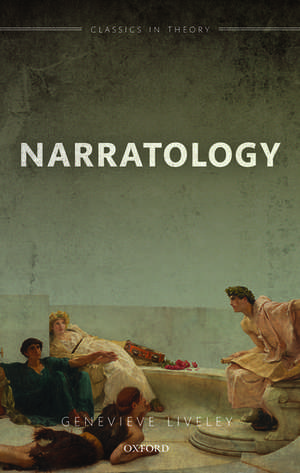
Narratology: Classics in Theory Series
Autor Genevieve Liveleyen Limba Engleză Hardback – 4 apr 2019
Din seria Classics in Theory Series
- 23%
 Preț: 785.16 lei
 - 30%
 Preț: 522.70 lei
 - 32%
 Preț: 654.22 lei
 - 32%
 Preț: 687.83 lei
 - 32%
 Preț: 582.45 lei
 - 21%
 Preț: 173.95 lei
 - 31%
 Preț: 707.75 lei
 - 21%
 Preț: 208.20 lei
 - 31%
 Preț: 660.01 lei
 - 31%
 Preț: 773.06 lei
 - 31%
 Preț: 740.66 lei
 - 31%
 Preț: 804.56 lei
 - 31%
 Preț: 740.14 lei
 - 19%
 Preț: 590.54 lei
 - 31%
 Preț: 601.12 lei
 - 30%
 Preț: 794.57 lei
 - 31%
 Preț: 638.46 lei
Preț: 708.48 lei
Preț vechi: 1029.64 lei
-31%
Puncte Express: 1063
Carte tipărită la comandă
Livrare economică 27 noiembrie-02 decembrie
Livrare prin curier în România Termenul estimat este afișat lângă disponibilitate.
Transport gratuit pentru acest produs Plată online sau ramburs, în funcție de opțiunile comenzii.
Retur gratuit în 14 zile Comandă securizată și suport în română.
Specificații
ISBN-13: 9780199687701
ISBN-10: 0199687706
Pagini: 300
Dimensiuni: 142 x 223 x 22 mm
Greutate: 0.47 kg
Editura: OUP OXFORD
Colecția OUP Oxford
Seria Classics in Theory Series
Locul publicării:Oxford, United Kingdom
ISBN-10: 0199687706
Pagini: 300
Dimensiuni: 142 x 223 x 22 mm
Greutate: 0.47 kg
Editura: OUP OXFORD
Colecția OUP Oxford
Seria Classics in Theory Series
Locul publicării:Oxford, United Kingdom
Recenzii
Liveley provides a rich and historically nuanced understanding of some of the key concepts and concerns in the field. ... Summing up: Recommended
Liveley makes accessible a number of complicated theoretical issues and presents narratological terminology in an intelligible way and in a brilliant style, both of which render this study a useful guide both for classicists and narratologists as well as for non-specialized readers. This is the first systematic study of the reception of ancient narrative poetics by narratologists, and its originality as well as the general quality of its insights make it a landmark in its field.
This is an important book that will hopefully open up the debate between mainstream narratologists and narratologists whoare experts in earlier historical periods (or in non-Western cultures, for that matter, or in both) in order to help us see more clearly when and why narrative practices emerged,which functions they fulfilled and how these practices may have shaped our modern notionsof narrative, in both practical and theoretical terms
Liveley makes accessible a number of complicated theoretical issues and presents narratological terminology in an intelligible way and in a brilliant style, both of which render this study a useful guide both for classicists and narratologists as well as for non-specialized readers. This is the first systematic study of the reception of ancient narrative poetics by narratologists, and its originality as well as the general quality of its insights make it a landmark in its field.
This is an important book that will hopefully open up the debate between mainstream narratologists and narratologists whoare experts in earlier historical periods (or in non-Western cultures, for that matter, or in both) in order to help us see more clearly when and why narrative practices emerged,which functions they fulfilled and how these practices may have shaped our modern notionsof narrative, in both practical and theoretical terms
Notă biografică
Genevieve Liveley is Senior Lecturer in Classics at the University of Bristol. Her research interests focus on ancient (especially Augustan) narratives and on narrative theories, both ancient and modern. She is the author of two books on Ovid - Ovid's Metamorphoses: A Reader's Guide (Bloomsbury, 2011) and Ovid: Love Songs (Bloomsbury, 2005) - and co-editor with Patricia Salzman-Mitchell of Latin Elegy and Narratology: Fragments of Story (Ohio State University Press, 2008).
Cuprins
- 1: Introduction
- 2: Ancient Narrative Theory before Aristotle - Plato
- 2.1: Arche
- 2.2: Plato's Ion
- 2.3: Plato's Republic
- 2.4: Teleute
- 3: Aristotle
- 3.1: Arche
- 3.2: Aristotle and Plato
- 3.3: Muthos
- 3.4: Katholou and idion
- 3.5: Ethos
- 3.6: Dianoia
- 3.7: Diegetic mimesis
- 3.8: Teleute
- 4: Ancient Narrative Theory after Aristotle - Horace
- 4.1: Arche
- 4.2: Horace 'Letter to the Pisones' or Ars poetica
- 4.3: Teleute
- 5: Ancient Narrative Theory in Practice
- 5.1: Arche
- 5.2: Ancient narratological terms and concepts in the Homeric scholia
- 5.3: Modern narratological terms and concepts in the Homeric scholia
- 5.4: Ancient commentaries
- 5.5: Ancient narratological terms and concepts in the Servius commentaries
- 5.6: Modern narratological terms and concepts in the Servius commentaries
- 5.7: Teleute
- 6: Russian Formalism
- 6.1: Arche
- 6.2: Victor Shklovsky
- 6.3: Mikhail Petrovsky
- 6.4: Boris Tomashevsky
- 6.5: Vladimir Propp
- 6.6: Epeisodion (On translation)
- 6.7: Teleute
- 7: Neo-Aristotelianism
- 7.1: Arche
- 7.2: Ronald Crane
- 7.3: Wayne Booth
- 7.4: David Richter, Peter Rabinowitz, and James Phelan
- 7.5: Teleute
- 8: Prestructuralism
- 8.1: Arche
- 8.2: Henry James
- 8.3: Percy Lubbock
- 8.4: E.M. Forster
- 8.5: Norman Friedman
- 8.6: Franz Stanzel
- 8.7: Teleute
- 9: Structuralism
- 9.1: Arche
- 9.2: Roland Barthes
- 9.3: Tzvetan Todorov
- 9.4: Gérard Genette
- 9.4.1: Diegesis as mimesis (Plato and Aristotle)
- 9.4.2: Diegesis as histoire (Benveniste)
- 9.4.3: Diegesis as narrative pure and simple (Todorov)
- 9.4.4: Diegesis as diégèse (Metz and Souriau)
- 9.4.5: Diegesis as diégésis (Plato and Aristotle revisited)
- 9.5: Mieke Bal
- 9.6: Epeisodion (On translation)
- 9.7: Teleute
- 10: Poststructuralism
- 10.1: Arche
- 10.2: Seymour Chatman
- 10.3: Susan Lanser
- 10.4: Peter Brooks
- 10.5: Teleute
- 11: Postclassicism
- 11.1: Arche
- 11.2: Monika Fludernik
- 11.3: David Herman
- 11.4: Jan Alber and Brian Richardson
- 11.5: Teleute
- Endmatter
- Glossary
- Bibliography
- Index