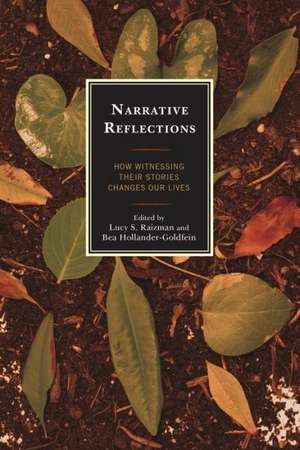
Narrative Reflections: How Witnessing Their Stories Changes Our Lives: Hamilton Books
Editat de Lucy S. Raizman, Bea Hollander-Goldfeinen Limba Engleză Paperback – 12 noi 2013
Din seria Hamilton Books
- 25%
 Preț: 525.96 lei
 - 14%
 Preț: 948.10 lei
 - 30%
 Preț: 472.82 lei
 - 25%
 Preț: 218.37 lei
 - 29%
 Preț: 216.87 lei
 - 26%
 Preț: 280.25 lei
 - 29%
 Preț: 218.37 lei
 - 29%
 Preț: 217.36 lei
 - 27%
 Preț: 252.91 lei
 - 29%
 Preț: 216.87 lei
 - 27%
 Preț: 262.13 lei
 - 17%
 Preț: 265.00 lei
 - 23%
 Preț: 319.68 lei
 -
 Preț: 218.37 lei
 - 27%
 Preț: 281.90 lei
 - 29%
 Preț: 217.36 lei
 - 27%
 Preț: 253.93 lei
 - 25%
 Preț: 304.07 lei
 - 36%
 Preț: 373.39 lei
 - 28%
 Preț: 252.44 lei
 - 20%
 Preț: 217.77 lei
 - 24%
 Preț: 253.93 lei
 - 24%
 Preț: 255.41 lei
 - 27%
 Preț: 274.30 lei
 - 27%
 Preț: 258.30 lei
 - 27%
 Preț: 357.15 lei
 - 28%
 Preț: 220.37 lei
 - 29%
 Preț: 216.87 lei
 - 30%
 Preț: 372.44 lei
 - 34%
 Preț: 475.70 lei
 - 28%
 Preț: 219.35 lei
 - 22%
 Preț: 331.24 lei
 - 29%
 Preț: 217.87 lei
 - 29%
 Preț: 342.93 lei
 - 28%
 Preț: 219.35 lei
 - 29%
 Preț: 176.91 lei
 - 33%
 Preț: 419.99 lei
 - 23%
 Preț: 255.93 lei
 - 29%
 Preț: 217.36 lei
 - 22%
 Preț: 333.30 lei
 -
 Preț: 218.37 lei
 - 23%
 Preț: 311.01 lei
 - 27%
 Preț: 268.04 lei
 - 27%
 Preț: 254.91 lei
 - 29%
 Preț: 217.87 lei
 - 27%
 Preț: 275.28 lei
 - 29%
 Preț: 177.86 lei
 - 32%
 Preț: 145.30 lei
 - 19%
 Preț: 321.53 lei
 - 28%
 Preț: 184.59 lei
Preț: 261.05 lei
Preț vechi: 358.54 lei
-27%
Puncte Express: 392
Carte tipărită la comandă
Livrare economică 26 noiembrie-10 decembrie
Livrare prin curier în România Termenul estimat este afișat lângă disponibilitate.
Transport gratuit de la 400.00 lei Plată online sau ramburs, în funcție de opțiunile comenzii.
Retur gratuit în 14 zile Comandă securizată și suport în română.
Specificații
ISBN-13: 9780761862352
ISBN-10: 0761862358
Pagini: 140
Dimensiuni: 151 x 229 x 11 mm
Greutate: 0.23 kg
Editura: Bloomsbury Publishing
Colecția Hamilton Books
Seria Hamilton Books
Locul publicării:New York, United States
ISBN-10: 0761862358
Pagini: 140
Dimensiuni: 151 x 229 x 11 mm
Greutate: 0.23 kg
Editura: Bloomsbury Publishing
Colecția Hamilton Books
Seria Hamilton Books
Locul publicării:New York, United States
Cuprins
Acknowledgements
Introduction
Chapter One
Living with Stories of Pain
Kilian Fritsch
Chapter Two
The Price of Silence
Ruthy Kaiser
Chapter Three
Saved by Living in Fortunate Times
Peter Capper
Chapter Four
An Accident of Birth
Lyn Groome
Chapter Five
Beyond the Screen Door
Margaret S. Roth
Chapter Six
Learning to Survive
Michael Izzo
Epilogue I
Their Stories, Our Lives
Lucy S. Raizman
Epilogue II
The Power of the Group and the Gift of Reflection
Bea Hollander-Goldfein
About the Editors and Contributors
Bibliography
Introduction
Chapter One
Living with Stories of Pain
Kilian Fritsch
Chapter Two
The Price of Silence
Ruthy Kaiser
Chapter Three
Saved by Living in Fortunate Times
Peter Capper
Chapter Four
An Accident of Birth
Lyn Groome
Chapter Five
Beyond the Screen Door
Margaret S. Roth
Chapter Six
Learning to Survive
Michael Izzo
Epilogue I
Their Stories, Our Lives
Lucy S. Raizman
Epilogue II
The Power of the Group and the Gift of Reflection
Bea Hollander-Goldfein
About the Editors and Contributors
Bibliography
Recenzii
This very powerful book highlights the invisible line between broken hearts and open hearts. Painful stories eloquently told invite us to look unflinchingly into the heart of suffering and the humanity beyond. But just as important, we find out that the act of bearing witness, of approaching suffering with an open heart, changes us. And always for the better.
In these astonishing chapters, six therapists work through their own pain and suffering through intimate witnessing of the transcripts of three families in the Transcending Trauma Project. The reader encounters the courage that the reflectors movingly present. Positioned as witnesses, we too have an opportunity to observe what openhearted reading can bring to our lives.
Michael White adapted what the anthropologist Barbara Myerhoff described as 'definitional ceremonies' in her fieldwork with Holocaust survivors in a California Old Folks center to become a central practice-outsider witnessing- of narrative therapy and community work. I find it a wonderful twist of fate that the authors of this book, children of survivors, adapt this and use it for their own purposes as they themselves become 'outsider witnesses' to the stories of their parent's 'survivor' generation. If Michael and Barbara had survived to learn about this, I suspect they would have embraced each other as kindred spirits.
The deeply inspiring essays in this volume clearly demonstrate the enormous healing power of human connections and bearing witness to the greatest atrocity of the twentieth century. Instead of focusing on the psychopathology, this group of experts listened and responded with their hearts. The reader will get a rare and invaluable look at the compassionate intertwining of pained lives and its triumphant aftermath.
This remarkably sensitive study reports on mental health therapists venturing to examine their own empathic reactivity in listening to Holocaust survivors' narratives bearing witness to their malignant victimization and suffering. This study richly furthers our understanding of how, if we allow it, our common humanity makes the suffering of another reverberate within oneself-and not only furthers our understanding of the other's experience of trauma, but by allowing our empathic reactivity evoke in us self-exploration and reflectiveness makes us aware of our own traumatization, heightening our own humanity as clinicians. Perhaps a world filled with people willing to listen-for real-to the traumas of others would become a world of diminishing intentional traumatization. This is a welcome addition to our multifaceted study of the Holocaust, of genocide.
Human beings have a deep need to tell our stories of suffering and survival, but there is something in our stories that can't be told-something in us that transcends any story, but that, paradoxically, emerges and comes more clearly into focus precisely in the telling of and bearing witness to each other's stories as the authors in Narrative Reflections have done.
In these astonishing chapters, six therapists work through their own pain and suffering through intimate witnessing of the transcripts of three families in the Transcending Trauma Project. The reader encounters the courage that the reflectors movingly present. Positioned as witnesses, we too have an opportunity to observe what openhearted reading can bring to our lives.
Michael White adapted what the anthropologist Barbara Myerhoff described as 'definitional ceremonies' in her fieldwork with Holocaust survivors in a California Old Folks center to become a central practice-outsider witnessing- of narrative therapy and community work. I find it a wonderful twist of fate that the authors of this book, children of survivors, adapt this and use it for their own purposes as they themselves become 'outsider witnesses' to the stories of their parent's 'survivor' generation. If Michael and Barbara had survived to learn about this, I suspect they would have embraced each other as kindred spirits.
The deeply inspiring essays in this volume clearly demonstrate the enormous healing power of human connections and bearing witness to the greatest atrocity of the twentieth century. Instead of focusing on the psychopathology, this group of experts listened and responded with their hearts. The reader will get a rare and invaluable look at the compassionate intertwining of pained lives and its triumphant aftermath.
This remarkably sensitive study reports on mental health therapists venturing to examine their own empathic reactivity in listening to Holocaust survivors' narratives bearing witness to their malignant victimization and suffering. This study richly furthers our understanding of how, if we allow it, our common humanity makes the suffering of another reverberate within oneself-and not only furthers our understanding of the other's experience of trauma, but by allowing our empathic reactivity evoke in us self-exploration and reflectiveness makes us aware of our own traumatization, heightening our own humanity as clinicians. Perhaps a world filled with people willing to listen-for real-to the traumas of others would become a world of diminishing intentional traumatization. This is a welcome addition to our multifaceted study of the Holocaust, of genocide.
Human beings have a deep need to tell our stories of suffering and survival, but there is something in our stories that can't be told-something in us that transcends any story, but that, paradoxically, emerges and comes more clearly into focus precisely in the telling of and bearing witness to each other's stories as the authors in Narrative Reflections have done.